Elberry Mostafa H, Darwish Noureldien H E, Mousa Shaker A
The Pharmaceutical Research Institute, Albany College of Pharmacy and Health Sciences, Rensselaer, NY, 12144, USA.
National Cancer Institute, Cairo University, Cairo, Egypt.
Virol J. 2017 May 2;14(1):88. doi: 10.1186/s12985-017-0753-1.
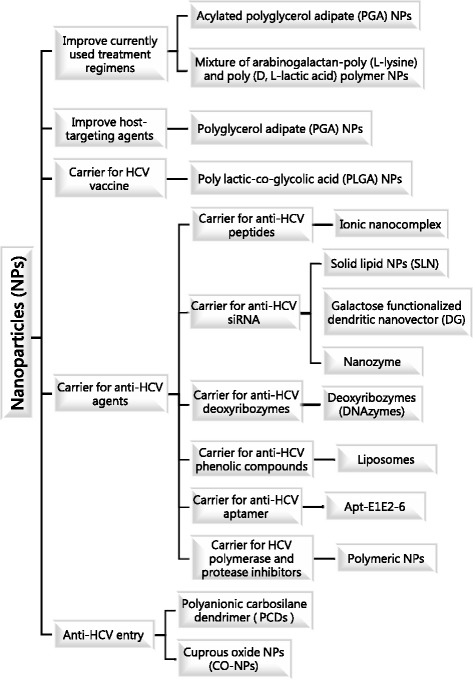
Around 170-200 million individuals have hepatitis C virus (HCV), which represents ~ 3% of the world population, including ~ 3-5 million people in the USA. According to the WHO regional office in the Middle East, Egypt has the highest prevalence in the world, with 7% prevalence in adults. There had been no effective vaccine for HCV; a combination of PEG-Interferon and ribavirin for at least 48 weeks was the standard therapy, but it failed in more than 40% of the patients and has a high cost and serious side effects. The recent introduction of direct-acting antivirals (DAA) resulted in major advances toward the cure of HCV. However, relapse and reduced antiviral efficacy in fibrotic, cirrhotic HCV patients in addition to some undesired effects restrain the full potential of these combinations. There is a need for new approaches for the combinations of different DAA and their targeted delivery using novel nanotechnology approaches. In this review, the role of nanoparticles as a carrier for HCV vaccines, anti-HCV combinations, and their targeted delivery are discussed.
约1.7亿至2亿人感染丙型肝炎病毒(HCV),约占世界人口的3%,其中美国约有300万至500万人感染。据世界卫生组织中东区域办事处称,埃及的丙型肝炎病毒感染率在全球最高,成年人感染率达7%。此前一直没有针对丙型肝炎病毒的有效疫苗;聚乙二醇干扰素和利巴韦林联合使用至少48周是标准疗法,但超过40%的患者治疗失败,且成本高昂、副作用严重。近期直接抗病毒药物(DAA)的问世,在丙型肝炎病毒治愈方面取得了重大进展。然而,纤维化、肝硬化丙型肝炎患者的复发和抗病毒疗效降低,以及一些不良影响,限制了这些联合用药的全部潜力。需要采用新方法将不同的直接抗病毒药物联合起来,并利用新型纳米技术实现其靶向递送。在本综述中,将讨论纳米颗粒作为丙型肝炎病毒疫苗、抗丙型肝炎病毒联合用药的载体及其靶向递送的作用。