Arnason Terra G, Bowen Matthew W, Mansell Kerry D
Terra G Arnason, Department of Medicine, College of Medicine, University of Saskatchewan, Saskatoon, SK S7K 5E5, Canada.
World J Diabetes. 2017 Apr 15;8(4):154-164. doi: 10.4239/wjd.v8.i4.154.
To determine the short-term biochemical effects and clinical tolerability of intermittent fasting (IF) in adults with type 2 diabetes mellitus (T2DM).
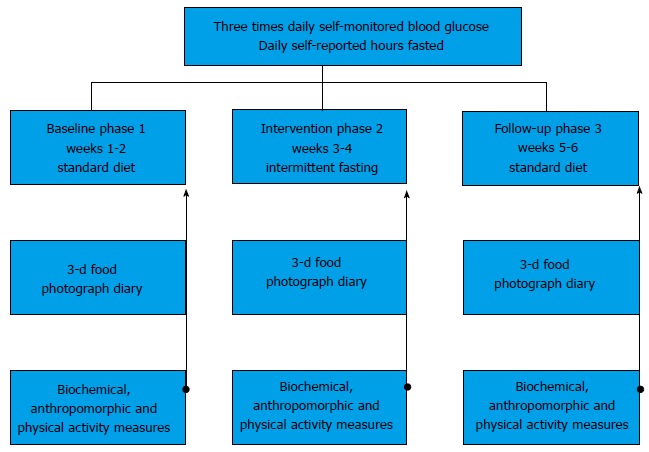
We describe a three-phase observational study (baseline 2 wk, intervention 2 wk, follow-up 2 wk) designed to determine the clinical, biochemical, and tolerability of IF in community-dwelling volunteer adults with T2DM. Biochemical, anthropometric, and physical activity measurements (using the Yale Physical Activity Survey) were taken at the end of each phase. Participants reported morning, afternoon and evening self-monitored blood glucose (SMBG) and fasting duration on a daily basis throughout all study stages, in addition to completing a remote food photography diary three times within each study phase. Fasting blood samples were collected on the final days of each study phase.
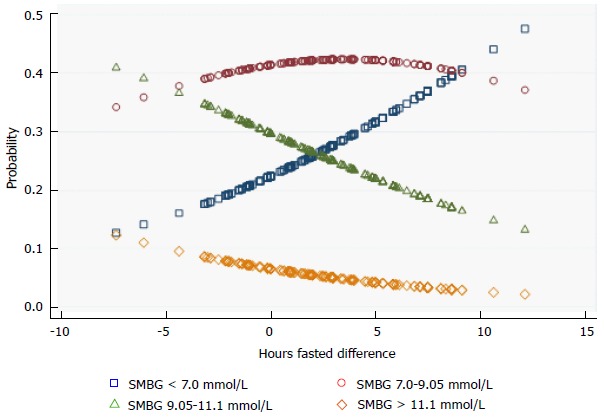
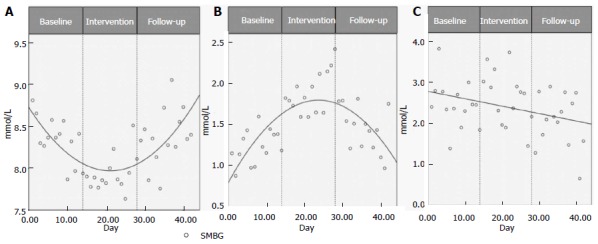
At baseline, the ten participants had a confirmed diagnosis of T2DM and were all taking metformin, and on average were obese [mean body mass index (BMI) 36.90 kg/m]. We report here that a short-term period of IF in a small group of individuals with T2DM led to significant group decreases in weight (-1.395 kg, = 0.009), BMI (-0.517, = 0.013), and at-target morning glucose (SMBG). Although not a study requirement, all participants preferentially chose eating hours starting in the midafternoon. There was a significant increase ( < 0.001) in daily hours fasted in the IF phase (+5.22 h), although few attained the 18-20 h fasting goal (mean 16.82 ± 1.18). The increased fasting duration improved at-goal (< 7.0 mmol/L) morning SMBG to 34.1%, from a baseline of 13.8%. Ordinal Logistic Regression models revealed a positive relationship between the increase in hours fasted and fasting glucose reaching target values ( likelihood ratio = 8.36, = 0.004) but not for afternoon or evening SMBG (all > 0.1). Postprandial SMBGs were also improved during the IF phase, with 60.5% readings below 9.05 mmol/L, compared to 52.6% at baseline, and with less glucose variation. Neither insulin resistance (HOMA-IR), nor inflammatory markers (C-reactive protein) normalized during the IF phase. IF led to an overall spontaneous decrease in caloric intake as measured by food photography (Remote Food Photography Method). The data demonstrated discernable trends during IF for lower energy, carbohydrate, and fat intake when compared to baseline. Physical activity, collected by a standardized measurement tool (Yale Physical Activity Survey), increased during the intervention phase and subsequently decreased in the follow-up phase. IF was well tolerated in the majority of individuals with 6/10 participants stating they would continue with the IF regimen after the completion of the study, in a full or modified capacity (, every other day or reduced fasting hours).
The results from this pilot study indicate that short-term daily IF may be a safe, tolerable, dietary intervention in T2DM patients that may improve key outcomes including body weight, fasting glucose and postprandial variability. These findings should be viewed as exploratory, and a larger, longer study is necessary to corroborate these findings.
确定间歇性禁食(IF)对2型糖尿病(T2DM)成年患者的短期生化影响及临床耐受性。
我们描述了一项分为三个阶段的观察性研究(基线期2周、干预期2周、随访期2周),旨在确定IF对社区居住的T2DM成年志愿者的临床、生化指标及耐受性。在每个阶段结束时进行生化、人体测量及身体活动测量(使用耶鲁身体活动调查问卷)。在所有研究阶段,参与者每天报告早晨、下午和晚上的自我监测血糖(SMBG)及禁食时长,此外,在每个研究阶段内还要完成三次远程食物摄影日记。在每个研究阶段的最后一天采集空腹血样。
在基线期,10名参与者确诊为T2DM,均服用二甲双胍,平均为肥胖[平均体重指数(BMI)36.90kg/m²]。我们在此报告,一小群T2DM患者进行短期IF导致体重(-1.395kg,P=0.009)、BMI(-0.517,P=0.013)及目标早晨血糖(SMBG)显著下降。尽管这并非研究要求,但所有参与者都优先选择从下午中段时间开始进食。在IF阶段,每日禁食时长显著增加(P<0.001)(增加5.22小时),尽管很少有人达到18 - 20小时的禁食目标(平均16.82±1.18小时)。禁食时长的增加使目标早晨SMBG(<7.0mmol/L)从基线时的13.8%提高到34.1%。有序逻辑回归模型显示,禁食时长的增加与空腹血糖达到目标值之间存在正相关关系(似然比=8.36,P=0.004),但与下午或晚上的SMBG无关(所有P>0.1)。在IF阶段,餐后SMBG也有所改善,60.5%的读数低于9.05mmol/L,而基线时为52.6%,且血糖波动较小。在IF阶段,胰岛素抵抗(HOMA-IR)和炎症标志物(C反应蛋白)均未恢复正常。通过食物摄影(远程食物摄影法)测量,IF导致热量摄入总体自发减少。与基线相比,数据显示在IF期间能量、碳水化合物和脂肪摄入有明显下降趋势。通过标准化测量工具(耶鲁身体活动调查问卷)收集的身体活动在干预期增加,随后在随访期减少。大多数人对IF耐受性良好,10名参与者中有6人表示在研究结束后将以全部或修改后的方式继续IF方案(即隔日进行或减少禁食时长)。
这项初步研究的结果表明,短期每日IF可能是T2DM患者一种安全、可耐受的饮食干预措施,可能改善包括体重、空腹血糖和餐后变异性等关键指标。这些发现应被视为探索性的,需要进行更大规模、更长时间的研究来证实这些发现。