School of Pharmacy and Medical Sciences, University of South Australia, Adelaide, SA 5000, Australia.
School of Health Sciences, Centre for Population Health Research, University of South Australia, Adelaide, SA 5000, Australia.
Nutrients. 2017 May 3;9(5):442. doi: 10.3390/nu9050442.
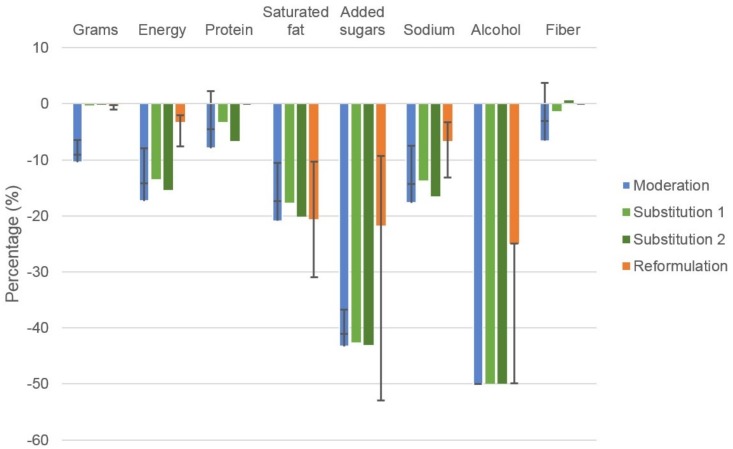
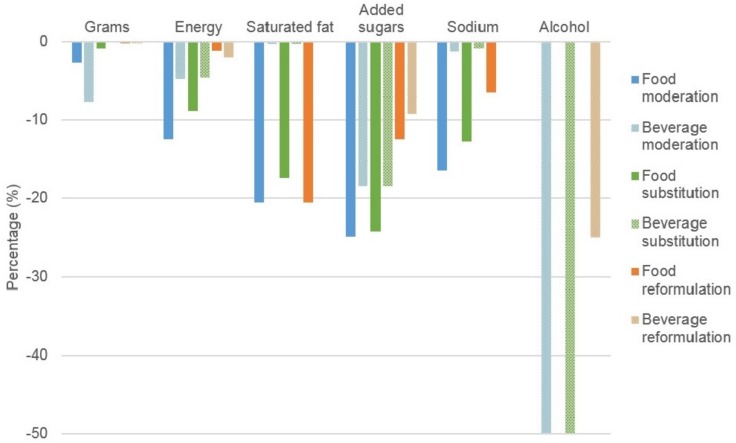
Dietary strategies to reduce discretionary choice intake are commonly utilized in practice, but evidence on their relative efficacy is lacking. The aim was to compare the potential impact on nutritional intake of three strategies to reducing discretionary choices intake in the Australian adult (19-90 years) population. Dietary simulation modelling using data from the National Nutrition and Physical Activity Survey 2011-2012 was conducted ( = 9341; one 24 h dietary recall). Strategies modelled were: moderation (reduce discretionary choices by 50%, with 0%, 25% or 75% energy compensation); substitution (replace 50% of discretionary choices with core choices); reformulation (replace 50% SFA with unsaturated fats, reduce added sugars by 25%, and reduce sodium by 20%). Compared to the base case (observed) intake, modelled intakes in the moderation scenario showed: -17.3% lower energy (sensitivity analyses, 25% energy compensation -14.2%; 75% energy compensation -8.0%), -20.9% lower SFA (-17.4%; -10.5%), -43.3% lower added sugars (-41.1%; -36.7%) and 17.7% lower sodium (-14.3%; -7.5%). Substitution with a range of core items, or with fruits, vegetables and core beverages only, resulted in similar changes in energy intake (-13.5% and -15.4%), SFA (-17.7% and -20.1%), added sugars (-42.6% and -43%) and sodium (-13.7% and -16.5%), respectively. Reformulating discretionary choices had minimal impact on reducing energy intake but reduced SFA (-10.3% to -30.9%), added sugars (-9.3% to -52.9%), and alcohol (-25.0% to -49.9%) and sodium (-3.3% to -13.2%). The substitution and reformulation scenarios minimized negative changes in fiber, protein and micronutrient intakes. While each strategy has strengths and limitations, substitution of discretionary choices with core foods and beverages may optimize the nutritional impact.
在实践中,通常采用减少随意选择摄入的饮食策略,但缺乏相关有效性的证据。本研究旨在比较三种减少澳大利亚成年人(19-90 岁)随意选择摄入的策略对营养摄入的潜在影响。采用 2011-2012 年全国营养和身体活动调查的数据进行饮食模拟建模(n = 9341;1 次 24 小时膳食回忆)。模拟的策略包括:适度(减少 50%的随意选择,能量补偿 0%、25%或 75%);替代(用核心选择替代 50%的随意选择);配方改革(用不饱和脂肪替代 50%的 SFA,减少 25%的添加糖,减少 20%的钠)。与基础情况(观察)相比,适度情景下的模拟摄入量显示:能量降低 17.3%(敏感性分析,25%的能量补偿为-14.2%;75%的能量补偿为-8.0%)、SFA 降低 20.9%(-17.4%;-10.5%)、添加糖降低 43.3%(-41.1%;-36.7%)和钠降低 17.7%(-14.3%;-7.5%)。用一系列核心食品或仅用水果、蔬菜和核心饮料替代,能量摄入的变化相似(-13.5%和-15.4%)、SFA(-17.7%和-20.1%)、添加糖(-42.6%和-43%)和钠(-13.7%和-16.5%)。配方改革对减少能量摄入的影响较小,但可降低 SFA(-10.3%至-30.9%)、添加糖(-9.3%至-52.9%)、酒精(-25.0%至-49.9%)和钠(-3.3%至-13.2%)。替代和配方改革策略最大限度地减少了纤维、蛋白质和微量营养素摄入的负变化。虽然每种策略都有其优势和局限性,但用核心食品和饮料替代随意选择可能会优化营养影响。