The George Institute for Global Health, Faculty of Medicine, University of New South Wales, Sydney, Australia.
University of Washington School of Medicine, Seattle, Washington, United States of America.
PLoS Med. 2021 Oct 26;18(10):e1003806. doi: 10.1371/journal.pmed.1003806. eCollection 2021 Oct.
The Australian Government recently established sodium targets for packaged foods to encourage voluntary reformulation to reduce population sodium consumption and related diseases. We modeled the health impact of Australia's sodium reformulation targets and additional likely health gains if more ambitious, yet feasible sodium targets had been adopted instead.
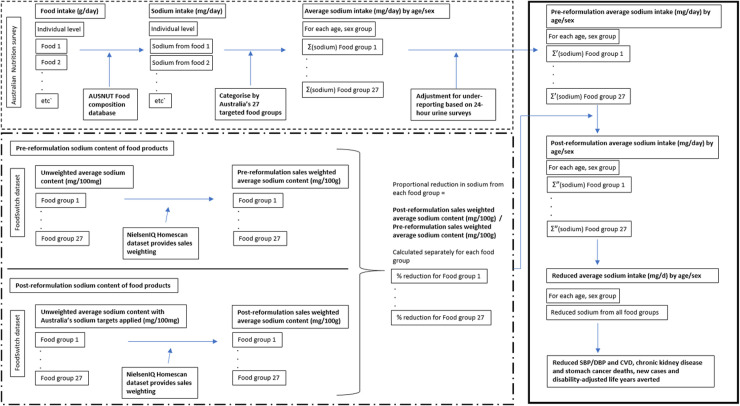
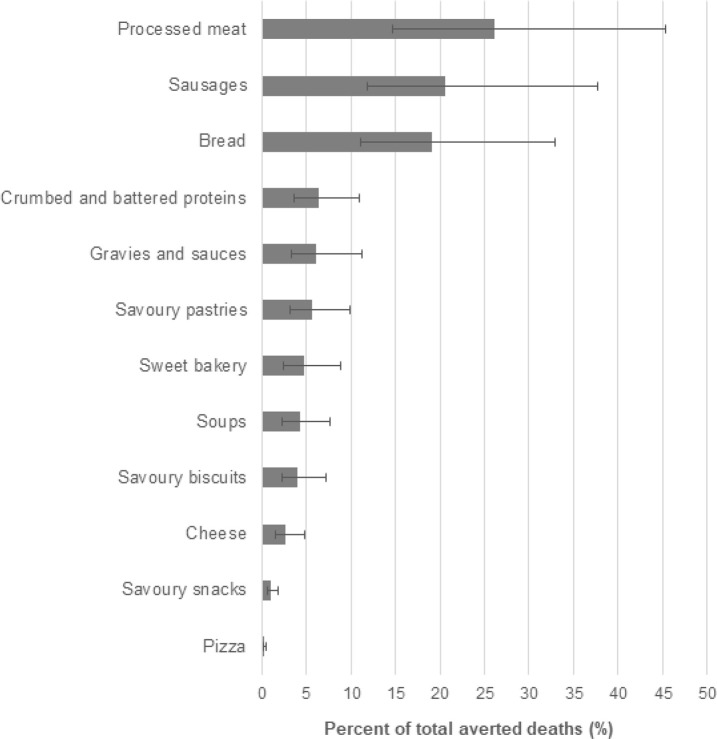
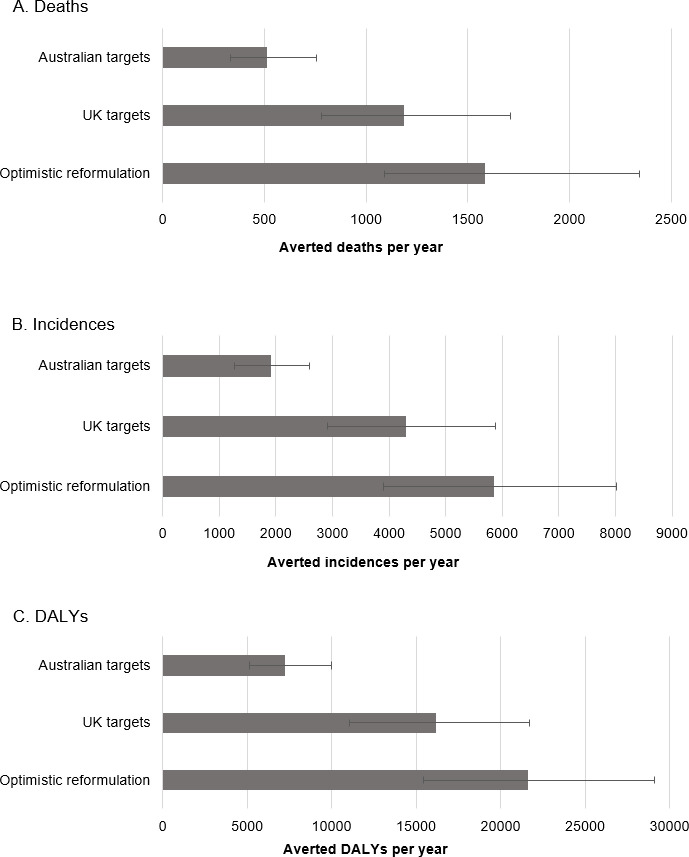
Using comparative risk assessment models, we estimated the averted deaths, incidence, and disability-adjusted life years (DALYs) from cardiovascular disease (CVD), chronic kidney disease (CKD) and stomach cancer after implementation of (a) Australia's sodium targets (overall and by individual companies); (b) United Kingdom's targets (that covers more product categories); and (c) an optimistic scenario (sales-weighted 25th percentile sodium content for each food category included in the UK program). We used nationally representative data to estimate pre- and post-intervention sodium intake, and other key data sources from the Global Burden of Disease study. Full compliance with the Australian government's sodium targets could prevent approximately 510 deaths/year (95% UI, 335 to 757), corresponding to about 1% of CVD, CKD, and stomach cancer deaths, and prevent some 1,920 (1,274 to 2,600) new cases and 7,240 (5,138 to 10,008) DALYs/year attributable to these diseases. Over half (59%) of deaths prevented is attributed to reformulation by 5 market-dominant companies. Compliance with the UK and optimistic scenario could avert approximately an additional 660 (207 to 1,227) and 1,070 (511 to 1,856) deaths/year, respectively, compared to Australia's targets. The main limitation of this study (like other modeling studies) is that it does not prove that sodium reformulation programs will prevent deaths and disease events; rather, it provides the best quantitative estimates and the corresponding uncertainty of the potential effect of the different programs to guide the design of policies.
There is significant potential to strengthen Australia's sodium reformulation targets to improve its health impact. Promoting compliance by market-dominant food companies will be critical to achieving the potential health gains.
澳大利亚政府最近为包装食品制定了钠含量目标,以鼓励自愿进行配方调整,从而减少人群的钠摄入量并预防相关疾病。我们构建了模型以评估澳大利亚的钠含量目标的健康影响,以及如果采用更为大胆但可行的钠含量目标,可能会带来的额外健康收益。
使用比较风险评估模型,我们估算了实施(a)澳大利亚钠含量目标(总体和各个公司);(b)英国目标(涵盖更多产品类别);以及(c)乐观情景(英国方案中包含的每个食品类别按销售额加权的第 25 百分位钠含量)后,心血管疾病(CVD)、慢性肾病(CKD)和胃癌的发病死亡人数、发病例数和伤残调整生命年(DALY)。我们使用全国代表性数据来估算干预前后的钠摄入量以及其他关键数据来源,包括全球疾病负担研究。完全遵守澳大利亚政府的钠含量目标每年可预防约 510 例死亡(95%可信区间,335 至 757 例),占 CVD、CKD 和胃癌死亡人数的 1%左右,还可预防约 1920 例(1274 至 2600 例)新发病例和 7240 例(5138 至 10008 例)DALY,归因于这些疾病。预防的死亡人数中,超过一半(59%)归因于 5 家市场主导公司的配方调整。与澳大利亚目标相比,遵守英国和乐观情景目标每年分别可预防约额外 660 例(207 至 1227 例)和 1070 例(511 至 1856 例)死亡。本研究(与其他建模研究一样)的主要局限性是,它不能证明钠配方调整方案将预防死亡和疾病事件;相反,它提供了不同方案潜在影响的最佳定量估计及其相应的不确定性,以指导政策的制定。
澳大利亚有很大潜力加强其钠含量目标,以提高其健康影响。促进市场主导型食品公司的合规将是实现潜在健康收益的关键。