The Boden Institute of Obesity, Nutrition, Exercise & Eating Disorders, Charles Perkins Centre, University of Sydney, Sydney, NSW 2006, Australia.
Sydney Health Economics, Sydney Local Health District, Sydney, NSW 2050, Australia.
Nutrients. 2019 Mar 22;11(3):683. doi: 10.3390/nu11030683.
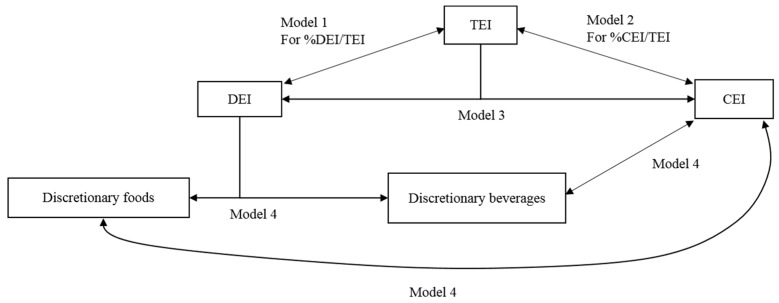
Many dietary recommendations for weight control rely on the assumption that greater core food intake will displace intake of energy-dense discretionary foods and beverages. However, there is little evidence to support these assumptions. This study examined the naturalistic relationship between daily core and discretionary energy intake, and with discretionary food and discretionary beverage intake, separately. The impact of weight status on these associations was also examined.
One hundred participants completed a four-day (non-consecutive) estimated food diary. Discretionary foods and beverages were identified by reference to the Australian Dietary Guidelines. Non-discretionary items were considered core items. Simultaneous-equation random effects models using disaggregated dietary data controlling for sociodemographic variables were used to determine the association between various dietary components.
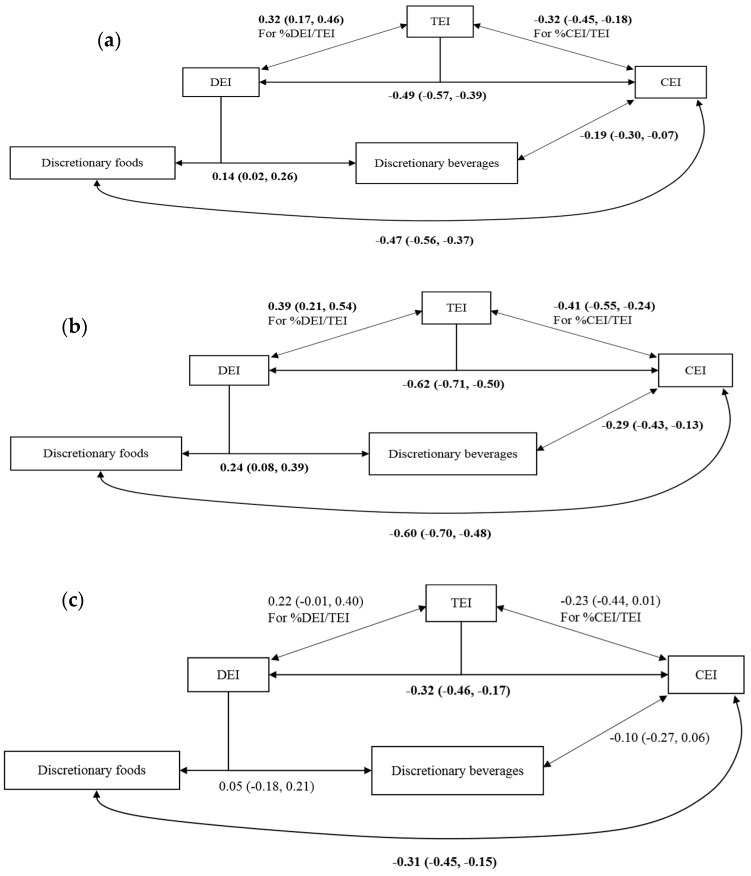
Core energy intake correlated negatively with discretionary energy intake (cross-equation correlation, ρ = -0.49 (95% CI: -0.57, -0.39)). Its correlation with discretionary foods (-0.47 (-0.56, -0.37)) was stronger than that with discretionary beverages (-0.19 (-0.30, -0.07)) The correlation between core energy intake and discretionary energy intake was significantly stronger in participants who did not have obesity (-0.67 (-0.71, -0.50)) than those with obesity (-0.32 (-0.46, -0.17)) ( = 0.0002).
Core and discretionary energy intake share an inverse and potentially bidirectional, relationship that appears to be stronger with discretionary foods than discretionary beverages. These relationships were significantly weaker in participants with obesity which may indicate less precise dietary compensation in these individuals. While strategies that promote greater intake of core foods may assist with weight maintenance in individuals of healthy weight, its impact in individuals with obesity may be limited. These strategies should be accompanied by direct messages to reduce commensurately the intake of discretionary items, with special attention paid to discretionary beverage consumption.
许多用于控制体重的饮食建议都基于这样一个假设,即更多的核心食物摄入会取代能量密集型随意性食物和饮料的摄入。然而,很少有证据支持这些假设。本研究分别考察了日常核心和随意性能量摄入以及随意性食物和随意性饮料摄入之间的自然关系。还检查了体重状况对这些关联的影响。
100 名参与者完成了为期四天(非连续)的估计食物日记。随意性食物和饮料是通过参考澳大利亚饮食指南确定的。非随意性物品被视为核心物品。使用离散饮食数据并控制社会人口变量的同时方程随机效应模型,用于确定各种饮食成分之间的关联。
核心能量摄入与随意性能量摄入呈负相关(交叉方程相关性,ρ=-0.49(95%CI:-0.57,-0.39))。它与随意性食物的相关性(-0.47(-0.56,-0.37))强于与随意性饮料的相关性(-0.19(-0.30,-0.07))。在没有肥胖的参与者中,核心能量摄入与随意性能量摄入之间的相关性(-0.67(-0.71,-0.50))明显强于肥胖参与者(-0.32(-0.46,-0.17))(=0.0002)。
核心和随意性能量摄入存在相互关联且可能是双向的关系,与随意性食物的关系比随意性饮料更强。在肥胖参与者中,这些关系明显较弱,这可能表明这些个体的饮食补偿不够精确。虽然促进更多核心食物摄入的策略可能有助于维持健康体重个体的体重,但在肥胖个体中的影响可能有限。这些策略应辅以直接信息,以相应减少随意性物品的摄入量,特别注意减少随意性饮料的摄入量。