Wang Xiao-Ning, Zhang Chang-Jun, Diao Hong-Lu, Zhang Ying
Reproductive Medical Center of Renmin Hospital, Hubei University of Medicine, Shiyan, Hubei 442000, China.
Chin Med J (Engl). 2017 May 5;130(9):1026-1032. doi: 10.4103/0366-6999.204927.
Excessive reactive oxygen species (ROS) may lead to a number of reproductive diseases such as polycystic ovary syndrome. This study aimed to establish an animal model of ovarian oxidative stress and to assess the protective effect of curcumin against oxidative injury.
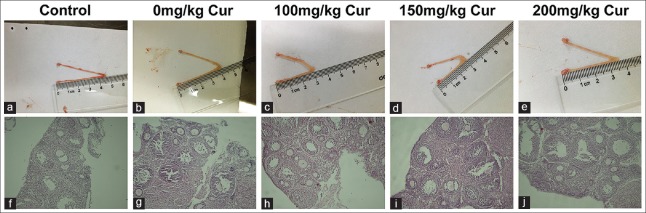
Ovarian oxidative stress was induced in female Kunming mice (n = 40) with intraperitoneal injection of 8 mg/kg sodium arsenite (As) once every other day for 16 days; meanwhile, they were, respectively, treated by intragastric administration of 0, 100, 150, or 200 mg/kg (n = 10/group) curcumin once per day for 21 days. Ten normal mice were used as control. Then, the mice were injected intraperitoneally with BrdU and sacrificed; the right ovaries were collected for hematoxylin and eosin (HE) staining and BrdU immunohistochemistry, and the left ovaries for enzyme-linked immunosorbent assay (ELISA) and Western blotting analyses.
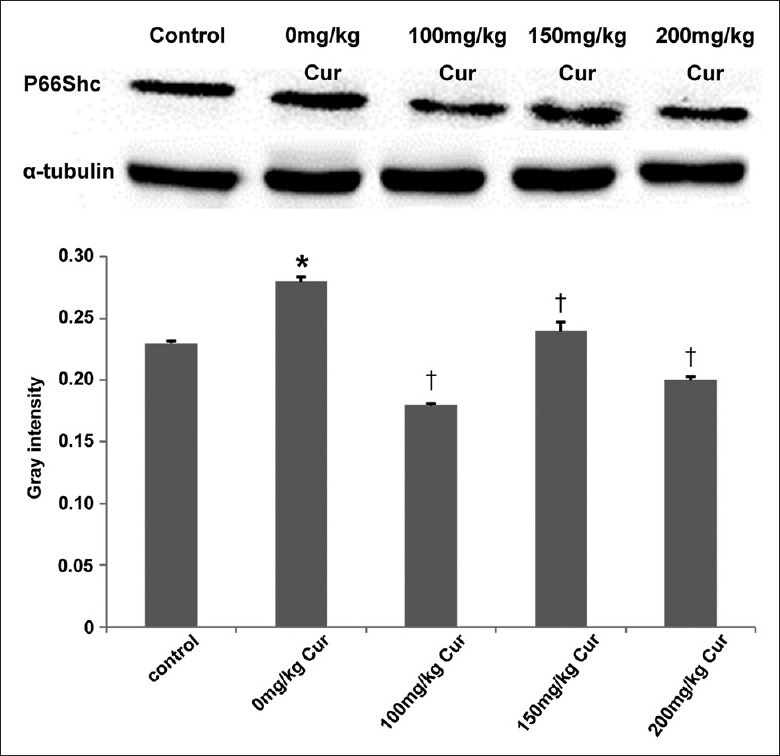
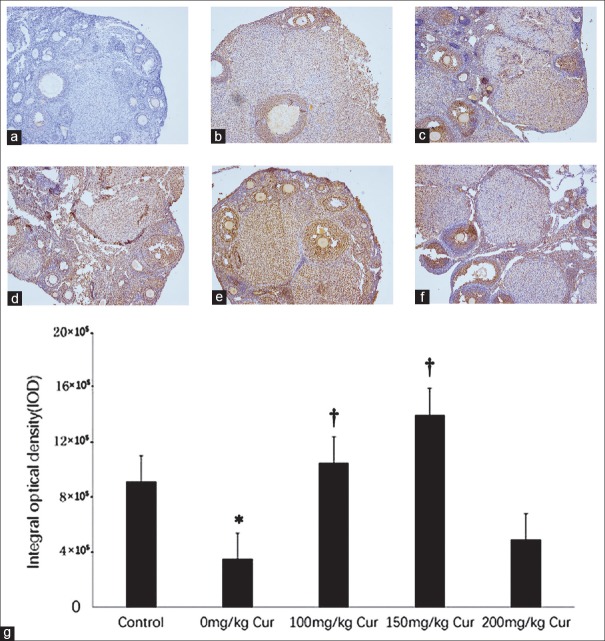
The ELISA results showed that ROS (11.74 ± 0.65 IU/mg in 8 mg/kg AS + 0 mg/kg curcumin group vs. 10.71 ± 0.91 IU/mg in control group, P= 0.021) and malondialdehyde (MDA) (0.32 ± 0.02 nmol/g in 8 mg/kg AS + 0 mg/kg curcumin group vs. 0.27 ± 0.02 nmol/g in control group, P= 0.048) increased while superoxide dismutase (SOD) (3.96 ± 0.36 U/mg in 8 mg/kg AS + 0 mg/kg curcumin group vs. 4.51 ± 0.70 U/mg in control group, P= 0.012) and glutathione peroxidase (17.36 ± 1.63 U/g in 8 mg/kg AS + 0 mg/kg curcumin group vs. 18.92 ± 1.80 U/g in control group, P= 0.045) decreased in the ovary after injection of As, indicating successful modeling of oxidative stress. Curcumin treatment could considerably increase SOD (4.57 ± 0.68, 4.49 ± 0.27, and 4.56 ± 0.25 U/mg in 100 mg/kg, 150 mg/kg, and 200 mg/kg curcumin group, respectively, allP < 0.05) while significantly reduce ROS (10.64 ± 1.38, 10.73 ± 0.71, and 10.67 ± 1.38 IU/mg in 100 mg/kg, 150 mg/kg, and 200 mg/kg curcumin group, respectively, allP < 0.05) and MDA (0.28 ± 0.02, 0.25 ± 0.03, and 0.27 ± 0.04 nmol/g in 100 mg/kg, 150 mg/kg, and 200 mg/kg curcumin group, respectively; bothP < 0.05) in the ovary. HE staining and BrdU immunohistochemistry of the ovarian tissues indicated the increased amount of atretic follicles (5.67 ± 0.81, 5.84 ± 0.98, and 5.72 ± 0.84 in 100 mg/kg, 150 mg/kg, and 200 mg/kg curcumin group, respectively, all P < 0.05), and the inhibited proliferation of granular cells under oxidative stress would be reversed by curcumin. Furthermore, the Western blotting of ovarian tissues showed that the p66Shc expression upregulated under oxidative stress would be lowered by curcumin.
Curcumin could alleviate arsenic-induced ovarian oxidative injury to a certain extent.
过量的活性氧(ROS)可能导致多种生殖疾病,如多囊卵巢综合征。本研究旨在建立卵巢氧化应激动物模型,并评估姜黄素对氧化损伤的保护作用。
将40只雌性昆明小鼠腹腔注射8mg/kg亚砷酸钠(As),隔日1次,共16天,诱导卵巢氧化应激;同时,分别每日灌胃给予0、100、150或200mg/kg(每组n = 10)姜黄素,共21天。10只正常小鼠作为对照。然后,小鼠腹腔注射BrdU后处死;收集右侧卵巢进行苏木精-伊红(HE)染色和BrdU免疫组化,左侧卵巢进行酶联免疫吸附测定(ELISA)和蛋白质印迹分析。
ELISA结果显示,注射As后卵巢中ROS(8mg/kg As + 0mg/kg姜黄素组为11.74±0.65IU/mg,对照组为10.71±0.91IU/mg,P = 0.021)和丙二醛(MDA)(8mg/kg As + 0mg/kg姜黄素组为0.32±0.02nmol/g,对照组为0.27±0.02nmol/g,P = 0.048)升高,而超氧化物歧化酶(SOD)(8mg/kg As + 0mg/kg姜黄素组为3.96±0.36U/mg,对照组为4.51±0.70U/mg,P = 0.012)和谷胱甘肽过氧化物酶(8mg/kg As + 0mg/kg姜黄素组为17.36±1.63U/g,对照组为18.92±1.80U/g,P = 0.045)降低,表明氧化应激模型建立成功。姜黄素治疗可显著增加卵巢中SOD(100mg/kg、150mg/kg和200mg/kg姜黄素组分别为4.57±0.68、4.49±0.27和4.56±0.25U/mg,均P < 0.05),同时显著降低ROS(100mg/kg、150mg/kg和200mg/kg姜黄素组分别为10.64±1.38、10.73±0.71和10.67±1.38IU/mg,均P < 0.05)和MDA(100mg/kg、150mg/kg和200mg/kg姜黄素组分别为0.28±0.02、0.25±0.03和0.27±0.04nmol/g;均P < 0.05)。卵巢组织的HE染色和BrdU免疫组化显示,闭锁卵泡数量增加(100mg/kg、150mg/kg和200mg/kg姜黄素组分别为5.67±0.81、5.84±0.98和5.72±0.84,均P < 0.05),姜黄素可逆转氧化应激下颗粒细胞增殖的抑制。此外,卵巢组织的蛋白质印迹显示,姜黄素可降低氧化应激下上调的p66Shc表达。
姜黄素可在一定程度上减轻砷诱导的卵巢氧化损伤。