Wang Zhong-Kun, Liu Fang-Fang, Wang Yu, Jiang Xin-Mei, Yu Xue-Fan
Department of Neurology, First Hospital, Jilin University, Changchun, Jilin Province, China.
Department of Neurology, Jilin Central Hospital, Jilin, Jilin Province, China.
Neural Regen Res. 2016 Feb;11(2):262-9. doi: 10.4103/1673-5374.177734.
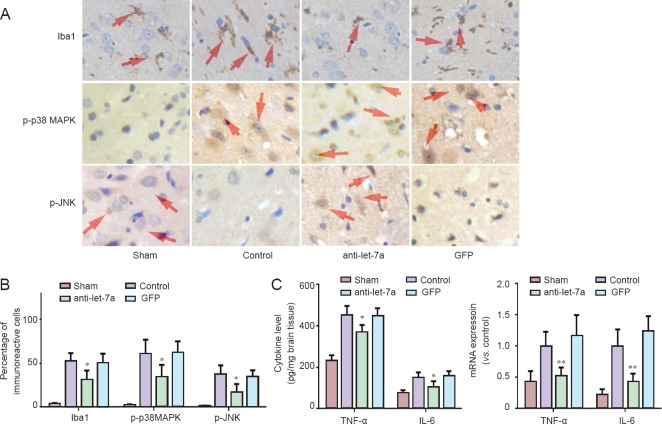
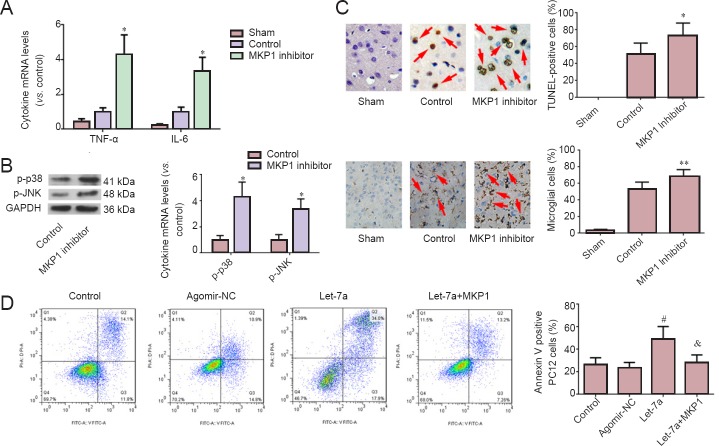
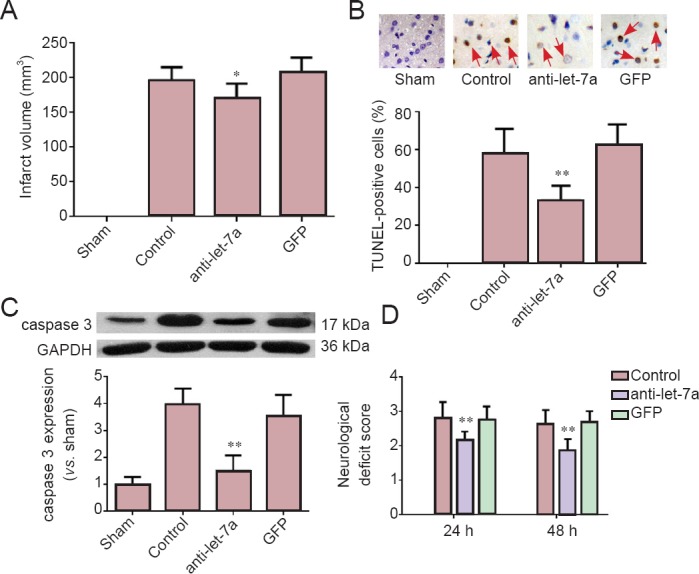
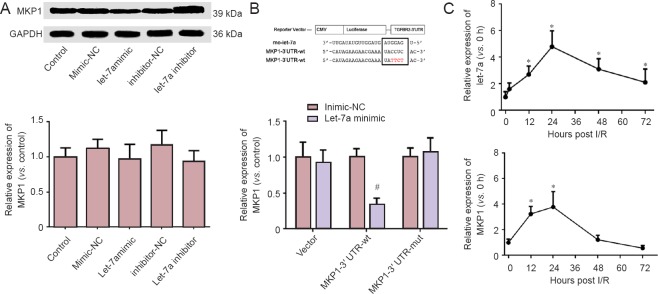
The microRNA (miRNA) let-7 was one of the first miRNAs to be discovered, and is highly conserved and widely expressed among species. let-7 expression increases in brain tissue after cerebral ischemia/reperfusion injury; however, no studies have reported let-7 effects on nerve injury after cerebral ischemia/reperfusion injury. To investigate the effects of let-7 gene knockdown on cerebral ischemia/reperfusion injury, we established a rat model of cerebral ischemia/reperfusion injury. Quantitative reverse transcription-polymerase chain reaction demonstrated that 12 hours after cerebral ischemia/reperfusion injury, let-7 expression was up-regulated, peaked at 24 hours, and was still higher than that in control rats after 72 hours. Let-7 gene knockdown in rats suppressed microglial activation and inflammatory factor release, reduced neuronal apoptosis and infarct volume in brain tissue after cerebral ischemia/reperfusion injury. Western blot assays and luciferase assays revealed that mitogen-activated protein kinase phosphatase-1 (MKP1) is a direct target of let-7. Let-7 enhanced phosphorylated p38 mitogen-activated protein kinase (MAPK) and c-Jun N-terminal kinase (JNK) expression by down-regulating MKP1. These findings suggest that knockdown of let-7 inhibited the activation of p38 MAPK and JNK signaling pathways by up-regulating MKP1 expression, reduced apoptosis and the inflammatory reaction, and exerted a neuroprotective effect following cerebral ischemia/reperfusion injury.
微小RNA(miRNA)let-7是最早被发现的miRNA之一,在物种间高度保守且广泛表达。脑缺血/再灌注损伤后脑组织中let-7表达增加;然而,尚无研究报道let-7对脑缺血/再灌注损伤后神经损伤的影响。为了研究let-7基因敲低对脑缺血/再灌注损伤的影响,我们建立了大鼠脑缺血/再灌注损伤模型。定量逆转录-聚合酶链反应表明,脑缺血/再灌注损伤12小时后,let-7表达上调,在24小时达到峰值,72小时后仍高于对照大鼠。大鼠中let-7基因敲低可抑制小胶质细胞活化和炎性因子释放,减少脑缺血/再灌注损伤后脑组织中的神经元凋亡和梗死体积。蛋白质免疫印迹分析和荧光素酶分析显示,丝裂原活化蛋白激酶磷酸酶-1(MKP1)是let-7的直接靶标。let-7通过下调MKP1增强磷酸化p38丝裂原活化蛋白激酶(MAPK)和c-Jun氨基末端激酶(JNK)的表达。这些发现表明,敲低let-7通过上调MKP1表达抑制p38 MAPK和JNK信号通路的激活,减少细胞凋亡和炎症反应,并在脑缺血/再灌注损伤后发挥神经保护作用。