Loh Siew-May, Gillett Amber, Ryan Una, Irwin Peter, Oskam Charlotte
Vector and Water-Borne Pathogen Research Group, School of Veterinary and Life Sciences, Murdoch University, Perth, Western Australia, Australia.
Australia Zoo Wildlife Hospital, Beerwah, Queensland, Australia.
Int J Syst Evol Microbiol. 2017 Apr;67(4):1075-1080. doi: 10.1099/ijsem.0.001929.
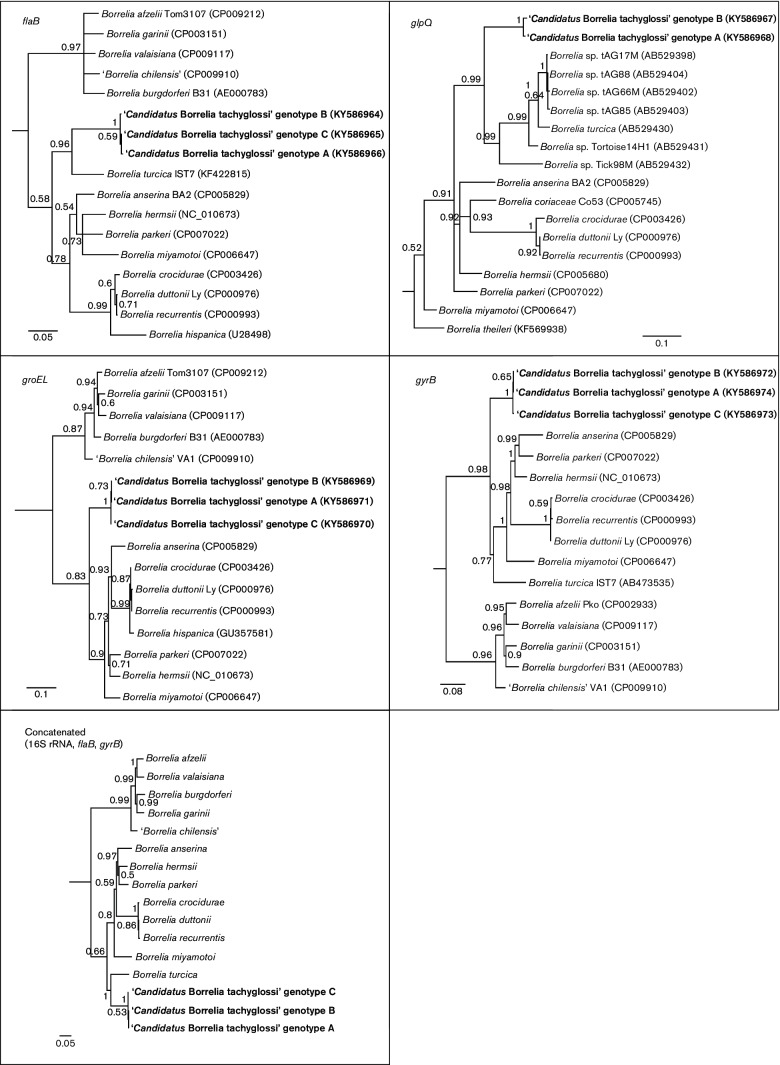
Recently, a novel species of the genus Borreliawas identified in Bothriocroton concolor and Ixodes holocyclus ticks from echidnas. Analyses of 16S rRNA and flaB genes identified three closely related genotypes of this bacterium (Borrelia sp. Aus A-C) that were unique and distinct from previously described borreliae. Phylogenetic analyses of flaB (763 bp), groEL (1537 bp), gyrB (1702 bp) and glpQ (874 bp) gene sequences and concatenated sequences (3585 bp) of three gene loci (16S rRNA, flaB and gyrB) were consistent with previous findings and confirm that this novel species of the genus Borrelia is more closely related to, yet distinct from, the Reptile-associated (REP) and Relapsing Fever (RF) groups. At the flaB locus, genotypes A, B and C shared the highest percentage sequence similarities (87.9, 88 and 87.9 %, respectively) with B.orrelia turcica (REP), whereas at the groEL and gyrB loci, these genotypes were most similar (88.2-89.4 %) to B.orrelia hermsii (RF). At the glpQ locus, genotypes A and B were most similar (85.7 and 85.4 % respectively) to Borrelia sp. Tortoise14H1 (REP). The presence of the glpQ gene, which is absent in the Lyme Borreliosis group spirochaetes, further emphasises that the novel species of the genus Borrelia characterized in the present study does not belong to this group. Phylogenetic analyses at multiple loci produced consistent topographies revealing the monophyletic grouping of this bacterium, therefore providing strong support for its species status. We propose the name 'CandidatusBorrelia tachyglossi', and hypothesize that this species of the genus Borrelia may be endemic to Australia. The pathogenic potential of this bacterium is not yet known.
最近,在来自针鼹的同色双距螯蝇和全环硬蜱中发现了一种新的疏螺旋体属物种。对16S rRNA和flaB基因的分析确定了这种细菌的三种密切相关的基因型(疏螺旋体属澳大利亚种A - C),它们是独特的,与先前描述的疏螺旋体不同。对flaB(763 bp)、groEL(1537 bp)、gyrB(1702 bp)和glpQ(874 bp)基因序列以及三个基因位点(16S rRNA、flaB和gyrB)的串联序列(3585 bp)进行的系统发育分析与先前的发现一致,并证实这种新的疏螺旋体属物种与爬行动物相关(REP)和回归热(RF)组关系更密切,但又有所不同。在flaB位点,A、B和C基因型与土耳其疏螺旋体(REP)的序列相似性百分比最高(分别为87.9%、88%和87.9%),而在groEL和gyrB位点,这些基因型与赫氏疏螺旋体(RF)最相似(88.2 - 89.4%)。在glpQ位点,A和B基因型与龟疏螺旋体14H1(REP)最相似(分别为85.7%和85.4%)。在莱姆病疏螺旋体组螺旋体中不存在的glpQ基因的存在,进一步强调了本研究中鉴定的新的疏螺旋体属物种不属于该组。多个位点的系统发育分析产生了一致的拓扑结构,揭示了这种细菌的单系聚类,因此为其物种地位提供了有力支持。我们提议将其命名为“候选针鼹疏螺旋体”,并假设这种疏螺旋体属物种可能是澳大利亚特有的。这种细菌的致病潜力尚不清楚。