Anaya Gabriel, Al-Delaimy Wael K
Department of Family Medicine and Public Health, Division of Global Health, University of California, 9500 Gilman Dr, La Jolla, San Diego, CA, 92093, USA.
BMC Public Health. 2017 May 6;17(1):400. doi: 10.1186/s12889-017-4332-6.
An array of risk factors has been associated with cardiovascular diseases, and developing nations are becoming disproportionately affected by such diseases. Cardiovascular diseases have been reported to be highly prevalent in the Mexican population, but local mortality data is poor. The Mexican side of the US-Mexico border has a culture that is closely related to a developed nation and therefore may share the same risk factors of cardiovascular diseases. We wanted to explore if there was higher cardiovascular mortality in the border region of Mexico compared to the rest of the nation.
We conducted a population based cross-sectional time series analysis to estimate the effects of education, insurance and municipal size in Mexican border (n = 38) and non-border municipalities (n = 2360) and its association with cardiovascular age-adjusted mortality rates between the years 1998-2012. We used a mixed effect linear model with random effect estimation and repeated measurements to compare the main outcome variable (mortality rate), the covariates (education, insurance and population size) and the geographic delimiter (border/non-border).
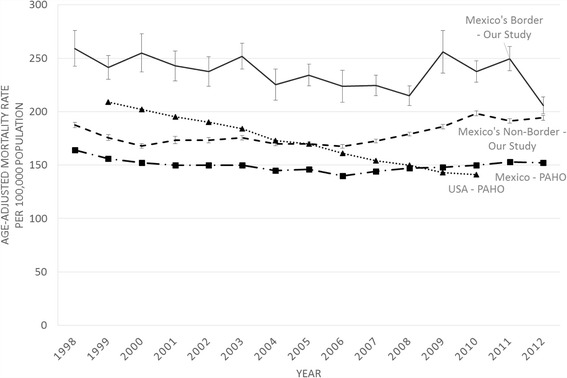
Mortality due to cardiovascular disease was consistently higher in the municipalities along the US-Mexico border, showing a difference of 78 · 5 (95% CI 58 · 7-98 · 3, p < 0 · 001) more cardiovascular deaths after adjusting for covariates. Larger municipal size and higher education levels showed a reduction in cardiovascular mortality of 12 · 6 (95% CI 11 · 4-13 · 8, p < 0 · 001) deaths and 8 · 6 (95% CI 5 · 5-11 · 8, p < 0 · 001) deaths respectively. Insurance coverage showed an increase in cardiovascular mortality of 3 · 6 (95% CI 3 · 1-4 · 0, p < 0 · 001) deaths per decile point increase. There was an increase in cardiovascular mortality of 0 · 3 (95% CI -0 · 001-0 · 6, p = 0 · 050) deaths per year increase in the non-border but a yearly reduction of 2 · 9 (95% CI 0 · 75-5.0, p = 0 · 008) deaths in the border over the time period of 1998-2012.
We observed that the Mexican side of the US-Mexico border region is disproportionately affected by cardiovascular disease mortality as compared to the non-border region of Mexico. This was not explained by education, population density, or insurance coverage. Proximity to the US culture and related diet and habits can be explanations of the increasing mortality trend.
一系列风险因素与心血管疾病相关,发展中国家受此类疾病的影响正日益加剧。据报道,心血管疾病在墨西哥人群中高度流行,但当地的死亡率数据却很匮乏。美墨边境的墨西哥一侧有着与发达国家紧密相关的文化,因此可能存在相同的心血管疾病风险因素。我们想探究墨西哥边境地区的心血管疾病死亡率是否高于该国其他地区。
我们进行了一项基于人群的横断面时间序列分析,以评估教育、保险和城市规模对墨西哥边境城市(n = 38)和非边境城市(n = 2360)的影响,及其与1998年至2012年间心血管疾病年龄调整死亡率的关联。我们使用了带有随机效应估计和重复测量的混合效应线性模型,来比较主要结果变量(死亡率)、协变量(教育、保险和人口规模)以及地理界定因素(边境/非边境)。
美墨边境沿线城市的心血管疾病死亡率一直较高,在对协变量进行调整后,心血管死亡人数多出78.5例(95%置信区间为58.7 - 98.3,p < 0.001)。城市规模较大和教育水平较高分别使心血管疾病死亡率降低了12.6例(95%置信区间为11.4 - 13.8,p < 0.001)和8.6例(95%置信区间为5.5 - 11.8,p < 0.001)。保险覆盖范围每增加十分位数,心血管疾病死亡率就增加3.6例(95%置信区间为3.1 - 4.0,p < 0.001)。在1998年至2012年期间,非边境地区每年心血管疾病死亡率增加0.3例(95%置信区间为 - 0.001 - 0.6,p = 0.050),而边境地区每年降低2.9例(95%置信区间为0.75 - 5.0,p = 0.008)。
我们观察到,与墨西哥非边境地区相比,美墨边境地区的墨西哥一侧受心血管疾病死亡率的影响更大。这无法通过教育、人口密度或保险覆盖范围来解释。与美国文化以及相关饮食和习惯的接近可能是死亡率上升趋势的原因。