Pangilinan Jayce, Quanstrom Kathryn, Bridge Mark, Walter Louise C, Finlayson Emily, Suskind Anne M
University of Arizona College of Medicine, Tucson, AZ.
Department of Urology, University of California, San Francisco, CA.
Urology. 2017 Aug;106:32-38. doi: 10.1016/j.urology.2017.03.054. Epub 2017 May 3.
To evaluate the prevalence of frailty, a known predictor of poor outcomes, among patients presenting to an academic nononcologic urology practice and to examine whether frailty differs among patients who did and did not undergo urologic surgery.
The Timed Up and Go Test (TUGT), a parsimonious measure of frailty, was administered to patients ages ≥65. The TUGT, demographic data, urologic diagnoses, and procedural history were abstracted from the medical record into a prospective database. TUGT times were categorized as nonfrail (≤10 seconds), prefrail (11-14 seconds), and frail (≥15 seconds). These times were evaluated across age and urologic diagnoses and compared between patients who did and did not undergo urologic surgery using chi-square and t tests.
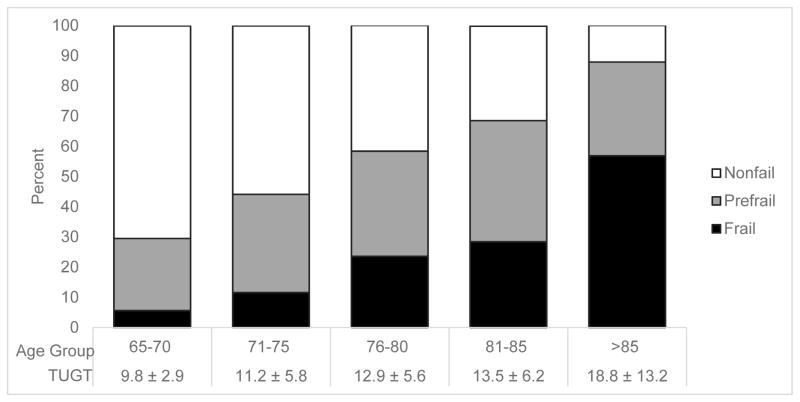
The TUGT was recorded for 78.9% of patient visits from December 2015 to May 2016. For 1089 patients, average age was 73.3 ± 6.3 years; average TUGT time was 11.6 ± 6.0 seconds; 30.0% were categorized as prefrail and 15.2% as frail. TUGT times increased with age, with 56.9% of patients age 86 and over categorized as frail. Times varied across diagnoses (highest average TUGT was 14.3 ± 11.9 seconds for patients with urinary tract infections); however, no difference existed between patients who did and did not undergo surgery (P = .94).
Among our population, prefrailty and frailty were common, TUGT times increased with age and varied by urologic diagnosis, but did not differ between patients who did and did not undergo urologic surgery, presenting an opportunity to consider frailty in preoperative surgical decision making.
评估在一家学术性非肿瘤泌尿外科诊所就诊的患者中衰弱(已知的不良预后预测因素)的患病率,并检查接受和未接受泌尿外科手术的患者之间衰弱情况是否存在差异。
对年龄≥65岁的患者进行计时起立行走测试(TUGT),这是一种衡量衰弱的简易方法。从病历中提取TUGT、人口统计学数据、泌尿外科诊断和手术史,并录入前瞻性数据库。TUGT时间分为非衰弱(≤10秒)、衰弱前期(11 - 14秒)和衰弱(≥15秒)。通过卡方检验和t检验,对这些时间在不同年龄和泌尿外科诊断中的情况进行评估,并比较接受和未接受泌尿外科手术的患者之间的差异。
2015年12月至2016年5月期间,78.9%的患者就诊记录了TUGT。1089例患者的平均年龄为73.3 ± 6.3岁;平均TUGT时间为11.6 ± 6.0秒;30.0%被归类为衰弱前期,15.2%为衰弱。TUGT时间随年龄增加,86岁及以上患者中有56.9%被归类为衰弱。不同诊断的时间有所不同(尿路感染患者的平均TUGT最高,为14.3 ± 11.9秒);然而,接受和未接受手术的患者之间没有差异(P = 0.94)。
在我们的研究人群中,衰弱前期和衰弱很常见,TUGT时间随年龄增加且因泌尿外科诊断而异,但接受和未接受泌尿外科手术的患者之间没有差异,这为在术前手术决策中考虑衰弱提供了机会。