Kamath Pooja, Pereira Treville, Chande Mayura, Shetty Subraj
Department of Oral Pathology and Microbiology, D. Y. Patil University School of Dentistry, Navi Mumbai, Maharashtra, India.
Department of Oral and Maxillofacial Pathology and Microbiology, D. Y. Patil University School of Dentistry, Navi Mumbai, Maharashtra, India.
J Oral Maxillofac Pathol. 2017 Jan-Apr;21(1):115-118. doi: 10.4103/jomfp.JOMFP_217_16.
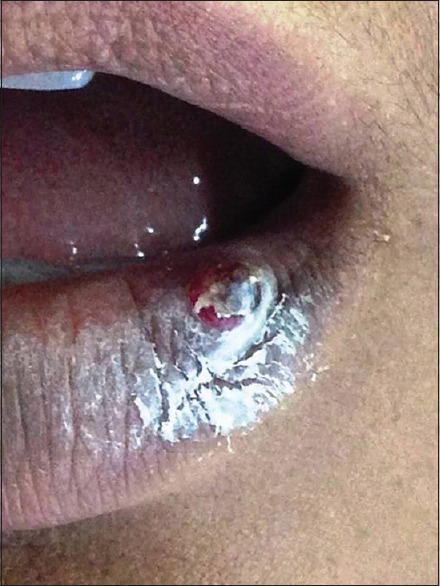
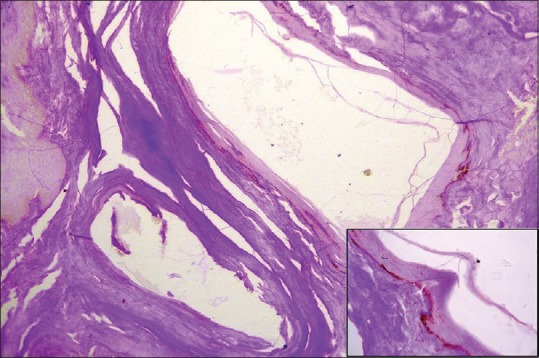
Keratoacanthoma (KA) is a benign epithelial tumor which presents clinically as a proliferating dome-shaped keratin-filled crater. The lesion occurs predominantly upon sun-exposed areas of the body and is known to arise from hair follicle. Actinic rays are a major contributing factor in the etiology. It simulates grossly as well as microscopically a low-grade squamous cell carcinoma. KAs occur habitually on the mucous membrane as well, but their origin in these cases is debatable, owing to the lack of hair follicles in these sites. Our report is an attempt to demonstrate the cells that could be responsible for initiation of this lesion on the oral mucosa.
角化棘皮瘤(KA)是一种良性上皮肿瘤,临床上表现为增生性圆顶状充满角蛋白的火山口状病变。该病变主要发生在身体暴露于阳光下的部位,已知起源于毛囊。光化射线是病因中的一个主要促成因素。它在大体和显微镜下都类似于低级别鳞状细胞癌。KA也常发生在黏膜上,但在这些情况下其起源存在争议,因为这些部位缺乏毛囊。我们的报告旨在证明可能导致口腔黏膜上这种病变起始的细胞。