Soliman Sameh S M, Semreen Mohammad H, El-Keblawy Ali A, Abdullah Arbab, Uppuluri Priya, Ibrahim Ashraf S
Department of Medicinal Chemistry, College of Pharmacy, University of Sharjah, Sharjah, PO Box 27272, United Arab Emirates.
Sharjah Institute for Medical Research, University of Sharjah, Sharjah, United Arab Emirates.
BMC Complement Altern Med. 2017 May 8;17(1):257. doi: 10.1186/s12906-017-1760-x.
Microbial infections are diverse and cause serious human diseases. Candida albicans infections are serious healthcare-related infections that are complicated by its morphological switching from yeast to hyphae, resistant biofilm formation and mixed infections with bacteria. Due to the increase in drug resistance to currently used antimicrobial agents and the presence of undesirable side effects, the need for safe and effective novel therapies is important. Compounds derived from plants are known for their medicinal properties including antimicrobial activities. The purpose of the study was to compare and evaluate the anti-Candida activities of several medicinal plants in order for the selection of a herbal drug for human use as effective antimicrobial. The selection was taking into considerations two important parameters; parameters related to the selected drug including activity, stability, solubility and toxicity and parameters related to the pathogen including its different dynamic growth and its accompanied secondary bacterial infections.
Seven different plants including Avicennia marina (Qurm), Fagonia indica (Shoka'a), Lawsania inermis (Henna), Portulaca oleracea (Baq'lah), Salvadora persica (Souwak), Ziziphus spina- Christi (Sidr) and Asphodelus tenuifolius (Kufer) were ground and extracted with ethanol. The ethanol extracts were evaporated and the residual extract dissolved in water prior to testing against Candida albicans in its different morphologies. The antibacterial and cytotoxic effects of the plants extracts were also tested.
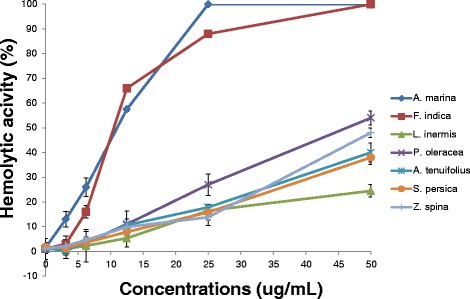
Out of the seven tested plants, L. inermis and P. oleracea showed significant anti-Candida activity with MIC ~10 μg/mL. Furthermore, both plant extracts were able to inhibit C. albicans growth at its dynamic growth phases including biofilm formation and age resistance. Accompanied secondary bacterial infections can complicate Candida pathogenesis. L. inermis and P. oleracea extracts showed effective antibacterial activities against S. aureus, P. aeruginosa, E. coli, and the multidrug resistant (MDR) A. baumannii and Klebsiella pneumoniae. Both extracts showed no toxicity when measured at their MIC on human erythrocytes.
The results from this study suggested that L. inermis and P. oleracea extracts and/or their chemicals are likely to be promising drugs for human use against C. albicans and MDR bacteria.
微生物感染多种多样,会引发严重的人类疾病。白色念珠菌感染是与医疗保健密切相关的严重感染,其从酵母形态转变为菌丝形态、形成耐药生物膜以及与细菌混合感染等情况会使病情复杂化。由于对目前使用的抗菌药物的耐药性增加以及存在不良副作用,因此需要安全有效的新型疗法。植物衍生的化合物以其包括抗菌活性在内的药用特性而闻名。本研究的目的是比较和评估几种药用植物的抗念珠菌活性,以便选择一种可供人类使用的有效抗菌草药。该选择考虑了两个重要参数;与所选药物相关的参数,包括活性、稳定性、溶解性和毒性,以及与病原体相关的参数,包括其不同的动态生长及其伴随的继发性细菌感染。
将七种不同的植物,包括白骨壤(Qurm)、指示费加罗草(Shoka'a)、无刺番荔枝(Henna)、马齿苋(Baq'lah)、药用海枣(Souwak)、枣椰(Sidr)和细叶阿福花(Kufer)研磨并用乙醇提取。将乙醇提取物蒸发,剩余提取物溶解于水后,针对不同形态的白色念珠菌进行测试。还测试了植物提取物的抗菌和细胞毒性作用。
在七种受试植物中,无刺番荔枝和马齿苋表现出显著的抗念珠菌活性,最低抑菌浓度(MIC)约为10μg/mL。此外,两种植物提取物都能够在白色念珠菌的动态生长阶段抑制其生长,包括生物膜形成和抗老化。伴随的继发性细菌感染会使念珠菌发病机制复杂化。无刺番荔枝和马齿苋提取物对金黄色葡萄球菌、铜绿假单胞菌、大肠杆菌以及多重耐药的鲍曼不动杆菌和肺炎克雷伯菌表现出有效的抗菌活性。当在其对人红细胞的最低抑菌浓度下测量时,两种提取物均未显示出毒性。
本研究结果表明,无刺番荔枝和马齿苋提取物和/或其化学成分可能是用于人类对抗白色念珠菌和多重耐药细菌的有前景的药物。