Saw Yu Mon, Saw Thu Nandar, Yasuoka Junko, Chan Nyein, Kham Nang Pann Ei, Khine Wint, Cho Su Myat, Jimba Masamine
Department of Healthcare Administration, Graduate School of Medicine, Nagoya University, 65 Tsurumai-cho, Showa-ku, Nagoya, 466-8550, Japan.
Nagoya University Asian Satellite Campuses Institute, Nagoya, Japan.
Harm Reduct J. 2017 May 8;14(1):21. doi: 10.1186/s12954-017-0147-0.
Globally, methamphetamine (MA) use is a significant public health concern due to unprecedented health effects of its use. However, gender similarities and differences in early age of MA initiation and its risk factors among current MA users have been understudied in a developing country setting.
A community-based, cross-sectional study was conducted using a computer assisted self-interviewing program from January to March 2013 in Muse, Northern Shan State, Myanmar. A total of 1362 (775 male and 587 female) self-reported current MA users aged between 18 and 35 years were recruited using respondent-driven sampling. Two gender-stratified multiple logistic regression models (models I and II) were done for analysis.
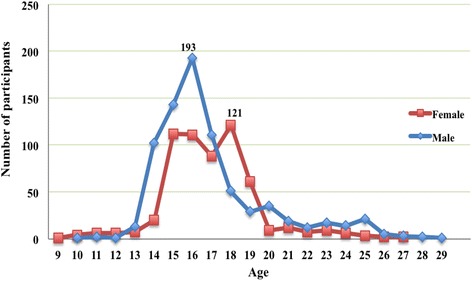
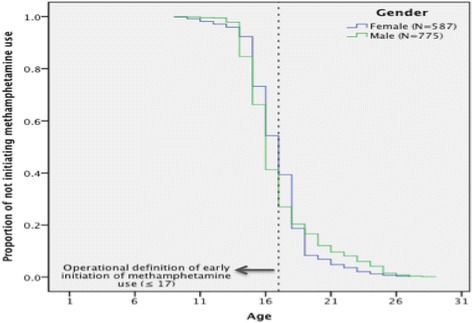
For similarities, 73.0% of males and 60.5% of females initiated MA before their 18th birthday. The early age of MA initiation was positively associated with the reasons and places of the first time MA use among both genders. For differences, males [hazard ratio 1.35; 95% confidence interval, 1.18-1.54] had a significantly higher risk than females to initiate MA at earlier age. Among male users, participants who had bisexual/homosexual preferences were more likely to initiate MA use earlier. In contrast, female users who exchanged sex for money and/or drugs were more likely to initiate MA in earlier age.
More than 60.0% of male and female participants initiated MA use early; however, males initiated use earlier than females. Although similarities were found among both genders, differences found in key risk factors for early age MA initiation suggest that gender-specific, MA prevention programs are urgently needed in Myanmar.
在全球范围内,甲基苯丙胺(MA)的使用因其前所未有的健康影响而成为一个重大的公共卫生问题。然而,在发展中国家的背景下,关于当前甲基苯丙胺使用者中开始使用甲基苯丙胺的早期年龄及其危险因素的性别异同尚未得到充分研究。
2013年1月至3月,在缅甸掸邦北部木姐市开展了一项基于社区的横断面研究,采用计算机辅助自我访谈程序。通过应答者驱动抽样招募了1362名(775名男性和587名女性)年龄在18至35岁之间的自我报告的当前甲基苯丙胺使用者。进行了两个按性别分层的多因素logistic回归模型(模型I和模型II)分析。
相同点方面,73.0%的男性和60.5%的女性在18岁之前开始使用甲基苯丙胺。甲基苯丙胺开始使用的早期年龄与首次使用甲基苯丙胺的原因和地点在两性中均呈正相关。不同点方面,男性[风险比1.35;95%置信区间,1.18 - 1.54]在更早年龄开始使用甲基苯丙胺的风险显著高于女性。在男性使用者中,有双性恋/同性恋偏好的参与者更有可能更早开始使用甲基苯丙胺。相比之下,用性交易换取金钱和/或毒品的女性使用者更有可能在更早年龄开始使用甲基苯丙胺。
超过60.0%的男性和女性参与者早期开始使用甲基苯丙胺;然而,男性比女性开始使用得更早。尽管两性之间存在相同点,但在甲基苯丙胺开始使用早期的关键危险因素中发现的差异表明,缅甸迫切需要针对性别的甲基苯丙胺预防项目。