Lischke Alexander, Domin Martin, Freyberger Harald J, Grabe Hans J, Mentel Renate, Bernheim Dorothee, Lotze Martin
Department of Psychiatry and Psychotherapy, University of GreifswaldGreifswald, Germany.
Department of Psychology, University of GreifswaldGreifswald, Germany.
Front Hum Neurosci. 2017 Apr 24;11:196. doi: 10.3389/fnhum.2017.00196. eCollection 2017.
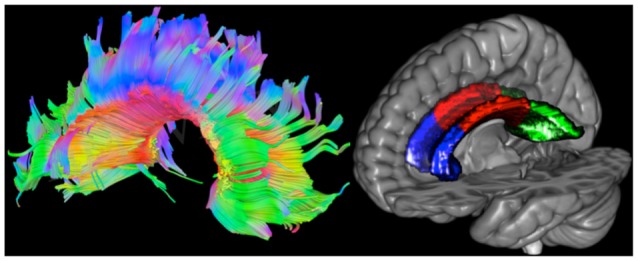
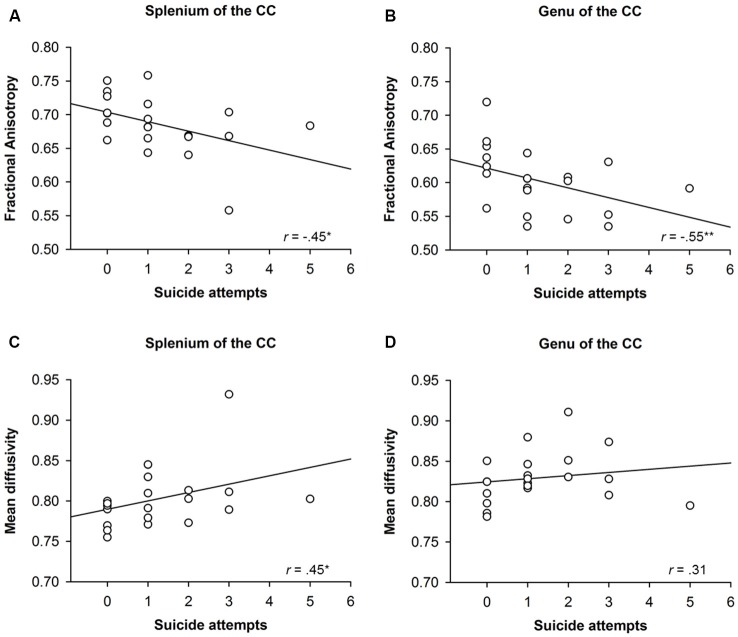
Structural alterations in the corpus callosum (CC), the major white matter tract connecting functionally related brain regions in the two hemispheres, have been shown to be associated with emotional instability, impulsivity and suicidality in various mental disorders. To explore whether structural alterations of the CC would be similarly associated with emotional instability, impulsivity and suicidality in borderline personality disorder (BPD), we used diffusion tensor imaging (DTI) to assess the structural integrity of the CC in 21 BPD and 20 healthy control (HC) participants. Our hypothesis-driven analyses revealed a positive correlation between BPD participants' suicidal behavior and fractional anisotropy (FA) in the splenium and genu of the CC and a negative correlation between BPD participants' suicidal behavior and mean diffusivity (MD) in the splenium of CC. Our exploratory analyses suggested that suicidal BPD participants showed less FA and more MD in these regions than HC participants but that non-suicidal BPD participants showed similar FA and MD in these regions as HC participants. Taken together, our findings suggest an association between BPD participants' suicidal behavior and structural alterations in regions of the CC that are connected with brain regions implicated in emotion regulation and impulse control. Structural alterations of the CC may, thus, account for deficits in emotion regulation and impulse control that lead to suicidal behavior in BPD. However, these findings should be considered as preliminary until replicated and extended in future studies that comprise larger samples of suicidal and non-suicidal BPD participants.
胼胝体(CC)是连接两个半球功能相关脑区的主要白质束,其结构改变已被证明与多种精神障碍中的情绪不稳定、冲动性和自杀行为有关。为了探究CC的结构改变是否同样与边缘型人格障碍(BPD)中的情绪不稳定、冲动性和自杀行为有关,我们使用扩散张量成像(DTI)来评估21名BPD患者和20名健康对照(HC)参与者的CC结构完整性。我们基于假设的分析揭示了BPD参与者的自杀行为与CC的压部和膝部的分数各向异性(FA)之间存在正相关,以及BPD参与者的自杀行为与CC压部的平均扩散率(MD)之间存在负相关。我们的探索性分析表明,有自杀行为的BPD参与者在这些区域的FA低于HC参与者,MD高于HC参与者,但无自杀行为的BPD参与者在这些区域的FA和MD与HC参与者相似。综上所述,我们的研究结果表明BPD参与者的自杀行为与CC中与涉及情绪调节和冲动控制的脑区相连区域的结构改变之间存在关联。因此,CC的结构改变可能是导致BPD患者出现自杀行为的情绪调节和冲动控制缺陷的原因。然而,在未来包含更大样本的有自杀行为和无自杀行为的BPD参与者的研究中进行重复和扩展之前,这些发现应被视为初步结果。