Liu Rong, Zhang Wei, Liu Zhao-Qian, Zhou Hong-Hao
Department of Clinical Pharmacology, Xiangya Hospital, Central South University, Changsha, 410008, People's Republic of China.
Institute of Clinical Pharmacology, Central South University; Hunan Key Laboratory of Pharmacogenetics, Changsha, 410078, People's Republic of China.
BMC Genomics. 2017 May 9;18(1):361. doi: 10.1186/s12864-017-3761-z.
Colon cancer (CC) is a heterogeneous disease influenced by complex gene networks. As such, the relationship between networks and CC should be elucidated to obtain further insights into tumour biology.
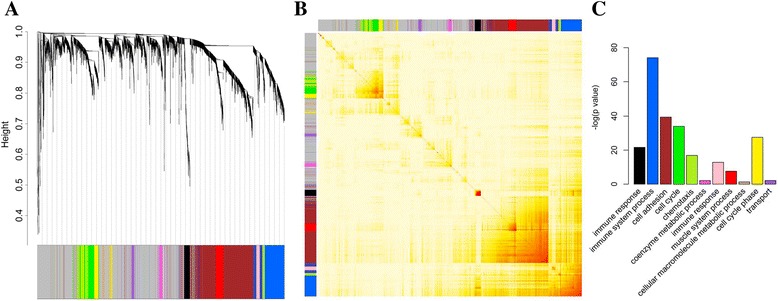
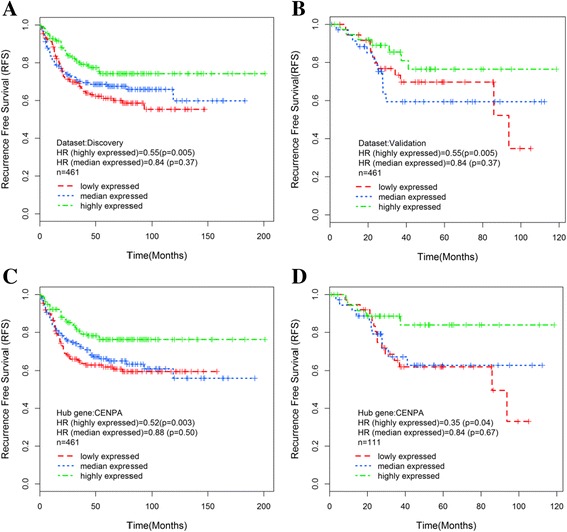
Weighted gene co-expression network analysis, a powerful technique used to extract co-expressed gene networks from mRNA expressions, was conducted to identify 11 co-regulated modules in a discovery dataset with 461 patients. A transcriptional module enriched in cell cycle processes was correlated with the recurrence-free survival of the CC patients in the discovery (HR = 0.59; 95% CI = 0.42-0.81) and validation (HR = 0.51; 95% CI = 0.25-1.05) datasets. The prognostic potential of the hub gene Centromere Protein-A (CENPA) was also identified and the upregulation of this gene was associated with good survival. Another cell cycle phase-related gene module was correlated with the survival of the patients with a KRAS mutation CC subtype. The downregulation of several genes, including those found in this co-expression module, such as cyclin-dependent kinase 1 (CDK1), was associated with poor survival.
Network-based approaches may facilitate the discovery of biomarkers for the prognosis of a subset of patients with stage II or III CC, these approaches may also help direct personalised therapies.
结肠癌(CC)是一种受复杂基因网络影响的异质性疾病。因此,应阐明网络与CC之间的关系,以进一步深入了解肿瘤生物学。
加权基因共表达网络分析是一种用于从mRNA表达中提取共表达基因网络的强大技术,在一个包含461例患者的发现数据集中进行分析,以识别11个共调控模块。一个富含细胞周期过程的转录模块与发现数据集(HR = 0.59;95% CI = 0.42 - 0.81)和验证数据集(HR = 0.51;95% CI = 0.25 - 1.05)中CC患者的无复发生存率相关。还确定了核心基因着丝粒蛋白A(CENPA)的预后潜力,该基因的上调与良好的生存率相关。另一个与细胞周期阶段相关的基因模块与KRAS突变CC亚型患者的生存相关。包括在该共表达模块中发现的几个基因(如细胞周期蛋白依赖性激酶1(CDK1))的下调与较差的生存率相关。
基于网络的方法可能有助于发现II期或III期CC患者亚组预后的生物标志物,这些方法也可能有助于指导个性化治疗。