Leung Yuet-Kin, Govindarajah Vinothini, Cheong Ana, Veevers Jennifer, Song Dan, Gear Robin, Zhu Xuegong, Ying Jun, Kendler Ady, Medvedovic Mario, Belcher Scott, Ho Shuk-Mei
Department of Environmental HealthCincinnati, Ohio, USA.
Center for Environmental GeneticsUniversity of Cincinnati College of Medicine, Cincinnati, Ohio, USA.
Endocr Relat Cancer. 2017 Jul;24(7):365-378. doi: 10.1530/ERC-17-0006. Epub 2017 May 9.
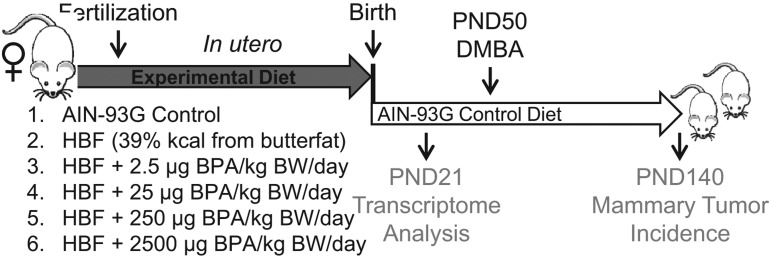
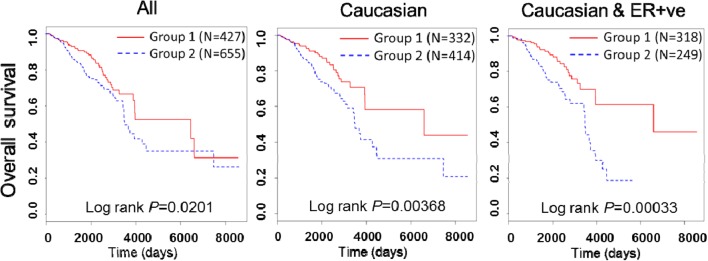
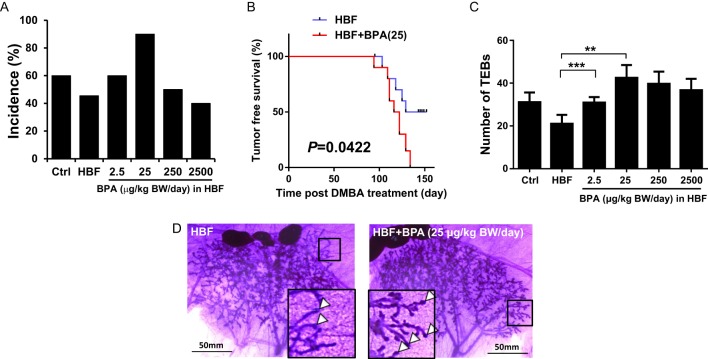
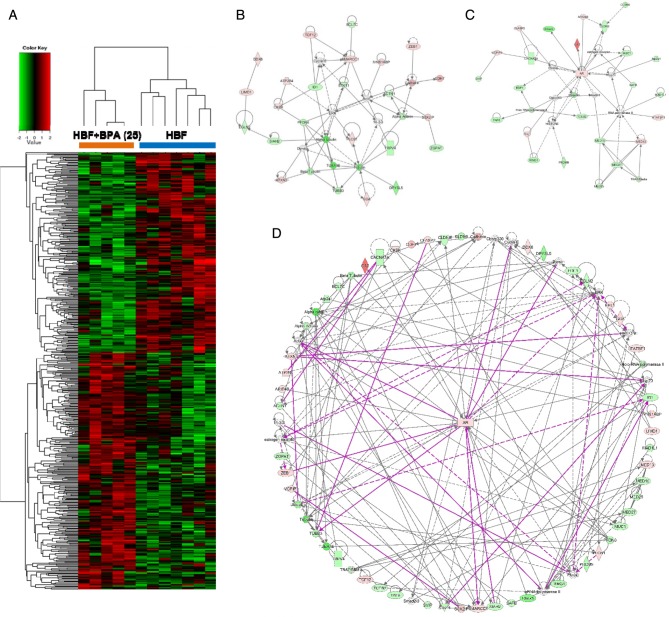
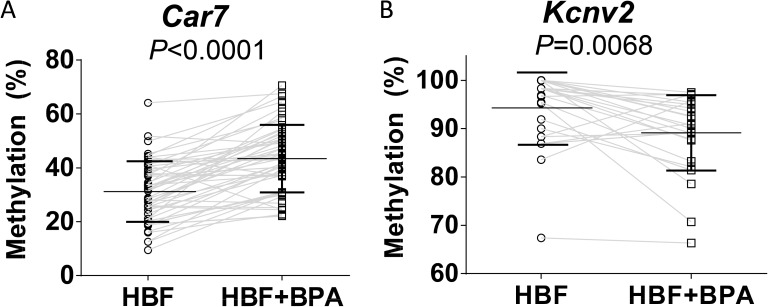
exposure to bisphenol A (BPA) increases mammary cancer susceptibility in offspring. High-fat diet is widely believed to be a risk factor of breast cancer. The objective of this study was to determine whether maternal exposure to BPA in addition to high-butterfat (HBF) intake during pregnancy further influences carcinogen-induced mammary cancer risk in offspring, and its dose-response curve. In this study, we found that gestational HBF intake in addition to a low-dose BPA (25 µg/kg BW/day) exposure increased mammary tumor incidence in a 50-day-of-age chemical carcinogen administration model and altered mammary gland morphology in offspring in a non-monotonic manner, while shortening tumor-free survival time compared with the HBF-alone group. HBF and BPA exposure elicited differential effects at the gene level in PND21 mammary glands through DNA methylation, compared with HBF intake in the absence of BPA. Top HBF + BPA-dysregulated genes (, , , , , and ) are associated with poor overall survival in The Cancer Genomic Atlas (TCGA) human breast cancer cohort ( = 1082). Furthermore, the prognostic power of the identified genes was further enhanced in the survival analysis of Caucasian patients with estrogen receptor-positive tumors. In conclusion, concurrent HBF dietary and a low-dose BPA exposure during pregnancy increases mammary tumor incidence in offspring, accompanied by alterations in mammary gland development and gene expression, and possibly through epigenetic reprogramming.
暴露于双酚A(BPA)会增加后代患乳腺癌的易感性。高脂饮食被广泛认为是乳腺癌的一个风险因素。本研究的目的是确定孕期母亲除了摄入高乳脂肪(HBF)外,再接触双酚A是否会进一步影响致癌物诱导的后代患乳腺癌的风险及其剂量反应曲线。在本研究中,我们发现,在50日龄化学致癌物给药模型中,孕期除了低剂量双酚A(25µg/kg体重/天)暴露外,摄入HBF会增加乳腺肿瘤发生率,并以非单调方式改变后代乳腺形态,同时与仅摄入HBF的组相比缩短无瘤生存时间。与在无双酚A情况下摄入HBF相比,HBF和双酚A暴露通过DNA甲基化在出生后21天(PND21)的乳腺中在基因水平上引发了不同的影响。HBF + 双酚A上调最明显的基因(、、、、、和)与癌症基因组图谱(TCGA)人类乳腺癌队列(n = 1082)中的总体生存率差相关。此外,在雌激素受体阳性肿瘤的白种人患者生存分析中,所鉴定基因的预后能力进一步增强。总之,孕期同时摄入HBF饮食和低剂量双酚A暴露会增加后代乳腺肿瘤发生率,伴有乳腺发育和基因表达的改变,并且可能通过表观遗传重编程实现。