Yuyama Kohei, Igarashi Yasuyuki
Laboratory of Biomembrane and Biofunctional Chemistry, Graduate School of Advanced Life Science, Hokkaido UniversitySapporo, Japan.
Front Neurosci. 2017 Apr 25;11:229. doi: 10.3389/fnins.2017.00229. eCollection 2017.
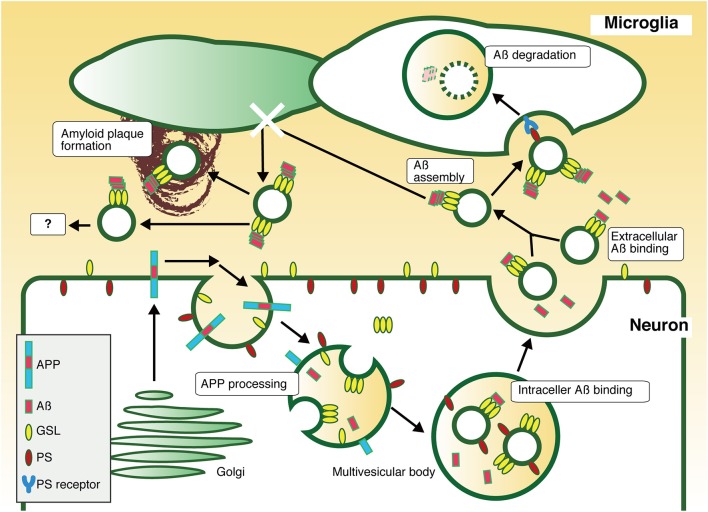
The intracerebral level of the aggregation-prone peptide, amyloid-ß (Aß), is constantly maintained by multiple clearance mechanisms, including several degradation enzymes, and brain efflux. Disruption of the clearance machinery and the resultant Aß accumulation gives rise to neurotoxic assemblies, leading to the pathogenesis of Alzheimer's disease (AD). In addition to the classic mechanisms of Aß clearance, the protein may be processed by secreted vesicles, although this possibility has not been extensively investigated. We showed that neuronal exosomes, a subtype of extracellular nanovesicles, enwrap, or trap Aß and transport it into microglia for degradation. Here, we review Aß sequestration and elimination by exosomes, and discuss how this clearance machinery might contribute to AD pathogenesis and how it might be exploited for effective AD therapy.
易聚集肽淀粉样β蛋白(Aβ)的脑内水平通过多种清除机制持续维持,这些机制包括几种降解酶和脑外流。清除机制的破坏以及由此导致的Aβ积累会产生神经毒性聚集体,从而引发阿尔茨海默病(AD)的发病机制。除了经典的Aβ清除机制外,该蛋白可能由分泌囊泡进行处理,尽管这种可能性尚未得到广泛研究。我们发现,神经元外泌体作为细胞外纳米囊泡的一种亚型,能够包裹或捕获Aβ,并将其转运至小胶质细胞进行降解。在此,我们综述外泌体对Aβ的隔离和清除,并讨论这种清除机制如何可能导致AD发病,以及如何利用它进行有效的AD治疗。