Department of Clinical Neuroscience, Karolinska Institutet, Berzelius Väg 3, Floor 6, SE-171 77, Stockholm, Sweden.
Institute of Health and Care Sciences, Sahlgrenska Academy, University of Gothenburg, Box 457, SE-405 30, Gothenburg, Sweden.
Eur J Health Econ. 2018 Apr;19(3):435-446. doi: 10.1007/s10198-017-0894-6. Epub 2017 May 9.
Multiple sclerosis (MS) causes work disability and healthcare resource use, but little is known about the distribution of the associated costs to society.
We estimated the cost of illness (COI) of working-aged individuals with MS, from the societal perspective, overall and in different groups.
A population-based study was conducted, using data linked from several nationwide registers, on 14,077 individuals with MS, aged 20-64 years and living in Sweden. Prevalence-based direct and indirect costs in 2010 were calculated, including costs for prescription drug use, specialized healthcare, sick leave, and disability pension.
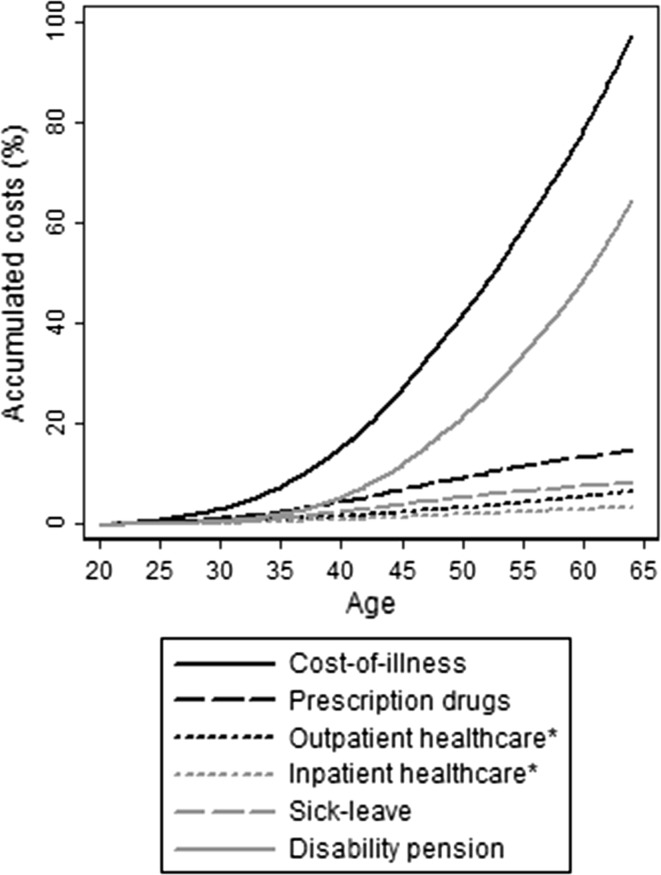
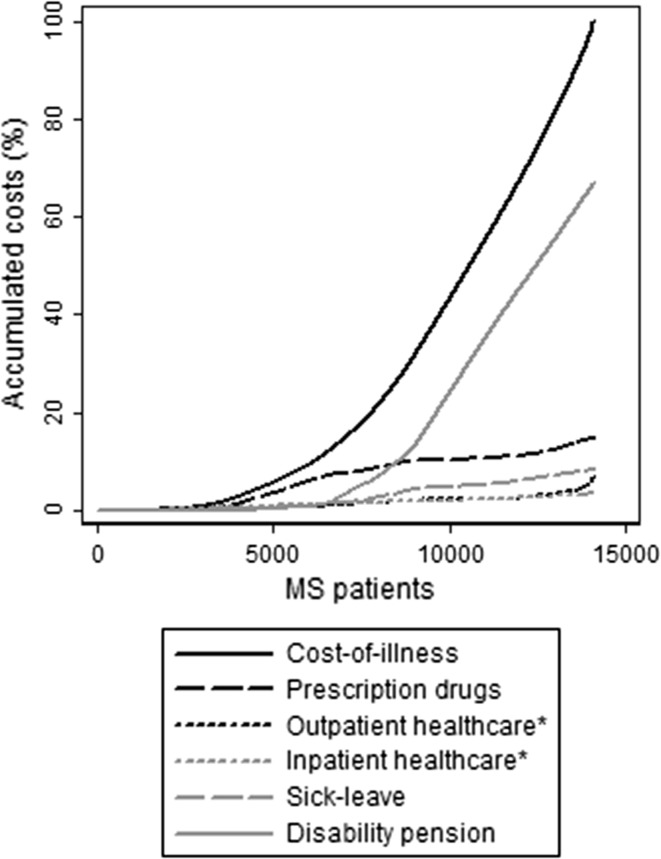
The estimated COI of all the MS patients were SEK 3950 million, of which 75% were indirect costs. MS was the main diagnosis for resource use, causing 38% of healthcare costs and 67% of indirect costs. The distribution of costs was skewed, in which less than 25% of the patients accounted for half the total COI.
Indirect costs contributed to approximately 75% of the estimated overall COI of MS patients of working age in Sweden. MS was the main diagnosis for more than half of the estimated COI in this patient group. Further studies are needed to gain knowledge on development of costs over time during the MS disease course.
多发性硬化症(MS)会导致工作能力丧失和医疗资源的使用,但对于其给社会带来的相关成本的分布情况却知之甚少。
我们从社会角度出发,评估了处于工作年龄段的多发性硬化症患者的疾病经济负担(COI),并对不同群体进行了分析。
这是一项基于人群的研究,使用了来自瑞典多个全国性登记处的数据链接,共纳入了 14077 名年龄在 20-64 岁之间、患有多发性硬化症的患者。我们计算了 2010 年基于患病率的直接和间接成本,包括处方药使用、专业医疗保健、病假和残疾抚恤金的费用。
所有多发性硬化症患者的估计 COI 为 39.50 亿瑞典克朗,其中 75%为间接成本。多发性硬化症是资源使用的主要诊断,导致 38%的医疗保健费用和 67%的间接成本。成本的分布呈偏态分布,其中不到 25%的患者占总 COI 的一半。
间接成本约占瑞典处于工作年龄段的多发性硬化症患者总体 COI 的 75%。多发性硬化症是该患者群体中超过一半估计 COI 的主要诊断。需要进一步的研究来了解多发性硬化症病程中成本随时间的发展情况。