School of Medicine and Public Health, University of Newcastle, New South Wales, Australia.
Department of Clinical Toxicology and Pharmacology, Calvary Mater Newcastle, Newcastle, New South Wales, Australia.
Br J Clin Pharmacol. 2017 Oct;83(10):2274-2282. doi: 10.1111/bcp.13326. Epub 2017 Jun 14.
Methadone is a widely used opioid agonist treatment associated with QT prolongation and torsades de pointes. We investigated the QT interval in patients treated with methadone or buprenorphine using continuous 12-lead Holter recordings.
We prospectively made 24-h Holter recordings in patients prescribed methadone or buprenorphine, compared to controls. After their normal dose a continuous 12-lead Holter recorder was attached for 24 h. Digital electrocardiograms were extracted hourly from the Holter recordings. The QT interval was measured automatically (H-scribe software, Mortara Pty Ltd) and checked manually. The QT interval was plotted against heart rate (HR) on the QT nomogram to determine abnormality. Demographics, dosing, medical history and laboratory investigations were recorded.
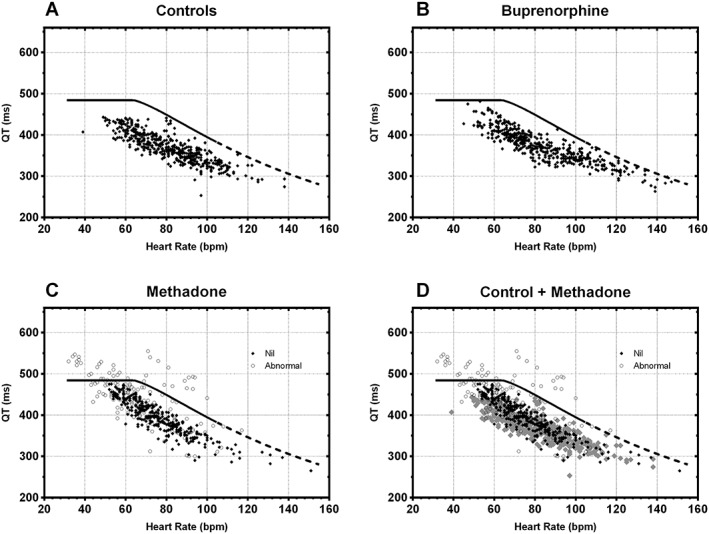
There were 58 patients (19 methadone, 20 buprenorphine and 19 control); median age 35 years (20-56 years); 33 males. Baseline characteristics were similar. Median dose of methadone was 110 mg day (70-170 mg day ) and buprenorphine was 16 mg day (12-32 mg day ). Seven participants had abnormal QT intervals. There was a significant difference in the proportion of prescribed methadone with abnormal QT intervals, 7/19 (37%; 95% confidence interval: 17-61%), compared to controls 0/19 (0%; 95% confidence interval: 0-21%; P = 0.008), but no difference between buprenorphine and controls (0/20). QT vs. HR plots showed patients prescribed methadone had higher QT-HR pairs over 24 h compared to controls. There was no difference in dose for patients prescribed methadone with abnormal QT intervals and those without.
Methadone is associated with prolonged QT intervals, but there was no association with dose. Buprenorphine did not prolong the QT interval. Twenty four-hour Holter recordings using the QT nomogram is a feasible method to assess the QT interval in patients prescribed methadone.
美沙酮是一种广泛使用的阿片类激动剂治疗药物,与 QT 间期延长和尖端扭转型室性心动过速有关。我们使用连续 12 导联 Holter 记录来研究接受美沙酮或丁丙诺啡治疗的患者的 QT 间期。
我们前瞻性地对接受美沙酮或丁丙诺啡治疗的患者进行了 24 小时 Holter 记录,并与对照组进行了比较。在他们的正常剂量后,连续 12 导联 Holter 记录器连接 24 小时。从 Holter 记录中每小时提取数字心电图。QT 间期使用 H-scribe 软件(Mortara Pty Ltd)自动测量并手动检查。将 QT 间期绘制在 QT 诺模图上,以确定异常情况。记录人口统计学、剂量、病史和实验室检查结果。
共有 58 名患者(19 名美沙酮、20 名丁丙诺啡和 19 名对照组);中位年龄 35 岁(20-56 岁);33 名男性。基线特征相似。美沙酮的中位剂量为 110mg/天(70-170mg/天),丁丙诺啡为 16mg/天(12-32mg/天)。7 名参与者的 QT 间期异常。服用美沙酮的患者中,QT 间期异常的比例显著高于对照组(7/19,37%;95%置信区间:17-61%),而丁丙诺啡与对照组之间无差异(0/20)。QT 与 HR 图显示,与对照组相比,服用美沙酮的患者在 24 小时内的 QT-HR 对更高。QT 间期异常和无异常的服用美沙酮的患者的剂量无差异。
美沙酮与 QT 间期延长有关,但与剂量无关。丁丙诺啡不会延长 QT 间期。使用 QT 诺模图的 24 小时 Holter 记录是评估服用美沙酮患者 QT 间期的一种可行方法。