Cui Shufang, Liao Xin, Ye Chao, Yin Xin, Liu Minghui, Hong Yeting, Yu Mengchao, Liu Yanqing, Liang Hongwei, Zhang Chen-Yu, Chen Xi
State Key Laboratory of Pharmaceutical Biotechnology, Collaborative Innovation Center of Chemistry for Life Sciences, Jiangsu Engineering Research Center for MicroRNA Biology and Biotechnology, NJU Advanced Institute for Life Sciences (NAILS), School of life sciences, Nanjing University, Nanjing, Jiangsu, 210046, China.
Beihai Marine Station, Evo-devo Institute, School of Life Sciences, Nanjing University, 22 Hankou Road, Nanjing, Jiangsu, 210093, China.
Mol Cancer. 2017 May 10;16(1):89. doi: 10.1186/s12943-017-0658-z.
The inhibitor of growth (ING) gene family of tumor suppressors is involved in multiple cellular functions such as cell cycle regulation, apoptosis, and chromatin remodeling. ING5 is a new member of the ING family whose function and regulation remain largely unknown.
Quantitative real-time PCR and western blot were used to examine the expression levels of ING5 in breast cancer tissues. The miRNAs that potentially targeted ING5 were determined by bioinformatics analysis and luciferase reporter assay. Cell viability assay, transwell invasion and apoptosis assay were used to characterize the changes induced by overexpressing or knocking down miR-24 or ING5. Hematoxylin and eosin (H&E) staining and immunohistochemical staining for ING5 and Ki-67 were used for xenograft assays in BALB/c nude mice.
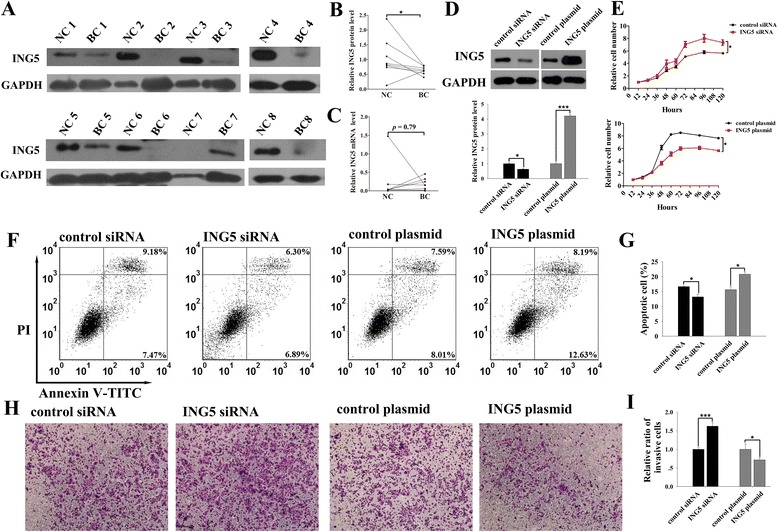
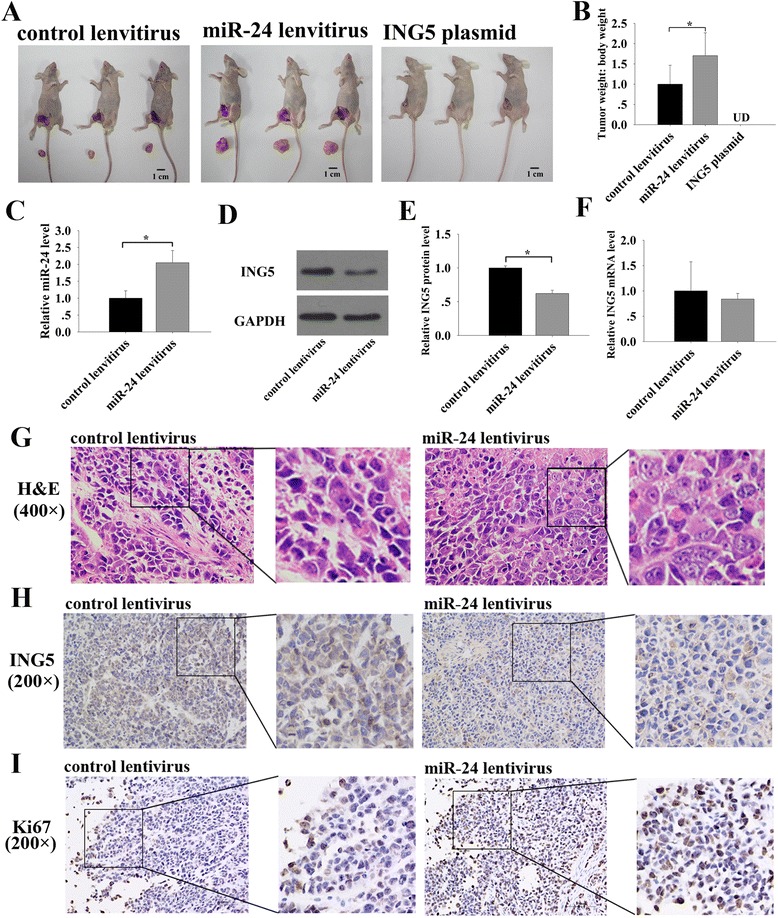
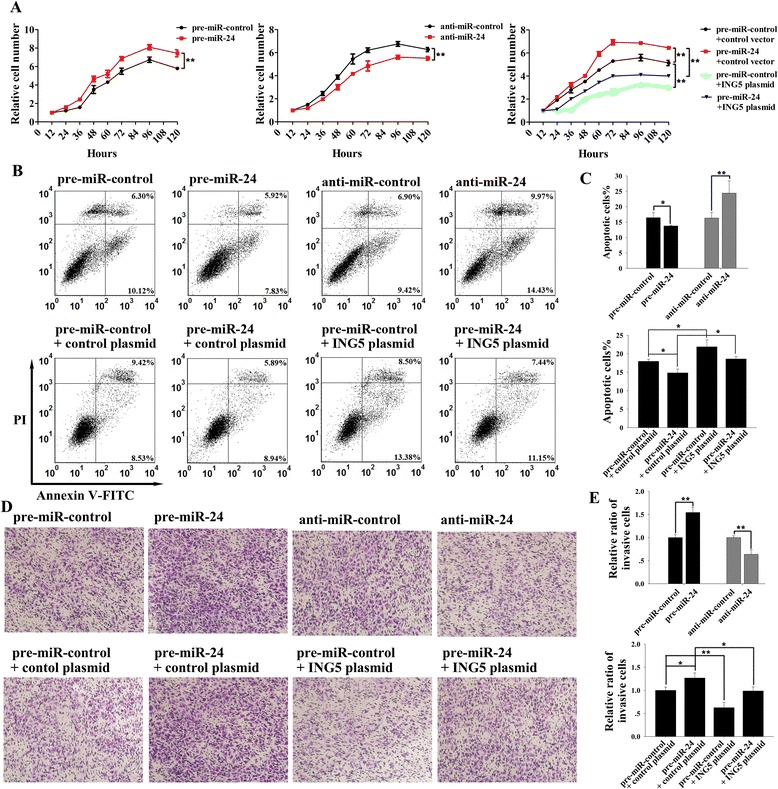
We showed that the ING5 protein rather than the mRNA, was significantly downregulated in breast cancer tissues. We also investigated the potential function of ING5 in breast tumorigenesis and found that ING5 suppressed the proliferation and invasion of breast cancer cells and promoted their apoptosis. Furthermore, we explored the molecular mechanisms accounting for the dysregulation of ING5 in breast cancer cells and identified an oncomiR, miR-24, as a direct upstream regulator of ING5. We revealed that miR-24 had the opposite effects to those of ING5 on breast cancer cells and could accelerate xenografted tumor growth in vivo.
Our findings uncover the tumor-suppressive role of ING5 and the regulatory pathway of ING5 in breast cancer and may provide insights into the molecular mechanisms of breast carcinogenesis.
肿瘤抑制因子生长抑制(ING)基因家族参与多种细胞功能,如细胞周期调控、细胞凋亡和染色质重塑。ING5是ING家族的新成员,其功能和调控在很大程度上仍不清楚。
采用定量实时PCR和蛋白质印迹法检测乳腺癌组织中ING5的表达水平。通过生物信息学分析和荧光素酶报告基因检测确定可能靶向ING5的微小RNA(miRNA)。采用细胞活力检测、Transwell侵袭实验和细胞凋亡检测来表征过表达或敲低miR-24或ING5所诱导的变化。苏木精-伊红(H&E)染色以及ING5和Ki-67的免疫组化染色用于BALB/c裸鼠的异种移植实验。
我们发现,乳腺癌组织中ING5蛋白而非mRNA显著下调。我们还研究了ING5在乳腺肿瘤发生中的潜在功能,发现ING5抑制乳腺癌细胞的增殖和侵袭并促进其凋亡。此外,我们探讨了乳腺癌细胞中ING5失调的分子机制,并确定了一种致癌miRNA,即miR-24,作为ING5的直接上游调节因子。我们发现miR-24对乳腺癌细胞的作用与ING5相反,并且可以加速体内异种移植肿瘤的生长。
我们的研究结果揭示了ING5在乳腺癌中的肿瘤抑制作用及其调控途径,可能为乳腺癌发生的分子机制提供见解。