Bonati Ulrike, Holiga Štefan, Hellbach Nicole, Risterucci Céline, Bergauer Tobias, Tang Wakana, Hafner Patricia, Thoeni Alain, Bieri Oliver, Gerlach Irene, Marquet Anne, Khwaja Omar, Sambataro Fabio, Bertolino Alessandro, Dukart Juergen, Fischmann Arne, Fischer Dirk, Czech Christian
Division of Neuropediatrics University of Basel Children's Hospital Spitalstrasse 334056 Basel Switzerland.
Department of Neurology University of Basel Hospital Petersgraben 44031 Basel Switzerland.
Ann Clin Transl Neurol. 2017 Apr 11;4(5):292-304. doi: 10.1002/acn3.406. eCollection 2017 May.
Recent advances in understanding Spinal Muscular Atrophy (SMA) etiopathogenesis prompted development of potent intervention strategies and raised need for sensitive outcome measures capable of assessing disease progression and response to treatment. Several biomarkers have been proposed; nevertheless, no general consensus has been reached on the most feasible ones. We observed a wide range of measures over 1 year to assess their ability to monitor the disease status and progression.
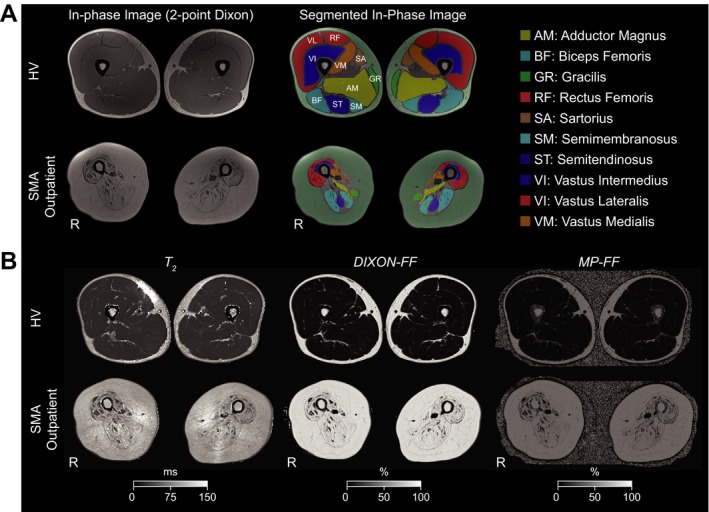
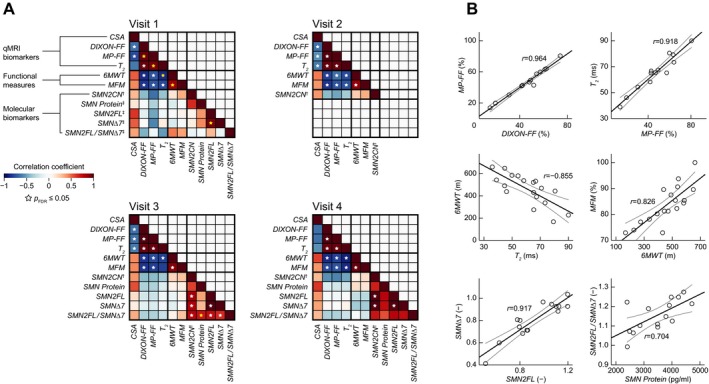
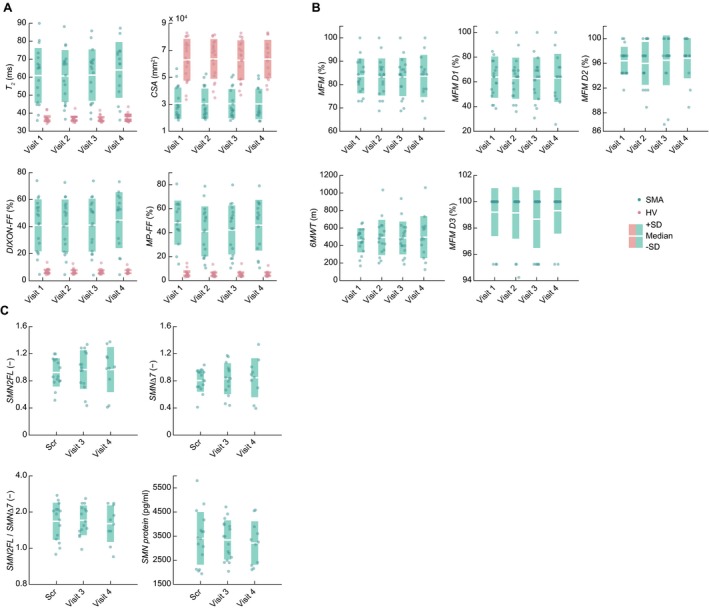
18 SMA patients and 19 healthy volunteers (HV) were followed in this 52-weeks observational study. Quantitative-MRI (qMRI) of both thighs and clinical evaluation of motor function was performed at baseline, 6, 9 and 12 months follow-up. Blood samples were taken in patients for molecular characterization at screening, 9 and 12 month follow-up. Progression, responsiveness and reliability of collected indices were quantified. Correlation analysis was performed to test for potential associations.
QMRI indices, clinical scales and molecular measures showed high to excellent reliability. Significant differences were found between qMRI of SMA patients and HV. Significant associations were revealed between multiple qMRI measures and functional clinical scales. None of the qMRI, clinical, or molecular measures was able to detect significant disease progression over 1 year.
We probed a variety of quantitative measures for SMA in a slowly-progressing disease population over 1 year. The presented measures demonstrated potential to provide a closer link to underlying disease biology as compared to conventional functional scales. The proposed biomarker framework can guide implementation of more sensitive endpoints in future clinical trials and prove their utility in search for novel disease-modifying therapies.
在脊髓性肌萎缩症(SMA)病因发病机制的理解方面取得的最新进展促使了有效干预策略的发展,并引发了对能够评估疾病进展和治疗反应的敏感结局指标的需求。已经提出了几种生物标志物;然而,对于最可行的生物标志物尚未达成普遍共识。我们在1年多的时间里观察了广泛的指标,以评估它们监测疾病状态和进展的能力。
在这项为期52周的观察性研究中,对18名SMA患者和19名健康志愿者(HV)进行了随访。在基线、随访6个月、9个月和12个月时,对双侧大腿进行定量磁共振成像(qMRI),并对运动功能进行临床评估。在筛查时、随访9个月和12个月时采集患者的血样进行分子特征分析。对收集到的指标的进展、反应性和可靠性进行了量化。进行相关性分析以测试潜在关联。
qMRI指标、临床量表和分子测量显示出高至极佳的可靠性。SMA患者和HV的qMRI之间存在显著差异。多种qMRI测量与功能性临床量表之间存在显著关联。在1年多的时间里,qMRI、临床或分子测量均未能检测到明显的疾病进展。
我们在一个疾病进展缓慢的人群中对SMA的多种定量指标进行了为期1年的研究。与传统功能量表相比,所呈现的指标显示出与潜在疾病生物学更紧密联系的潜力。所提出的生物标志物框架可指导在未来临床试验中实施更敏感的终点,并证明它们在寻找新型疾病修饰疗法中的效用。