Department of Pediatrics, Columbia University, New York, New York; Mailman School Public Health, Columbia University, New York, New York; NewYork Presbyterian Hospital, New York, New York.
Immunization Safety Office, Centers for Disease Control and Prevention, Atlanta, Georgia.
Am J Prev Med. 2017 Sep;53(3):282-289. doi: 10.1016/j.amepre.2017.03.014. Epub 2017 May 8.
The feasibility and accuracy of text messaging to monitor events after influenza vaccination throughout pregnancy and the neonatal period has not been studied, but may be important for seasonal and pandemic influenza vaccines and future maternal vaccines.
This prospective observational study was conducted during 2013-2014 and analyzed in 2015-2016. Enrolled pregnant women receiving inactivated influenza vaccination at a gestational age <20 weeks were sent text messages intermittently through participant-reported pregnancy end to request fever, health events, and neonatal outcomes. Text message response rates, Day 0-2 fever (≥100.4°F), health events, and birth/neonatal outcomes were assessed.
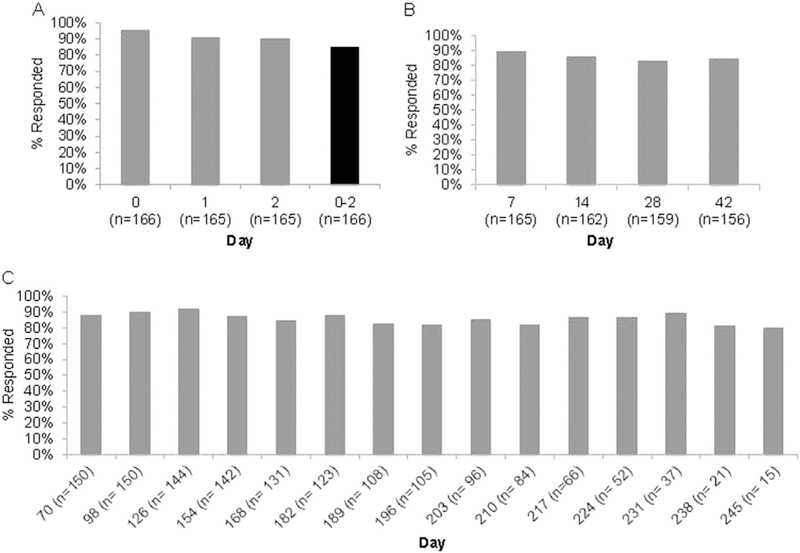
Most (80.2%, n=166) eligible women enrolled. Median gestational age was 8.9 (SD=3.9) weeks at vaccination. Response rates remained high (80.0%-95.2%). Only one Day 0-2 fever was reported. Women reported via text both pregnancy- and non-pregnancy-specific health events, not all associated with medical visits. Most pregnancy-specific events in the electronic medical record (EMR) were reported via text message. Of all enrollees, 84.9% completed the study (131 reported live birth, ten reported pregnancy loss). Two losses reported via text were not medically attended; there was one additional EMR-identified loss. Gestational age and weight at birth were similar between text message-reported and EMR-abstracted data and 95% CIs were overlapping for proportions of prematurity, low birth weight, small for gestational age, and major birth defects, as identified by text message-reported versus EMR-abstracted plus text message-reported versus EMR-abstracted data only.
This study demonstrated the feasibility of text messaging for influenza vaccine safety surveillance sustained throughout pregnancy. In these women receiving inactivated influenza vaccination during pregnancy, post-vaccination fever was infrequent and a typical pattern of maternal and neonatal health outcomes was observed.
尚未研究通过短信监测流感疫苗接种后孕妇和新生儿期事件的可行性和准确性,但对于季节性和大流行流感疫苗以及未来的孕产妇疫苗可能很重要。
本前瞻性观察性研究于 2013-2014 年进行,并于 2015-2016 年进行分析。在妊娠<20 周时,向接受灭活流感疫苗接种的孕妇发送间歇性短信,要求报告发热、健康事件和新生儿结局。评估短信回复率、第 0-2 天发热(≥100.4°F)、健康事件和分娩/新生儿结局。
大多数(80.2%,n=166)符合条件的孕妇入组。接种疫苗时的中位妊娠龄为 8.9(SD=3.9)周。回复率保持较高(80.0%-95.2%)。仅报告了一例第 0-2 天发热。女性通过短信报告了妊娠和非妊娠特异性健康事件,并非所有事件都与就诊有关。电子病历(EMR)中报告的大多数妊娠特异性事件都通过短信报告。所有入组者中,84.9%完成了研究(131 例报告活产,10 例报告妊娠丢失)。通过短信报告的两次丢失未进行医学随访;EMR 还识别出一次额外的丢失。短信报告与 EMR 摘录数据之间的出生时胎龄和体重相似,并且通过短信报告与 EMR 摘录加短信报告与 EMR 摘录数据仅报告的早产儿、低出生体重儿、小于胎龄儿和重大出生缺陷的比例的 95%CI 重叠。
本研究证明了通过短信进行流感疫苗安全性监测贯穿整个妊娠的可行性。在这些孕妇中,接种灭活流感疫苗后发热少见,观察到了典型的母婴健康结局模式。