Bangerter Abi, Ness Seth, Aman Michael G, Esbensen Anna J, Goodwin Matthew S, Dawson Geraldine, Hendren Robert, Leventhal Bennett, Khan Anzalee, Opler Mark, Harris Adrianne, Pandina Gahan
1 Janssen Research & Development, LLC , Titusville, New Jersey.
2 The Nisonger Center University Center for Excellence in Developmental Disabilities (UCEDD), Ohio State University , Columbus, Ohio.
J Child Adolesc Psychopharmacol. 2017 Nov;27(9):814-822. doi: 10.1089/cap.2017.0018. Epub 2017 May 12.
Autism Behavior Inventory (ABI) is a new measure for assessing changes in core and associated symptoms of autism spectrum disorder (ASD) in participants (ages: 3 years-adulthood) diagnosed with ASD. It is a web-based tool with five domains (two ASD core domains: social communication, restrictive and repetitive behaviors; three associated domains: mental health, self-regulation, and challenging behavior). This study describes design, development, and initial psychometric properties of the ABI.
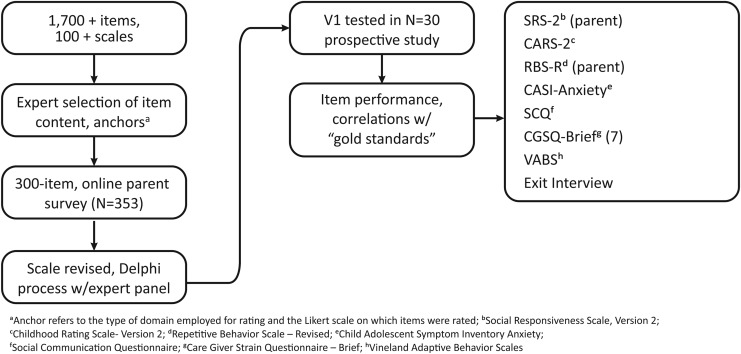
ABI items were generated following review of existing measures and inputs from expert clinicians. Initial ABI scale contained 161 items that were reduced to fit a factor analytic model, retaining items of adequate reliability. Two versions of the scale, ABI-full (ABI-F; 93 items) and ABI-short version (ABI-S; 36 items), were developed and evaluated for psychometric properties, including validity comparisons with commonly used measures. Both scales were administered to parents and healthcare professionals (HCPs) involved with study participants.
Test-retest reliability (intraclass correlation coefficient [ICC] = 0.79) for parent ratings on ABI was robust and compared favorably to existing scales. Test-retest correlations for HCP ratings were generally lower versus parent ratings. ABI core domains and comparison measures strongly correlated (r ≥ 0.70), demonstrating good concurrent validity.
Overall, ABI demonstrates promise as a tool for measuring change in core symptoms of autism in ASD clinical studies, with further validation required.
自闭症行为量表(ABI)是一种用于评估被诊断为自闭症谱系障碍(ASD)的参与者(年龄范围:3岁至成年)核心及相关症状变化的新测量工具。它是一个基于网络的工具,有五个领域(两个ASD核心领域:社交沟通、局限重复行为;三个相关领域:心理健康、自我调节和挑战性行为)。本研究描述了ABI的设计、开发及初步心理测量学特性。
ABI条目是在回顾现有测量工具并纳入专家临床医生的意见后生成的。最初的ABI量表包含161个条目,经过简化以符合因素分析模型,保留了具有足够信度的条目。开发了该量表的两个版本,即完整版ABI(ABI-F;93个条目)和简版ABI(ABI-S;36个条目),并对其心理测量学特性进行评估,包括与常用测量工具的效度比较。两个版本的量表均施测于参与研究的参与者的父母和医疗保健专业人员(HCPs)。
父母对ABI评分的重测信度(组内相关系数[ICC]=0.79)很强,与现有量表相比具有优势。HCP评分的重测相关性总体上低于父母评分。ABI核心领域与对照测量工具高度相关(r≥0.70),显示出良好的同时效度。
总体而言,ABI作为一种在ASD临床研究中测量自闭症核心症状变化的工具显示出应用前景,但仍需进一步验证。