Weilnhammer Veith, Stuke Heiner, Hesselmann Guido, Sterzer Philipp, Schmack Katharina
Department of Psychiatry, Charité Universitätsmedizin Berlin, 10117 Berlin, Germany.
Bernstein Center for Computational Neuroscience, Charité Universitätsmedizin Berlin, 10117 Berlin, Germany.
PLoS Comput Biol. 2017 May 15;13(5):e1005536. doi: 10.1371/journal.pcbi.1005536. eCollection 2017 May.
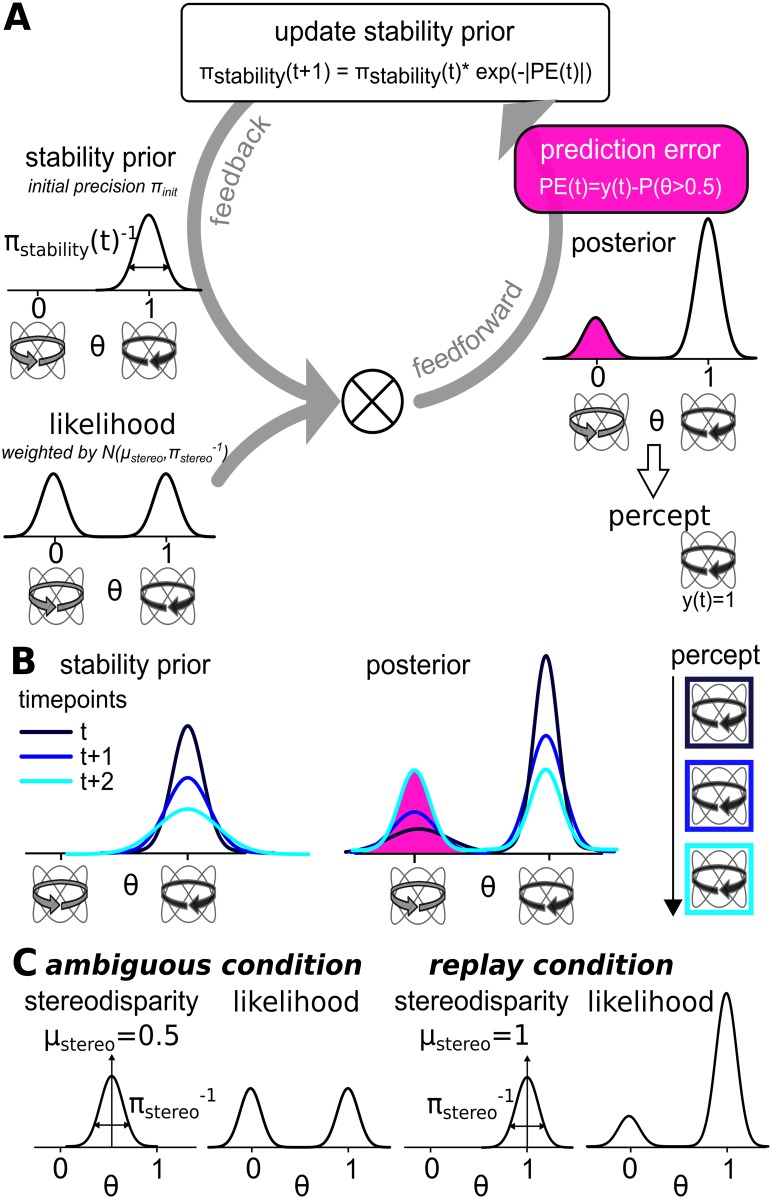
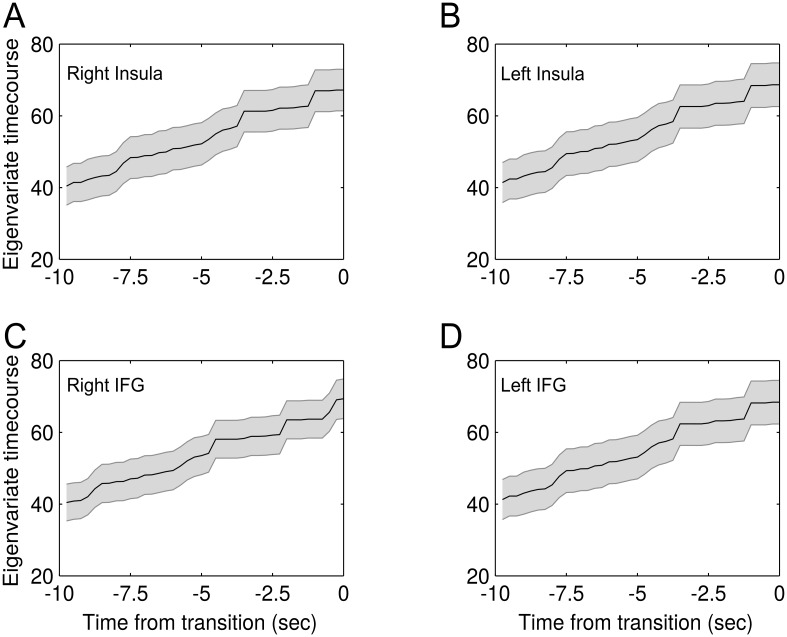
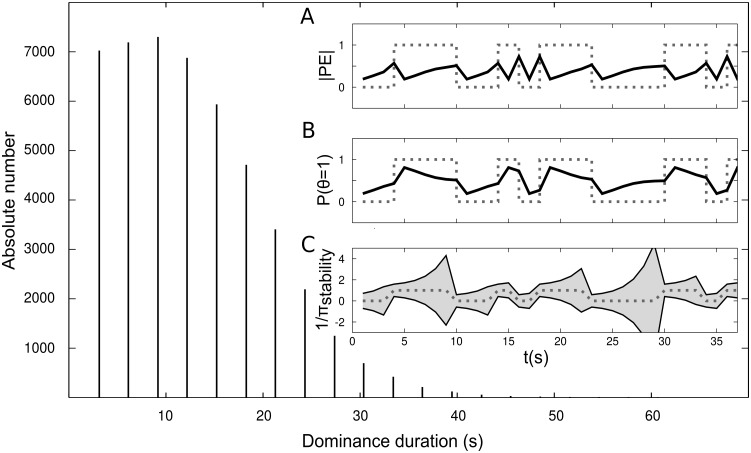
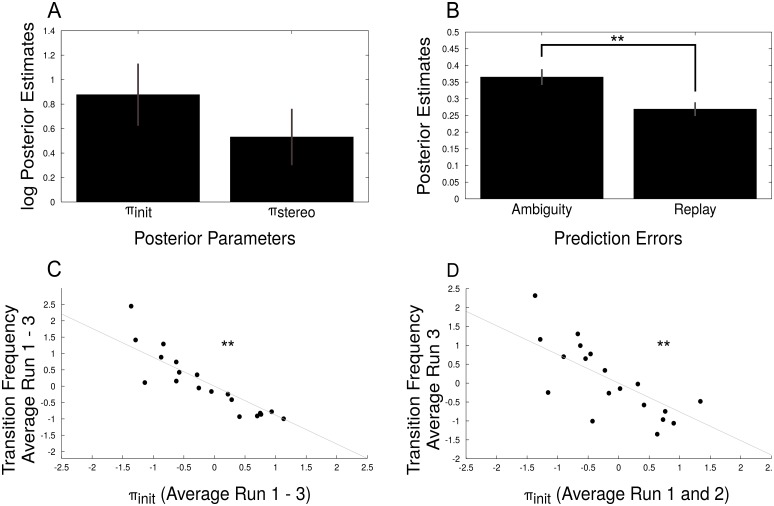
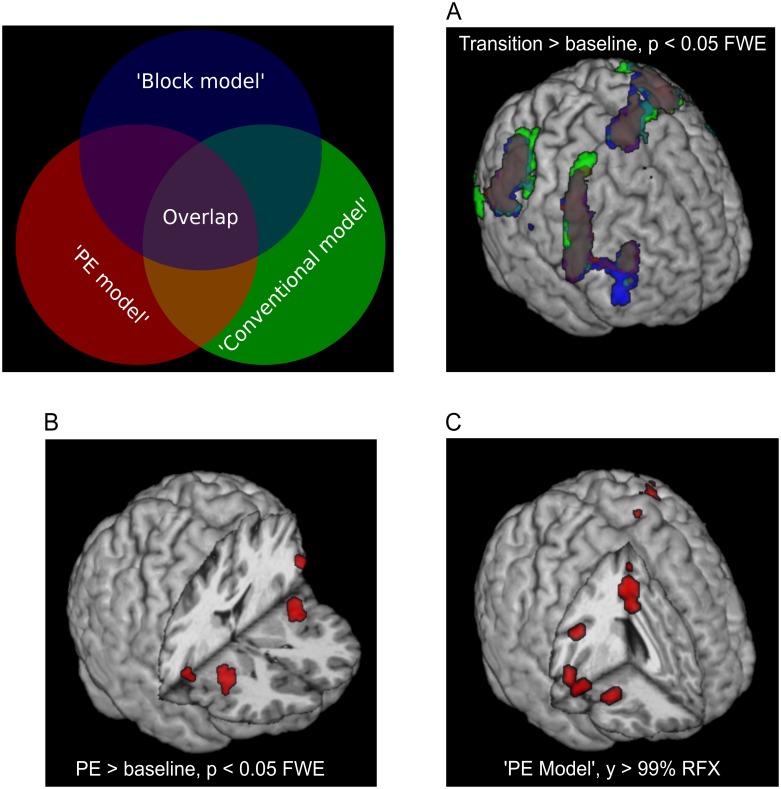
In bistable vision, subjective perception wavers between two interpretations of a constant ambiguous stimulus. This dissociation between conscious perception and sensory stimulation has motivated various empirical studies on the neural correlates of bistable perception, but the neurocomputational mechanism behind endogenous perceptual transitions has remained elusive. Here, we recurred to a generic Bayesian framework of predictive coding and devised a model that casts endogenous perceptual transitions as a consequence of prediction errors emerging from residual evidence for the suppressed percept. Data simulations revealed close similarities between the model's predictions and key temporal characteristics of perceptual bistability, indicating that the model was able to reproduce bistable perception. Fitting the predictive coding model to behavioural data from an fMRI-experiment on bistable perception, we found a correlation across participants between the model parameter encoding perceptual stabilization and the behaviourally measured frequency of perceptual transitions, corroborating that the model successfully accounted for participants' perception. Formal model comparison with established models of bistable perception based on mutual inhibition and adaptation, noise or a combination of adaptation and noise was used for the validation of the predictive coding model against the established models. Most importantly, model-based analyses of the fMRI data revealed that prediction error time-courses derived from the predictive coding model correlated with neural signal time-courses in bilateral inferior frontal gyri and anterior insulae. Voxel-wise model selection indicated a superiority of the predictive coding model over conventional analysis approaches in explaining neural activity in these frontal areas, suggesting that frontal cortex encodes prediction errors that mediate endogenous perceptual transitions in bistable perception. Taken together, our current work provides a theoretical framework that allows for the analysis of behavioural and neural data using a predictive coding perspective on bistable perception. In this, our approach posits a crucial role of prediction error signalling for the resolution of perceptual ambiguities.
在双稳态视觉中,主观感知在对持续存在的模糊刺激的两种解释之间波动。这种意识感知与感觉刺激之间的分离激发了关于双稳态感知神经关联的各种实证研究,但内源性感知转换背后的神经计算机制仍然难以捉摸。在这里,我们采用了预测编码的通用贝叶斯框架,并设计了一个模型,将内源性感知转换视为因被抑制感知的残余证据产生的预测误差的结果。数据模拟显示该模型的预测与感知双稳态的关键时间特征之间有密切相似性,表明该模型能够重现双稳态感知。将预测编码模型与关于双稳态感知的功能磁共振成像实验的行为数据进行拟合,我们发现参与者之间,编码感知稳定性的模型参数与行为测量的感知转换频率之间存在相关性,证实该模型成功解释了参与者的感知。基于相互抑制和适应、噪声或适应与噪声组合的双稳态感知既定模型进行形式化模型比较,用于将预测编码模型与既定模型进行验证。最重要的是,基于模型的功能磁共振成像数据分析表明,从预测编码模型得出的预测误差时间进程与双侧额下回和前脑岛的神经信号时间进程相关。体素级模型选择表明,在解释这些额叶区域的神经活动方面,预测编码模型优于传统分析方法,这表明额叶皮层编码介导双稳态感知中内源性感知转换的预测误差。综上所述,我们目前的工作提供了一个理论框架,允许从预测编码角度分析双稳态感知的行为和神经数据。在此,我们的方法假定预测误差信号在解决感知模糊性方面起着关键作用。