
探索层状铁电 KNbO 纳米晶薄膜和纳米层片的光电性质及其机制。
Exploring optoelectronic properties and mechanisms of layered ferroelectric KNbO nanocrystalline films and nanolaminas.
机构信息
Technical Center for Multifunctional Magneto-Optical Spectroscopy (ECNU), Shanghai, China.
Department of Electronic Engineering, East China Normal University, Shanghai, 200241, China.
出版信息
Sci Rep. 2017 May 15;7(1):1883. doi: 10.1038/s41598-017-01838-6.
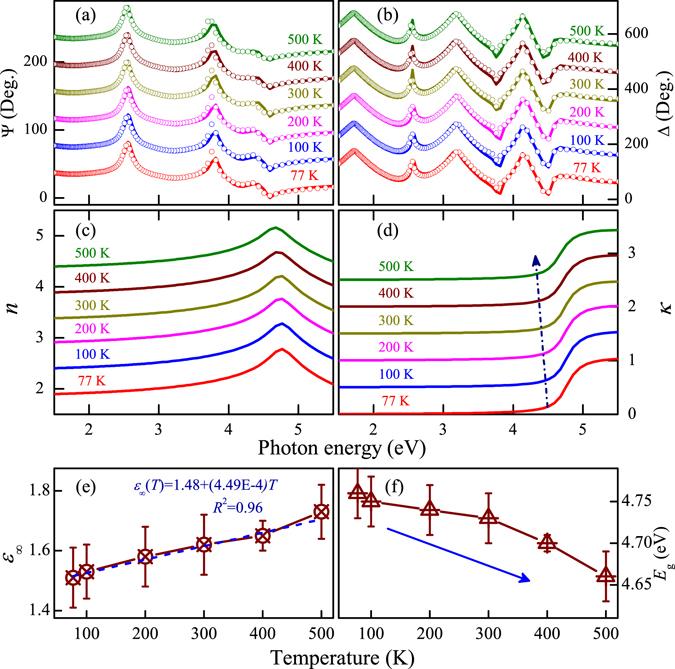
Two-dimensional layered KNbO (KN) was easily formed as a secondary phase caused by the volatilization of alkali metal ions, when preparing ferroelectric K Na NbO based ceramics and films. In this work, it was believed that KN film is with weak ferroelectricity and has a little effect on the ferroelectric properties of K Na NbO based films. Moreover, temperature dependent (77-500 K) dielectric functions of KN film have been firstly extracted by fitting ellipsometric spectra with the Adachi dielectric function model and a four-phase layered model. The high-frequency dielectric constant linearly increases and optical band gap slightly decreases with increasing the temperature. We also research its photoelectrochemical properties and its application in high-efficient light-induced H evolution. In addition, X-ray photoelectron spectroscopy, Raman scattering, temperature dependent transmittance and infrared reflectance spectra, and first-principles calculation were conjointly performed to further reveal the intrinsic optoelectronic features and relevant mechanisms of KN.
在制备铁电 K Na NbO 基陶瓷和薄膜的过程中,由于碱金属离子的挥发,很容易形成二维层状 KNbO(KN)作为次要相。在这项工作中,我们认为 KN 薄膜具有较弱的铁电性,对 K Na NbO 基薄膜的铁电性能影响不大。此外,我们还首次通过使用 Adachi 介电函数模型和四相分层模型拟合椭圆偏振光谱,提取了 KN 薄膜的温度相关(77-500 K)介电函数。随着温度的升高,高频介电常数呈线性增加,光学带隙略有减小。我们还研究了其光电化学性能及其在高效光诱导 H 2 演化中的应用。此外,我们还联合使用了 X 射线光电子能谱、拉曼散射、温度相关透射率和红外反射率光谱以及第一性原理计算,进一步揭示了 KN 的本征光电特性和相关机制。



 Zotero 插件