Kovac Jasna, Cummings Kevin J, Rodriguez-Rivera Lorraine D, Carroll Laura M, Thachil Anil, Wiedmann Martin
Department of Food Science, Cornell University, IthacaNY, USA.
Department of Veterinary Integrative Biosciences, Texas A&M University, College StationTX, USA.
Front Microbiol. 2017 May 1;8:737. doi: 10.3389/fmicb.2017.00737. eCollection 2017.
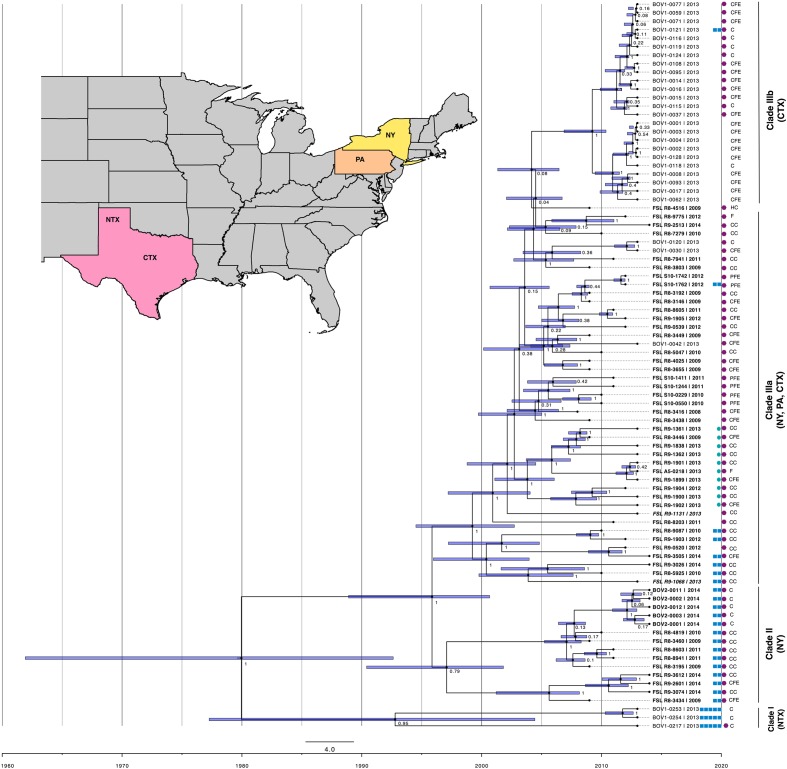
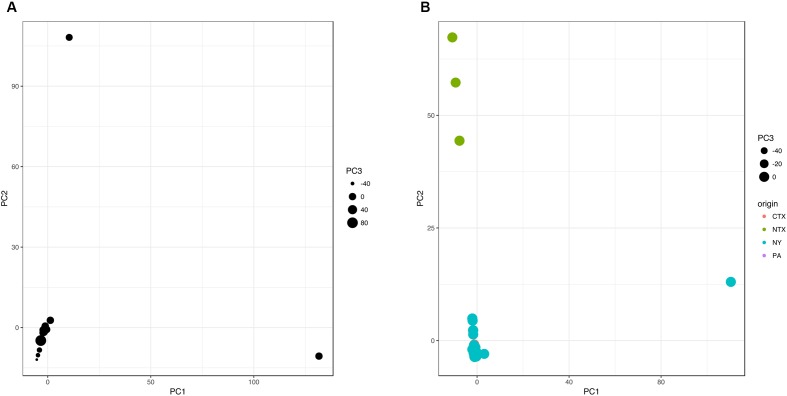
Cerro has become one of the most prevalent serotypes isolated from dairy cattle in several U.S. states, including New York where it represented 36% of all isolates of bovine origin in 2015. This serotype is commonly isolated from dairy cattle with clinical signs of salmonellosis, including diarrhea and fever, although it has also been identified in herds without evidence of clinical disease or decreased production. To better understand the transmission patterns and drivers of its geographic spread, we have studied the genomic similarity and microevolution of Cerro isolates from the northeast U.S. and Texas. Eighty-three out of 86 isolates were confirmed as multilocus sequence type 367. We identified core genome SNPs in 57 upstate New York (NY), 2 Pennsylvania (PA), and 27 Texas Cerro isolates from dairy cattle, farm environments, raw milk, and one human clinical case and used them to construct a tip-dated phylogeny. Cerro isolates clustered in three distinct clades, including (i) clade I ( = 3; 2013) comprising isolates from northwest Texas (NTX), (ii) clade II ( = 14; 2009-2011, 2014) comprising isolates from NY, and (iii) clade III comprising isolates from NY, PA, and central Texas (CTX) in subclade IIIa ( = 45; 2008-2014), and only CTX isolates in subclade IIIb ( = 24; 2013). Temporal phylogenetic analysis estimated the divergence of these three clades from the most recent common ancestor in approximately 1980. The CTX clade IIIb was estimated to have evolved and diverged from the NY ancestor around 2004. Furthermore, gradual temporal loss of genes encoding a D-alanine transporter, involved in virulence, was observed. These genes were present in the isolates endemic to NTX clade I and were gradually lost in clades II and III. The virulence gene , which is part of the Pathogenicity Island 1, was lost in a subgroup of Texas isolates in clades I and IIIb. All Cerro isolates had an additional cytosine inserted in a cytosine-rich region of the virulence gene , resulting in premature termination of translation likely responsible for loss of pathogenic capacity in humans. A group of closely related NY isolates was characterized by the loss of hydrogen sulfide production due to the truncation or complete loss of . Our data suggest the ability of to rapidly diverge and adapt to specific niches (e.g., bovine niche), and to modify virulence-related characteristics such as the ability to utilize tetrathionate as an alternative electron acceptor, which is commonly used to detect . Overall, our results show that clinical outcome data and genetic data for Cerro isolates, such as truncations in virulence genes leading to novel pheno- and pathotypes, should be correlated to allow for accurate risk assessment.
塞罗血清型已成为美国几个州从奶牛中分离出的最常见血清型之一,包括纽约州,在2015年该血清型占所有牛源分离株的36%。这种血清型通常从有沙门氏菌病临床症状(包括腹泻和发热)的奶牛中分离得到,不过在没有临床疾病证据或生产下降迹象的牛群中也有发现。为了更好地了解其传播模式和地理扩散驱动因素,我们研究了来自美国东北部和得克萨斯州的塞罗分离株的基因组相似性和微观进化。86株分离株中有83株被确认为多位点序列类型367。我们在来自纽约州北部(NY)的57株、宾夕法尼亚州(PA)的2株以及得克萨斯州的27株奶牛、农场环境、生牛奶和1例人类临床病例的塞罗分离株中鉴定出核心基因组单核苷酸多态性(SNP),并利用它们构建了带时间标记的系统发育树。塞罗分离株聚为三个不同的分支,包括:(i)分支I(n = 3;2013年),包含来自得克萨斯州西北部(NTX)的分离株;(ii)分支II(n = 14;2009 - 2011年、2014年),包含来自纽约州的分离株;(iii)分支III,在亚分支IIIa(n = 45;2008 - 2014年)中包含来自纽约州、宾夕法尼亚州和得克萨斯州中部(CTX)的分离株,而在亚分支IIIb(n = 24;2013年)中仅包含来自CTX的分离株。时间系统发育分析估计这三个分支从最近共同祖先的分歧时间约在1980年。估计CTX分支IIIb大约在2004年从纽约州的祖先进化并分歧出来。此外,观察到与毒力相关的编码D - 丙氨酸转运蛋白的基因随时间逐渐丢失。这些基因存在于NTX分支I的地方流行分离株中,在分支II和III中逐渐丢失。作为致病岛1一部分的毒力基因spvC在分支I和IIIb的得克萨斯州分离株亚组中丢失。所有塞罗分离株在毒力基因spvB的富含胞嘧啶区域额外插入了一个胞嘧啶,导致翻译提前终止,这可能是其对人类致病能力丧失的原因。一组密切相关的纽约州分离株的特征是由于ttr基因截断或完全缺失而失去了产生硫化氢的能力。我们的数据表明塞罗血清型有能力快速分化并适应特定生态位(如牛的生态位),并改变与毒力相关的特征,如利用连四硫酸盐作为替代电子受体的能力,连四硫酸盐常用于检测沙门氏菌。总体而言,我们的结果表明,塞罗分离株的临床结果数据和遗传数据,如毒力基因截断导致新的表型和致病型,应相互关联以进行准确的风险评估。