Köckerling Ferdinand, Schug-Pass Christine
Department of Surgery, Center for Minimally Invasive Surgery, Academic Teaching Hospital of Charité Medical School, Vivantes Hospital, Berlin, Germany.
Front Surg. 2017 May 1;4:22. doi: 10.3389/fsurg.2017.00022. eCollection 2017.
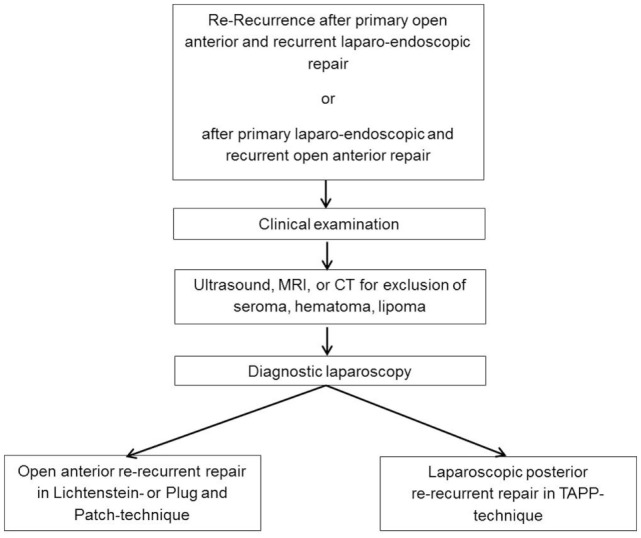
The guidelines of the international hernia societies recommend posterior repair in laparo-endoscopic technique for recurrent inguinal hernia after open anterior mesh repair and, conversely, open anterior repair for recurrence after laparo-endoscopic primary repair. Even when these guidelines are followed, already 1 year after repair a re-recurrence rate of 1-2% must be expected, with that rate rising further in the subsequent years. Accordingly, increasingly more patients with re-recurrence after anterior and posterior mesh implantation must be treated, which constitutes a problem that to date has been investigated in only very few studies. Hence, there are no well-founded recommendations. This paper now presents a number of case reports aimed at identifying the role of explorative laparoscopy as decision tool for re-recurrent inguinal hernia treatment.
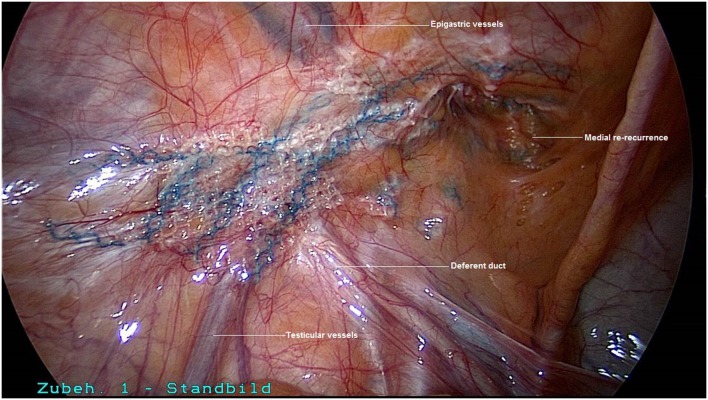
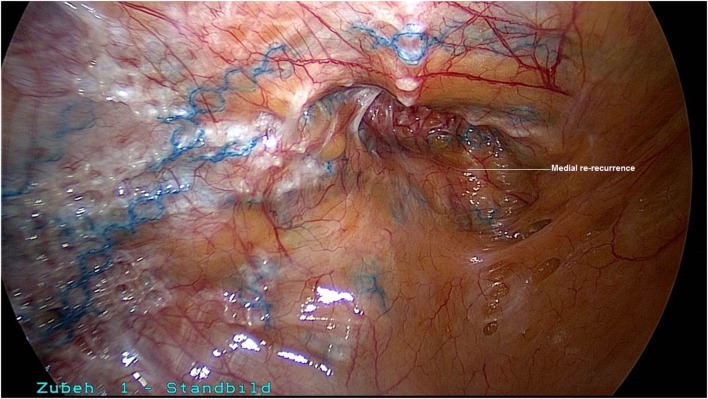
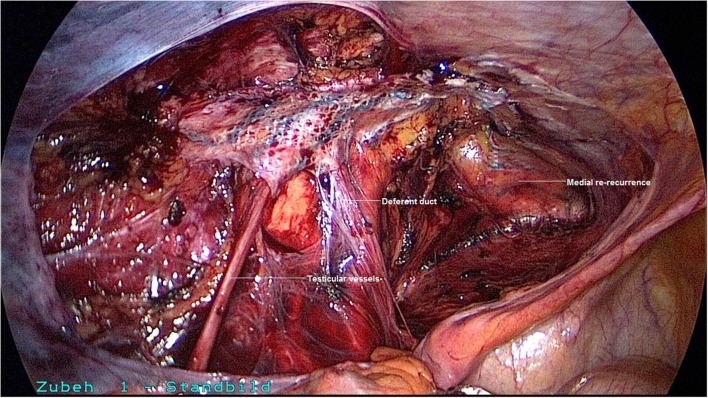
Based on three case reports the role of explorative laparoscopy as decision tool for re-recurrent inguinal hernia treatment is presented below.
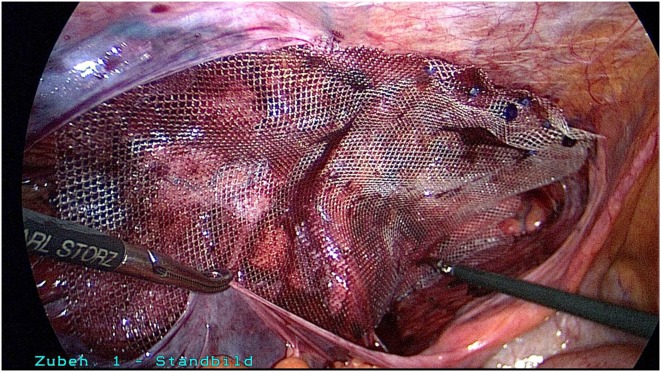
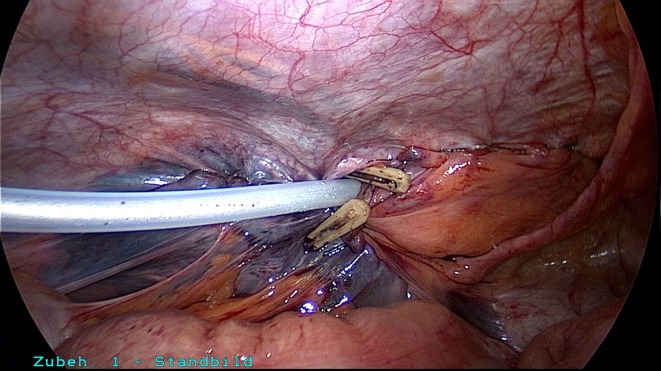
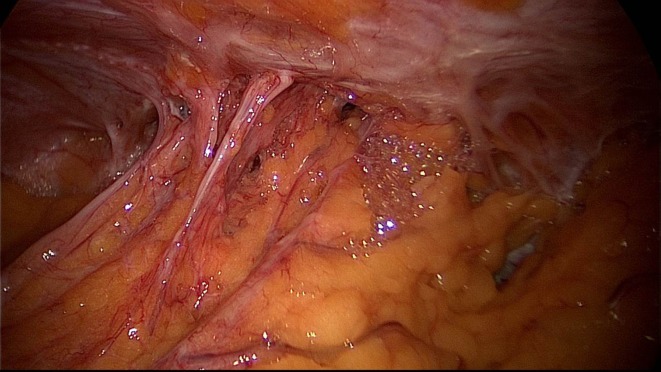
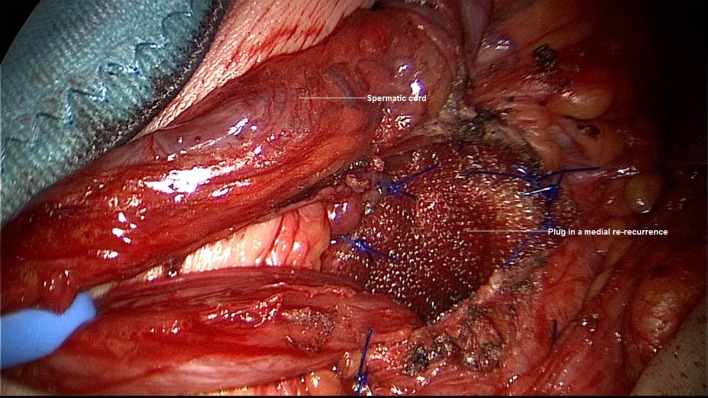
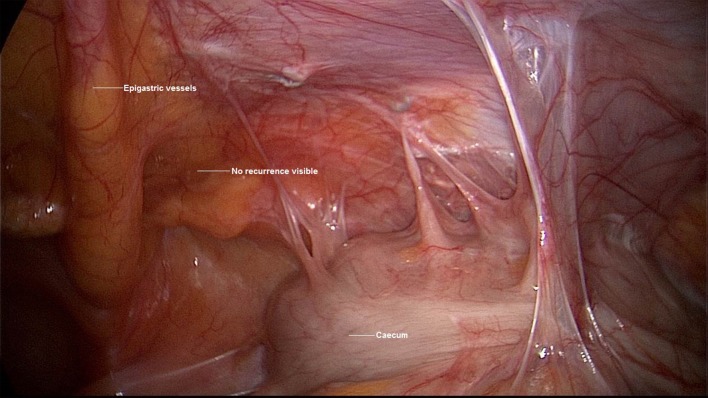
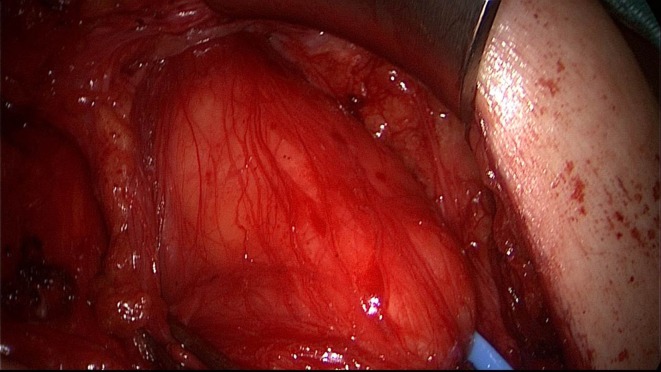
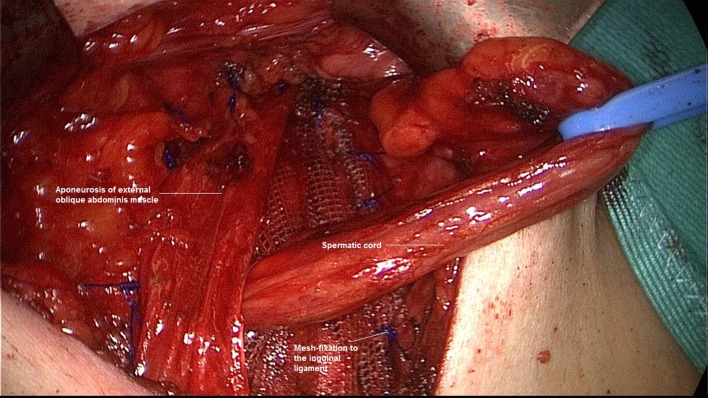
In all the three cases described explorative laparoscopy played a key role as decision tool when deciding how best to treat re-recurrence after anterior and posterior inguinal hernia repair. In one case severe adhesions after robotic prostatectomy and in another case correct placement of the mesh in the posterior plane, adhesions from the cecum to the groin region and no definitive finding of a re-recurrence resulted in an open repair. In the third case, an insufficient laparoscopic posterior mesh placement made the re-recurrent TAPP procedure relatively easy.
Explorative laparoscopy is an important decision tool for re-recurrent inguinal hernia treatment to minimize the risks of the procedure for the patients.
国际疝气协会的指南建议,对于开放前路网片修补术后复发性腹股沟疝,采用腹腔镜技术进行后路修补;相反,对于腹腔镜初次修补术后的复发,则采用开放前路修补。即使遵循这些指南,修补术后1年仍可预期有1%-2%的再次复发率,且在随后几年该比率还会进一步上升。因此,越来越多的前路和后路网片植入术后再次复发的患者需要接受治疗,这是一个迄今为止仅有极少研究进行过调查的问题。所以,目前尚无充分依据的建议。本文现呈现一系列病例报告,旨在确定探索性腹腔镜检查作为复发性腹股沟疝治疗决策工具的作用。
基于三例病例报告,下文阐述了探索性腹腔镜检查作为复发性腹股沟疝治疗决策工具的作用。
在所述的所有三例病例中,探索性腹腔镜检查在决定如何最佳治疗腹股沟疝前后路修补术后的再次复发时,发挥了关键的决策工具作用。在一例中,机器人前列腺切除术后出现严重粘连;在另一例中,网片在后方平面放置正确,盲肠至腹股沟区存在粘连且未明确发现再次复发,最终采用开放修补。在第三例中,腹腔镜后路网片放置不当,使得复发性经腹腔腹膜前修补手术相对容易进行。
探索性腹腔镜检查是复发性腹股沟疝治疗的重要决策工具,可将手术对患者的风险降至最低。