
通过交配型转换失败后的全基因组复制,在种间杂交酵母中实现生育能力的进化恢复。
Evolutionary restoration of fertility in an interspecies hybrid yeast, by whole-genome duplication after a failed mating-type switch.
作者信息
Ortiz-Merino Raúl A, Kuanyshev Nurzhan, Braun-Galleani Stephanie, Byrne Kevin P, Porro Danilo, Branduardi Paola, Wolfe Kenneth H
机构信息
UCD Conway Institute, School of Medicine, University College Dublin, Dublin, Ireland.
Department of Biotechnology and Biosciences, University of Milano-Bicocca, Milano, Italy.
出版信息
PLoS Biol. 2017 May 16;15(5):e2002128. doi: 10.1371/journal.pbio.2002128. eCollection 2017 May.
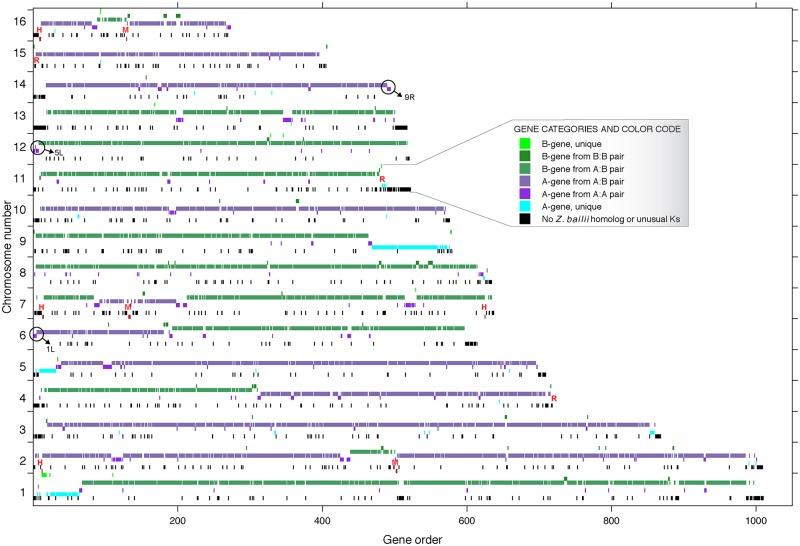
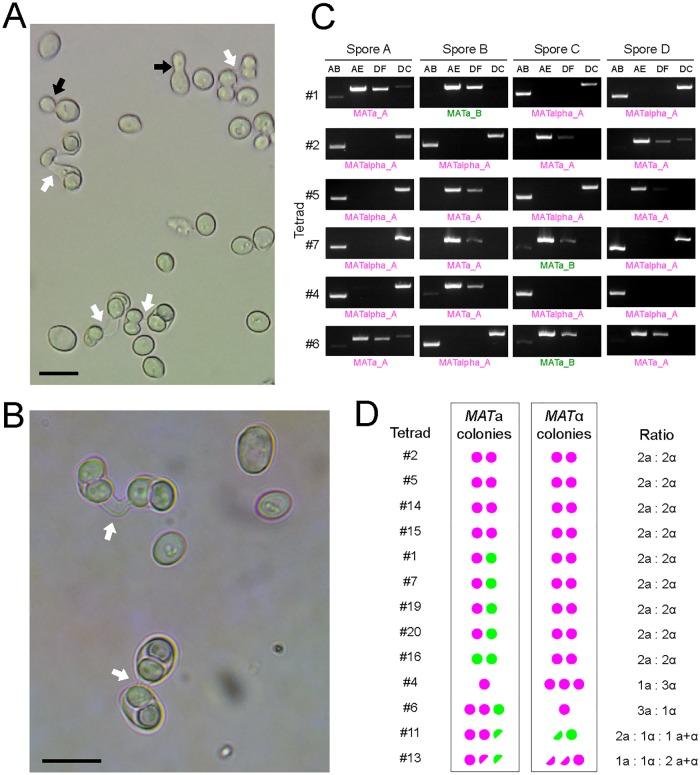
Many interspecies hybrids have been discovered in yeasts, but most of these hybrids are asexual and can replicate only mitotically. Whole-genome duplication has been proposed as a mechanism by which interspecies hybrids can regain fertility, restoring their ability to perform meiosis and sporulate. Here, we show that this process occurred naturally during the evolution of Zygosaccharomyces parabailii, an interspecies hybrid that was formed by mating between 2 parents that differed by 7% in genome sequence and by many interchromosomal rearrangements. Surprisingly, Z. parabailii has a full sexual cycle and is genetically haploid. It goes through mating-type switching and autodiploidization, followed by immediate sporulation. We identified the key evolutionary event that enabled Z. parabailii to regain fertility, which was breakage of 1 of the 2 homeologous copies of the mating-type (MAT) locus in the hybrid, resulting in a chromosomal rearrangement and irreparable damage to 1 MAT locus. This rearrangement was caused by HO endonuclease, which normally functions in mating-type switching. With 1 copy of MAT inactivated, the interspecies hybrid now behaves as a haploid. Our results provide the first demonstration that MAT locus damage is a naturally occurring evolutionary mechanism for whole-genome duplication and restoration of fertility to interspecies hybrids. The events that occurred in Z. parabailii strongly resemble those postulated to have caused ancient whole-genome duplication in an ancestor of Saccharomyces cerevisiae.
在酵母中已发现许多种间杂交体,但这些杂交体大多是无性的,只能进行有丝分裂复制。全基因组复制被认为是一种机制,通过该机制种间杂交体可以恢复育性,恢复其进行减数分裂和形成孢子的能力。在这里,我们表明这个过程在近平腹酵母的进化过程中自然发生,近平腹酵母是一种种间杂交体,由基因组序列相差7%且存在许多染色体间重排的两个亲本交配形成。令人惊讶的是,近平腹酵母具有完整的有性周期,并且是遗传单倍体。它经历交配型转换和自身二倍体化,随后立即形成孢子。我们确定了使近平腹酵母恢复育性的关键进化事件,即杂交体中交配型(MAT)位点的两个同源拷贝之一发生断裂,导致染色体重排和一个MAT位点的不可修复损伤。这种重排是由HO内切核酸酶引起的,它通常在交配型转换中起作用。由于一个MAT拷贝失活,种间杂交体现在表现为单倍体。我们的结果首次证明,MAT位点损伤是种间杂交体全基因组复制和育性恢复的一种自然发生的进化机制。近平腹酵母中发生的事件与推测导致酿酒酵母祖先古老全基因组复制的事件非常相似。



 Zotero 插件