Sun ShuLan, Zhong JianQiang, Li ShuHua, Wang XiaoJing
Guangdong Key Lab of Biotechnology for Plant Development, College of Life Sciences, South China Normal University, Guangzhou, Guangdong, 510631, People's Republic of China.
Bot Stud. 2013 Dec;54(1):36. doi: 10.1186/1999-3110-54-36. Epub 2013 Sep 23.
Phenotypic and genotypic variations, collectively called somaclonal variations, are induced during tissue culture.
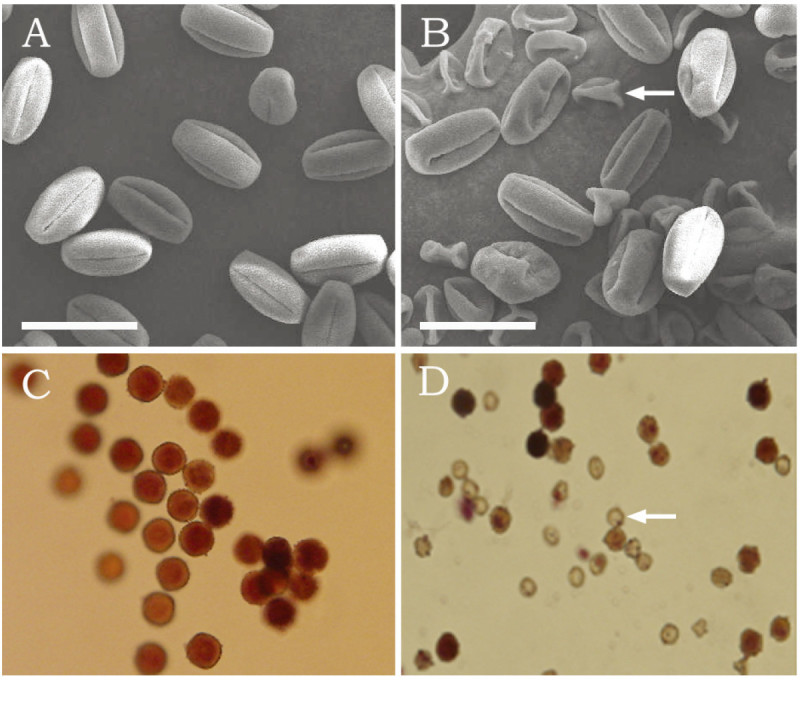
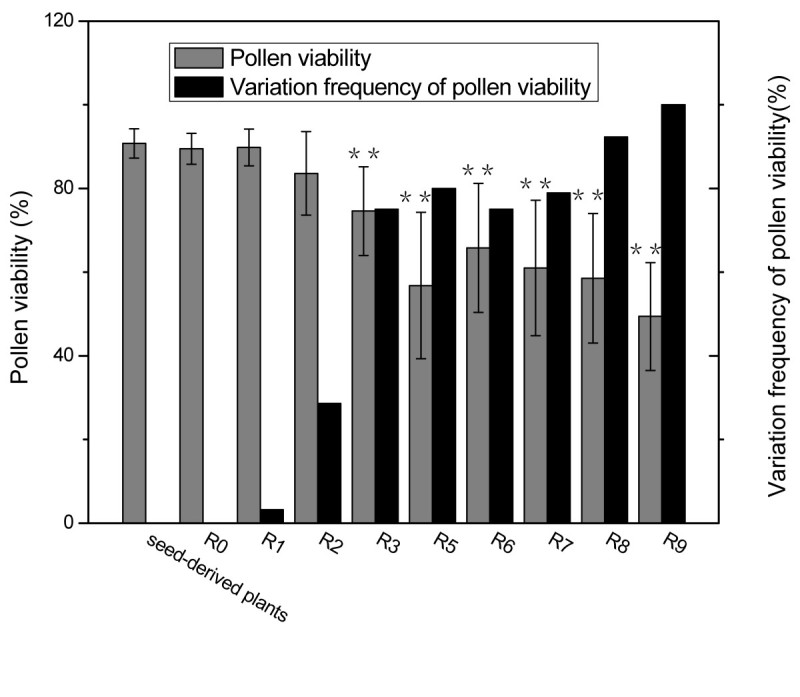
We studied the phenotypic variation in pollen viability of regenerants of torenia after subculturing for one to nine generations. We found that pollen viability of regenerants continuously decreased with increasing subculture time. High concentrations of plant growth regulators applied to the Murashige and Skoog (MS) medium also resulted in diminished pollen viability. Furthermore, antibiotic application during gene transformation also decreased pollen viability of the transformants. However, the process of long-term culture did not significantly change pollen viability. The mean methylation level of regenerants showed a 0.28% to 3.95% decrease in seedlings subcultured in vitro for nine generations. Moreover, when the ninth subcultured regenerants with reduced pollen vibility were recovered in soil to get seeds, the pollen viability of seed-derive plants was similar to that of the wild type.
The results show that plant growth regulators, antibiotics, and the number of subculture generations influence somaclonal variations in torenia. The somaclonal variations in torenia may results from epigenetic changes.
表型和基因型变异统称为体细胞克隆变异,是在组织培养过程中诱导产生的。
我们研究了蓝猪耳继代培养1至9代后再生植株花粉活力的表型变异。我们发现,再生植株的花粉活力随着继代培养时间的增加而持续下降。在Murashige和Skoog(MS)培养基中添加高浓度的植物生长调节剂也会导致花粉活力降低。此外,基因转化过程中使用抗生素也会降低转化体的花粉活力。然而,长期培养过程并未显著改变花粉活力。在体外继代培养9代的幼苗中,再生植株的平均甲基化水平下降了0.28%至3.95%。此外,当花粉活力降低的第9代继代培养再生植株移栽到土壤中结籽时,种子衍生植株的花粉活力与野生型相似。
结果表明,植物生长调节剂、抗生素和继代培养代数会影响蓝猪耳的体细胞克隆变异。蓝猪耳的体细胞克隆变异可能是由表观遗传变化引起的。