Awasthi A, Rao C R, Hegde D S, Rao N K
Kasturba Medical College, Manipal University, Manipal, Karnataka 576104, India.
Department of Community Medicine, Kasturba Medical College, Manipal University, Manipal, Karnataka 576104, India.
J Prev Med Hyg. 2017 Mar;58(1):E56-E62.
Obesity is a major risk factor for type 2 diabetes mellitus (T2DM). Clinical evidence indicates a stronger association of diabetes with central obesity than general obesity. The present study aimed to compare the association between type 2 diabetes mellitus and different anthropometric measurements and evaluate the usefulness of these measurements in clinical practice.
A case-control study was done among 102 individuals; of whom 51 cases included diagnosed T2DM (≥ 20 years age) patients attending the Medicine out-patient consultation of a tertiary care hospital and 51 controls who were screen negative for T2DM and recruited from the local community. Various anthropometric measurements were used according to standard World Health Organization (WHO) protocols. Data was entered and analyzed using Statistical Package for Social Sciences (SPSS) version 15.
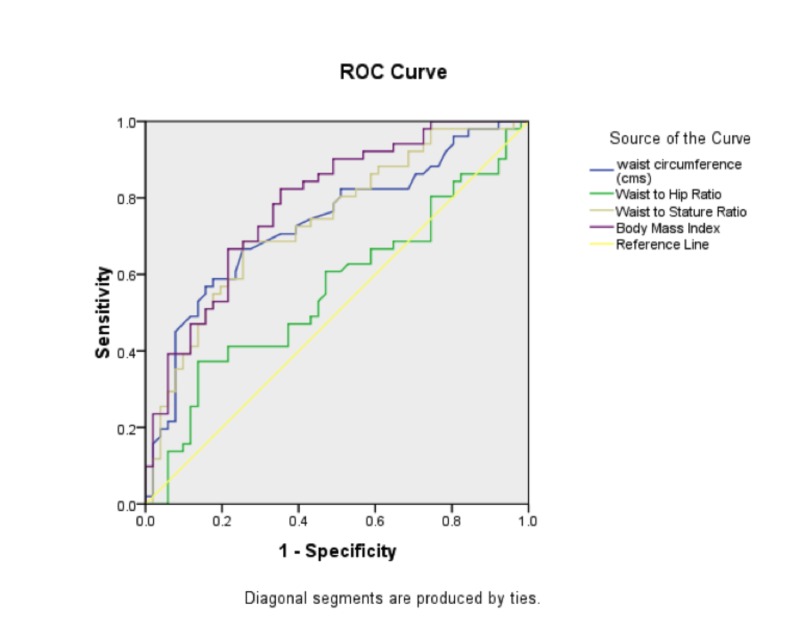
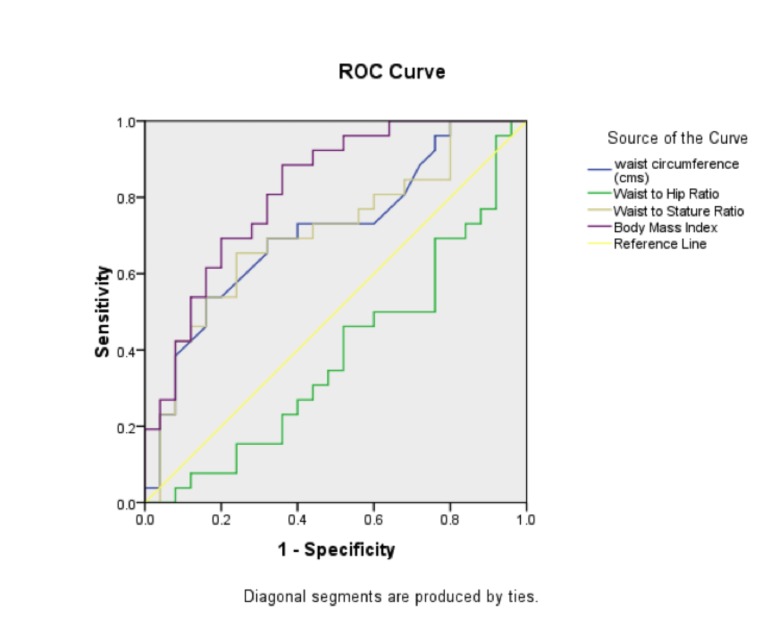
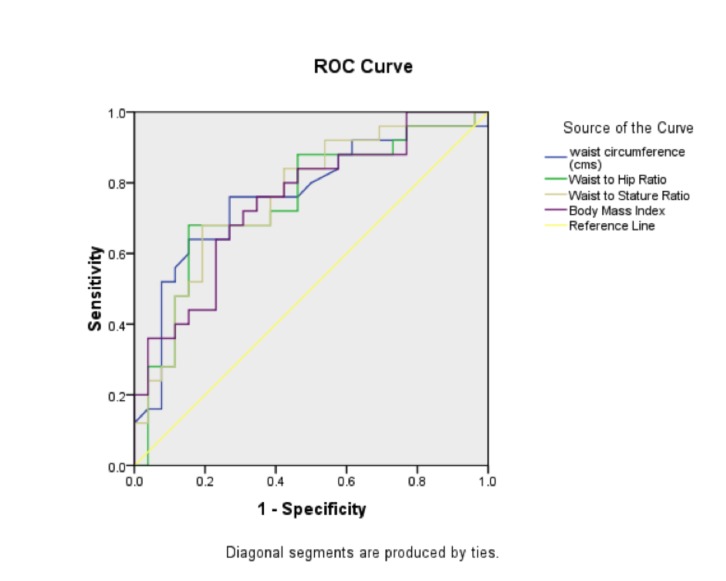
The proportion of cases with Body Mass Index (BMI) ≥ 25 kg/m was 55% as compared to 22% of controls and this association was statistically significant (p < 0.05). The proportion of cases with high waist circumference cut-offs (WC) was 74.5% as compared to 45.1% healthy individuals and this association was also statistically significant (p < 0.05, OR = 3.56). A Receiver Operating Characteristic (ROC) curve for both gender revealed highest area under the curve for body mass index (area = 0.787). Body mass index had the best discriminatory power. Waist to hip ratio was not a sensitive marker especially for females.
A strong association between obesity indices and diabetes was identified. BMI and WC could be used in clinical practice for suggesting life style modifications.
肥胖是2型糖尿病(T2DM)的主要危险因素。临床证据表明,糖尿病与中心性肥胖的关联比与全身性肥胖的关联更强。本研究旨在比较2型糖尿病与不同人体测量指标之间的关联,并评估这些测量指标在临床实践中的实用性。
对102名个体进行了病例对照研究;其中51例病例包括在一家三级医院内科门诊就诊的确诊T2DM(年龄≥20岁)患者,51名对照为T2DM筛查阴性且从当地社区招募。根据世界卫生组织(WHO)的标准方案进行各种人体测量。使用社会科学统计软件包(SPSS)15版录入和分析数据。
体重指数(BMI)≥25 kg/m²的病例比例为55%,而对照组为22%,这种关联具有统计学意义(p<0.05)。高腰围临界值(WC)的病例比例为74.5%,而健康个体为45.1%,这种关联也具有统计学意义(p<0.05,OR=3.56)。两性的受试者工作特征(ROC)曲线显示,体重指数的曲线下面积最大(面积=0.787)。体重指数具有最佳的鉴别能力。腰臀比不是一个敏感指标,尤其是对女性而言。
确定了肥胖指数与糖尿病之间存在密切关联。BMI和WC可用于临床实践中建议生活方式的改变。