Lin Xiaolong, Liu Yuan Bo, Hu Huijun
Department of Pathology, Huizhou Third People's Hospital, Guangzhou Medical University, Huizhou, Guangdong 516002, P.R. China.
The Medical Department of Neurology, The Sixth People's Hospital of Huizhou (The People's Hospital of Huiyang), Huizhou, Guangdong 516211, P.R. China.
Biomed Rep. 2017 May;6(5):495-502. doi: 10.3892/br.2017.890. Epub 2017 Apr 10.
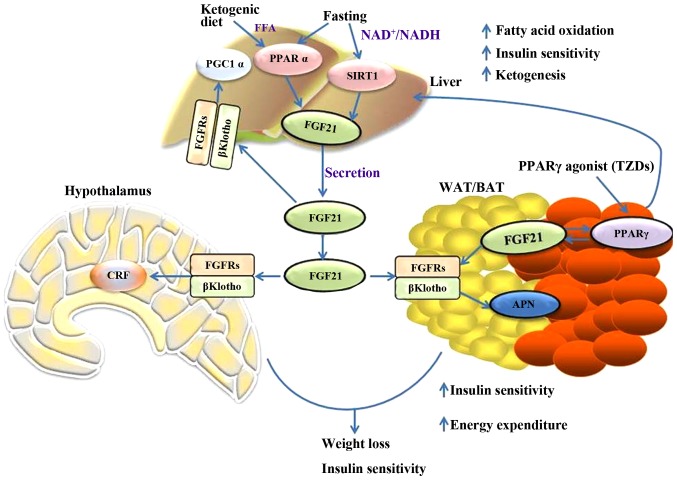
The hepatokine fibroblast growth factor 21 (FGF21) is a novel polypeptide ligand, which is involved in glucose and lipid metabolism, and contributes significantly to lowering body weight and enhancing insulin sensitivity. A large number of pre-clinical and clinical results demonstrate that FGF21 is a potential drug target for treating obesity and type 2 diabetes mellitus. In the present review, the tissue specific actions and molecular mechanisms of FGF21 are discussed with a focus on the liver, adipose tissue and nervous system, as well as investigating the outcomes of clinical trials of FGF21, with the aim of interpreting and delineating the complexity physiology of FGF21.
肝脏因子成纤维细胞生长因子21(FGF21)是一种新型多肽配体,参与葡萄糖和脂质代谢,对减轻体重和增强胰岛素敏感性有显著作用。大量临床前和临床研究结果表明,FGF21是治疗肥胖症和2型糖尿病的潜在药物靶点。在本综述中,我们讨论了FGF21的组织特异性作用和分子机制,重点关注肝脏、脂肪组织和神经系统,并研究了FGF21的临床试验结果,旨在阐释和勾勒FGF21复杂的生理学特性。