von Peter Sebastian, Bieler Patrick
Psychiatric University Clinic of the Charité, St. Hedwig Hospital, Berlin, Germany.
Institute of European Ethnology, Humboldt University of Berlin, Berlin, Germany.
Front Public Health. 2017 May 3;5:88. doi: 10.3389/fpubh.2017.00088. eCollection 2017.
The Convention on the Rights of Persons with Disabilities (CRPD) has been received considerable attention internationally.
The Convention's main arguments are conceptually analyzed. Implications for the development of research designs are elaborated upon.
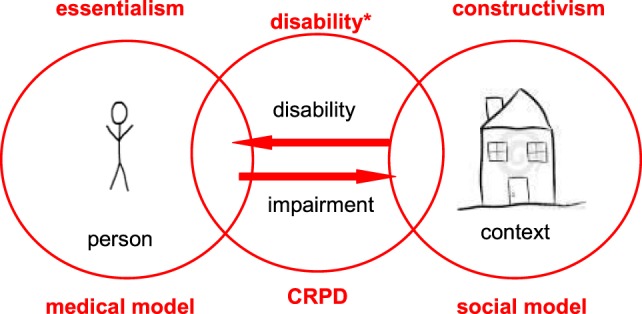
The Convention entails both a human rights and a sociopolitical dimension. Advancing a relational notion of disability, it enters a rather foreign terrain to medical sciences. Research designs have to be changed accordingly.
Research designs in accordance with the CRPD should employ and further develop context-sensitive research strategies and interdisciplinary collaboration. Complex designs that allow for a relational analysis of personalized effects have to be established and evaluated, thereby systematically integrating qualitative methods.
《残疾人权利公约》(CRPD)在国际上受到了广泛关注。
对该公约的主要论点进行了概念分析。阐述了其对研究设计发展的影响。
该公约兼具人权和社会政治层面。它提出了一种关于残疾的关系性概念,进入了医学领域相对陌生的领域。研究设计必须相应改变。
符合《残疾人权利公约》的研究设计应采用并进一步发展情境敏感型研究策略和跨学科合作。必须建立并评估能够对个性化效果进行关系性分析的复杂设计,从而系统地整合定性方法。