Xue Yangjing, Tao Luyuan, Wu Shaoze, Wang Guoqiang, Qian Lu, Li Jiwu, Liao Lianming, Tang Jifei, Ji Kangting
Department of Cardiology, The Second Affiliated Hospital and Yuying Children's Hospital of Wenzhou Medical University, Xueyuanxi Road, No 109, Wenzhou, Zhejiang, 325000, China.
Department of Oncology, Academy of Integrative Medicine, Fujian University of Traditional Chinese Medicine, Huatuo Road, No 1, Fuzhou, Fujian, 350122, China.
BMC Cardiovasc Disord. 2017 May 18;17(1):127. doi: 10.1186/s12872-017-0560-z.
About 10-15% patients who take statins experience skeletal muscle problems. Red yeast rice has a good safety profile could provide a compromise therapeutic strategy. Therefore, the aim of this study was to evaluate the effects of red yeast rice, when compared to simvastatin, on the muscle fatigue symptom and the serum lipid level in dyslipidemic patients with low to moderate cardiovascular risk.
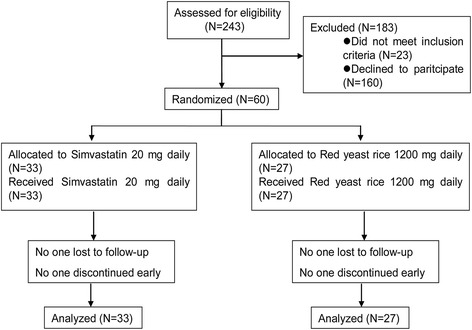
A total of 60 dyslipidemic patients with low to moderate cardiovascular risk were recruited and randomly assigned to receive either simvastatin (n = 33) or red yeast rice (n = 27) for 4 weeks. The muscle fatigue score, the physical activity, the serum lipid profile and the safety profile were then evaluated.
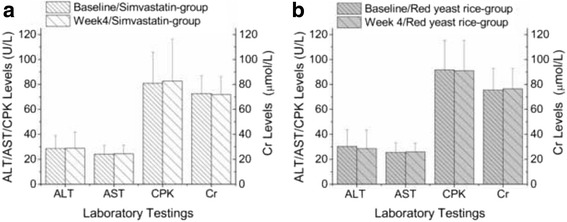
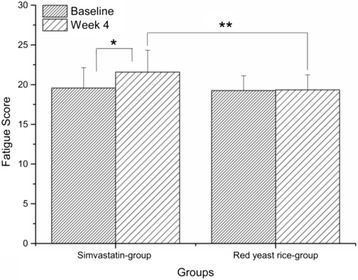
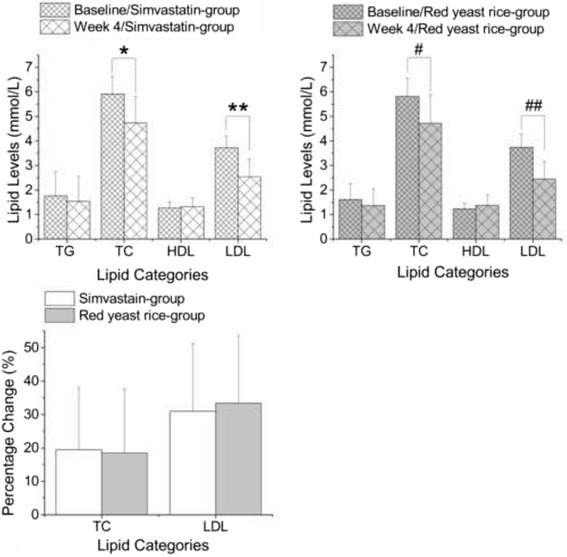
At the end of study, the fatigue score was significantly increased in patients treated with simvastatin, whereas no significant change was observed in patients receiving red yeast rice. In addition, the physical activity level was significantly decreased in patients from simvastatin group when compared to those from red yeast rice group. Similar lipid-lowering effects were observed in two groups. The safety profile was not affected after the treatments.
Among dyslipidemic patients with low to moderate cardiovascular risk, red yeast rice induced less fatigue side effect and exerted comparable lipid-lowering effects when compared to simvastatin in this pilot primary prevention study.
NCT01686451 .
约10%-15%服用他汀类药物的患者会出现骨骼肌问题。红曲米具有良好的安全性,可提供一种折中的治疗策略。因此,本研究的目的是评估红曲米与辛伐他汀相比,对心血管风险低至中度的血脂异常患者的肌肉疲劳症状和血脂水平的影响。
共招募60例心血管风险低至中度的血脂异常患者,随机分为两组,分别接受辛伐他汀(n = 33)或红曲米(n = 27)治疗4周。随后评估肌肉疲劳评分、身体活动情况、血脂谱和安全性。
研究结束时,辛伐他汀治疗的患者疲劳评分显著增加,而接受红曲米治疗的患者未观察到显著变化。此外,与红曲米组相比,辛伐他汀组患者的身体活动水平显著降低。两组观察到相似的降脂效果。治疗后安全性未受影响。
在本初步一级预防研究中,对于心血管风险低至中度的血脂异常患者,与辛伐他汀相比,红曲米引起的疲劳副作用更少,且降脂效果相当。
NCT01686451 。