Grande Enrico, Zucchetto Antonella, Suligoi Barbara, Grippo Francesco, Pappagallo Marilena, Virdone Saverio, Camoni Laura, Taborelli Martina, Regine Vincenza, Serraino Diego, Frova Luisa
Servizio Sistema integrato salute, assistenza, previdenza e giustizia, Istituto Nazionale di Statistica, Viale Liegi 13, 00198, Rome, Italy.
Unit of Cancer Epidemiology, CRO Aviano National Cancer Institute, Via Gallini 2, 33081, Aviano, PN, Italy.
Popul Health Metr. 2017 May 18;15(1):19. doi: 10.1186/s12963-017-0135-3.
Multiple cause-of-death (MCOD) data allow analyzing the contribution to mortality of conditions reported on the death certificate that are not selected as the underlying cause of death. Using MCOD data, this study aimed to fully describe the cause-specific mortality of people with AIDS (PWA) compared to people without AIDS.
We conducted a nationwide investigation based on death certificates of 2,515 Italian PWA and 123,224 people without AIDS who had died between 2006 and 2010. The conditions most frequently associated with PWA mortality, compared to people without AIDS, were identified using an age-standardized proportion ratio (ASPR) calculated as the ratio between the age-standardized proportion of a specific cause among PWA and the same proportion among people without AIDS.
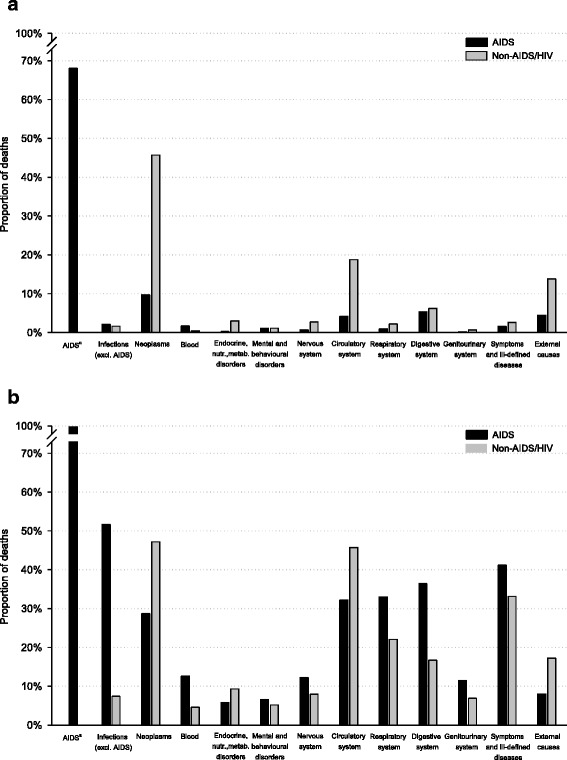
The most frequently reported conditions at death among PWA were infectious/parasitic diseases (52%), digestive (36%), respiratory (33%), and circulatory (32%) system diseases, and neoplasms (29%). All AIDS-defining conditions resulted highly associated (ASPR significantly greater than unity) with PWA deaths. Significant associations also emerged for leishmaniasis (ASPR = 188.0), encephalitis/myelitis/encephalomyelitis (ASPR = 14.3), dementia (ASPR = 13.1), chronic viral hepatitis (ASPR = 13.1), liver fibrosis/cirrhosis (ASPR = 4.4), pneumonia (ASPR = 4.4), anal (ASPR = 12.1) and liver (ASPR = 1.9) cancers, and Hodgkin's disease (ASPR = 3.1).
Study findings identified the contribution of several non-AIDS-defining conditions on PWA mortality, emphasizing the need of preventive public health interventions targeting this population.
多死因(MCOD)数据有助于分析死亡证明上报告的、未被选为根本死因的疾病对死亡率的影响。本研究利用MCOD数据,旨在全面描述艾滋病患者(PWA)与非艾滋病患者的死因别死亡率。
我们基于2006年至2010年间死亡的2515例意大利PWA和123224例非艾滋病患者的死亡证明进行了一项全国性调查。通过计算年龄标准化比例比(ASPR)来确定与PWA死亡率相比,非艾滋病患者中最常出现的相关疾病,ASPR的计算方法是PWA中特定病因的年龄标准化比例与非艾滋病患者中相同比例的比值。
PWA死亡时最常报告的疾病是感染性/寄生虫病(52%)、消化系统疾病(36%)、呼吸系统疾病(33%)、循环系统疾病(32%)和肿瘤(29%)。所有艾滋病定义疾病都与PWA死亡高度相关(ASPR显著大于1)。利什曼病(ASPR = 18...显示全部
多死因(MCOD)数据有助于分析死亡证明上报告的、未被选为根本死因的疾病对死亡率的影响。本研究利用MCOD数据,旨在全面描述艾滋病患者(PWA)与非艾滋病患者在特定病因死亡率方面的差异。
我们基于2006年至2010年间死亡的2515例意大利PWA和123224例非艾滋病患者的死亡证明进行了一项全国性调查。通过计算年龄标准化比例比(ASPR)来确定与PWA死亡率相比,非艾滋病患者中最常出现的相关疾病,ASPR的计算方法是PWA中特定病因的年龄标准化比例与非艾滋病患者中相同比例的比值。
PWA死亡时最常报告的疾病是感染性/寄生虫病(52%)、消化系统疾病(36%)、呼吸系统疾病(33%)、循环系统疾病(32%)和肿瘤(29%)。所有艾滋病定义疾病都与PWA死亡高度相关(ASPR显著大于1)。利什曼病(ASPR = 188.0)、脑炎/脊髓炎/脑脊髓炎(ASPR = 14.3)、痴呆(ASPR = 13.1)、慢性病毒性肝炎(ASPR = 13.1)、肝纤维化/肝硬化(ASPR = 4.4)、肺炎(ASPR = 4.4)、肛门癌(ASPR = 12.1)和肝癌(ASPR = 1.9)以及霍奇金病(ASPR = 3.1)也出现了显著关联。
研究结果确定了几种非艾滋病定义疾病对PWA死亡率的影响,强调了针对该人群进行预防性公共卫生干预的必要性。 显示全部
多死因(MCOD)数据有助于分析死亡证明上报告的、未被选为根本死因的疾病对死亡率的影响。本研究利用MCOD数据,旨在全面描述艾滋病患者(PWA)与非艾滋病患者相比的特定病因死亡率情况。
我们基于2006年至2010年间死亡的2515例意大利PWA和123224例非艾滋病患者的死亡证明进行了一项全国性调查。通过计算年龄标准化比例比(ASPR)来确定与PWA死亡率相比非艾滋病患者中最常出现的相关疾病,ASPR的计算方法是PWA中特定病因的年龄标准化比例与非艾滋病患者中相同比例的比值。
PWA死亡时最常报告的疾病是感染性/寄生虫病(52%)、消化系统疾病(36%)、呼吸系统疾病(33%)、循环系统疾病(32%)和肿瘤(29%)。所有艾滋病定义疾病都与PWA死亡高度相关(ASPR显著大于1)。利什曼病(ASPR = 188.0)、脑炎/脊髓炎/脑脊髓炎(ASPR = 14.3)、痴呆(ASPR = 13.1)、慢性病毒性肝炎(ASPR = 13.1)、肝纤维化/肝硬化(ASPR = 4.4)、肺炎(ASPR = 4.4)、肛门癌(ASPR = 12.1)和肝癌(ASPR = 1.9)以及霍奇金病(ASPR = 3.1)也呈现出显著关联。
研究结果明确了几种非艾滋病定义疾病对PWA死亡率的作用,强调了针对该人群开展预防性公共卫生干预措施的必要性。 显示全部
多死因(MCOD)数据能用于分析死亡证明上报告的、未被选为根本死因的疾病对死亡率的影响。本研究利用MCOD数据,旨在全面描述艾滋病患者(PWA)与非艾滋病患者相比的特定病因死亡率。
我们基于2006年至2010年间死亡的2515例意大利PWA和123224例非艾滋病患者的死亡证明进行了一项全国性调查。通过计算年龄标准化比例比(ASPR)来确定与PWA死亡率相比非艾滋病患者中最常出现的相关疾病,ASPR的计算方法是PWA中特定病因的年龄标准化比例与非艾滋病患者中相同比例的比值。
PWA死亡时最常报告的疾病是感染性/寄生虫病(52%)、消化系统疾病(36%)、呼吸系统疾病(33%)、循环系统疾病(32%)和肿瘤(29%)。所有艾滋病定义疾病都与PWA死亡高度相关(ASPR显著大于1)。利什曼病(ASPR = 188.0)、脑炎/脊髓炎/脑脊髓炎(ASPR =