Department of Psychiatry and Human Behavior Alpert Brown Medical School Brown University Providence RI USA.
Center for Neurorestoration and Neurotechnology Providence VA Medical Center Providence RI USA.
Brain Behav. 2017 Apr 11;7(5):e00681. doi: 10.1002/brb3.681. eCollection 2017 May.
Abnormalities in fear extinction and recall are core components of posttraumatic stress disorder (PTSD). Data from animal and human studies point to a role of the ventromedial prefrontal cortex (vmPFC) in extinction learning and subsequent retention of extinction memories. Given the increasing interest in developing noninvasive brain stimulation protocols for psychopathology treatment, we piloted whether transcranial direct current stimulation (tDCS) during extinction learning, vs. during consolidation of extinction learning, might improve extinction recall in veterans with warzone-related PTSD.
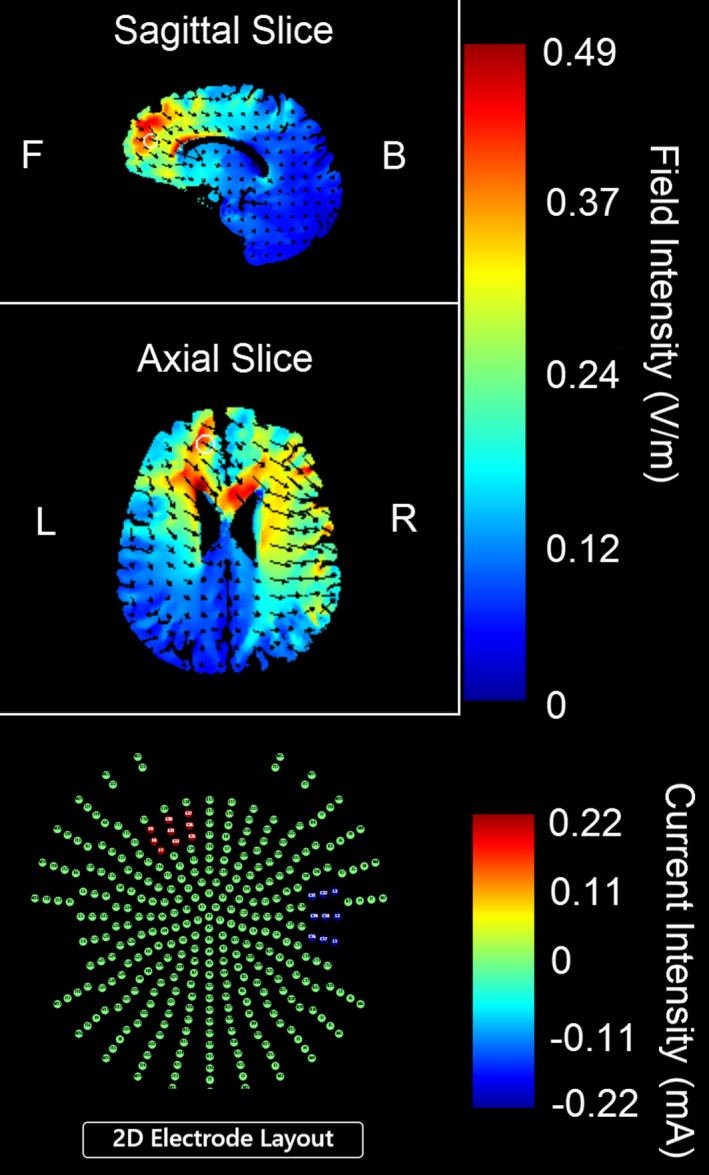
Twenty-eight veterans with PTSD completed a 2-day Pavlovian fear conditioning, extinction, and recall paradigm. Participants received one 10-min session of 2 mA anodal tDCS over AF3, intended to target the vmPFC. Fourteen received tDCS that started simultaneously with extinction learning onset, and the remaining 14 participants received tDCS during extinction consolidation. Normalized skin conductance reactivity (SCR) was the primary outcome measure. Linear mixed effects models were used to test for effects of tDCS on late extinction and early extinction recall 24 hr later.
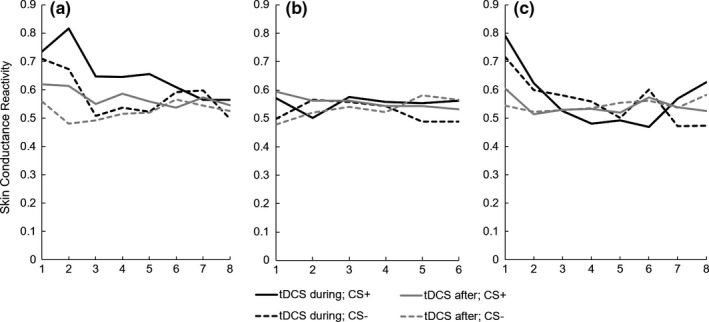
During early recall, veterans who received tDCS during extinction consolidation showed slightly lower SCR in response to previously extinguished stimuli as compared to veterans who received tDCS simultaneous with extinction learning (= .08), generating a medium effect size (Cohen's = .38). There was no significant effect of tDCS on SCR during late extinction.
These preliminary findings suggest that testing the effects of tDCS during consolidation of fear extinction may have promise as a way of enhancing extinction recall.
恐惧消退和回忆异常是创伤后应激障碍(PTSD)的核心组成部分。动物和人类研究的数据表明,腹内侧前额叶皮层(vmPFC)在消退学习和随后的消退记忆保留中起作用。鉴于人们对开发非侵入性脑刺激技术治疗精神病理学的兴趣日益浓厚,我们初步探讨了在消退学习期间进行经颅直流电刺激(tDCS),与在消退学习巩固期间进行相比,是否可以改善与战区相关 PTSD 的退伍军人的消退回忆。
28 名 PTSD 退伍军人完成了为期 2 天的条件性恐惧反应、消退和回忆范式。参与者接受了为期 10 分钟的 2 mA 阳极 tDCS,旨在靶向 vmPFC。其中 14 名参与者在消退学习开始时同时接受 tDCS,其余 14 名参与者在消退巩固期间接受 tDCS。正常化皮肤电反应(SCR)是主要的测量结果。线性混合效应模型用于检验 tDCS 对 24 小时后晚期消退和早期消退回忆的影响。
在早期回忆中,与在消退学习期间接受 tDCS 的退伍军人相比,在消退巩固期间接受 tDCS 的退伍军人对先前消退的刺激的 SCR 略低(= 0.08),产生了中等的效应大小(Cohen's = 0.38)。tDCS 对晚期消退时的 SCR 没有显著影响。
这些初步发现表明,在恐惧消退巩固期间测试 tDCS 的效果可能是增强消退回忆的一种有前途的方法。