Valdez-Salas Benjamin, Beltrán-Partida Ernesto, Castillo-Uribe Sandra, Curiel-Álvarez Mario, Zlatev Roumen, Stoytcheva Margarita, Montero-Alpírez Gisela, Vargas-Osuna Lidia
Instituto de Ingeniería, Departamento de Corrosión y Materiales, Universidad Autónoma de Baja California, Blvd. Benito Juárez y Calle de la Normal s/n, Mexicali C.P., 21040 Baja California, Mexico.
Facultad de Odontología Mexicali, Universidad Autónoma de Baja California, Av. Zotoluca y Chinampas, s/n, Mexicali C.P., 21280 Baja California, Mexico.
Molecules. 2017 May 18;22(5):832. doi: 10.3390/molecules22050832.
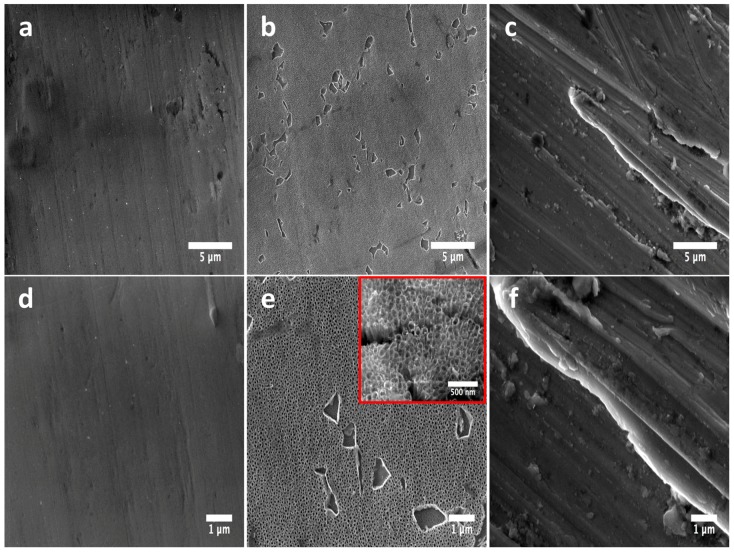
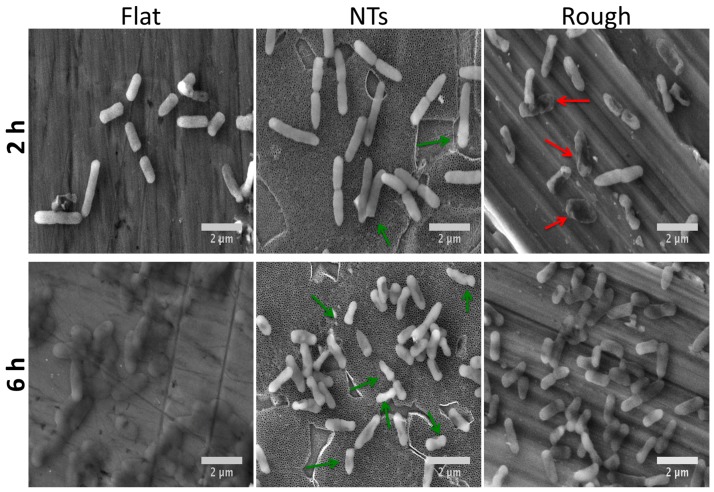
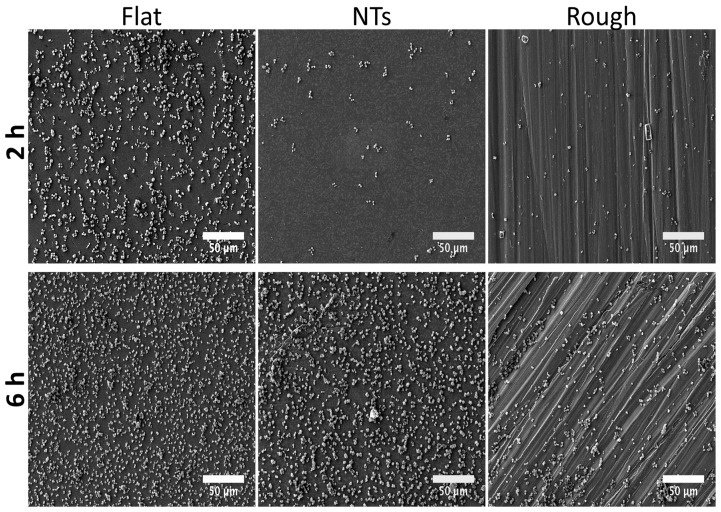
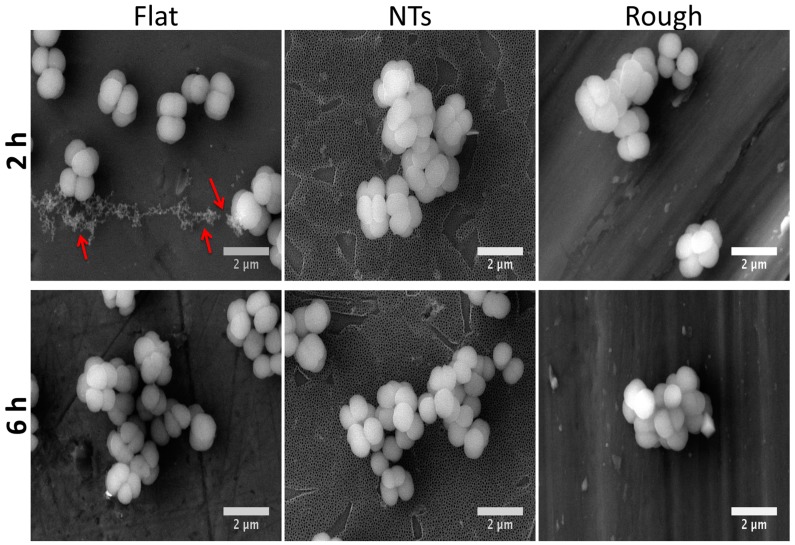
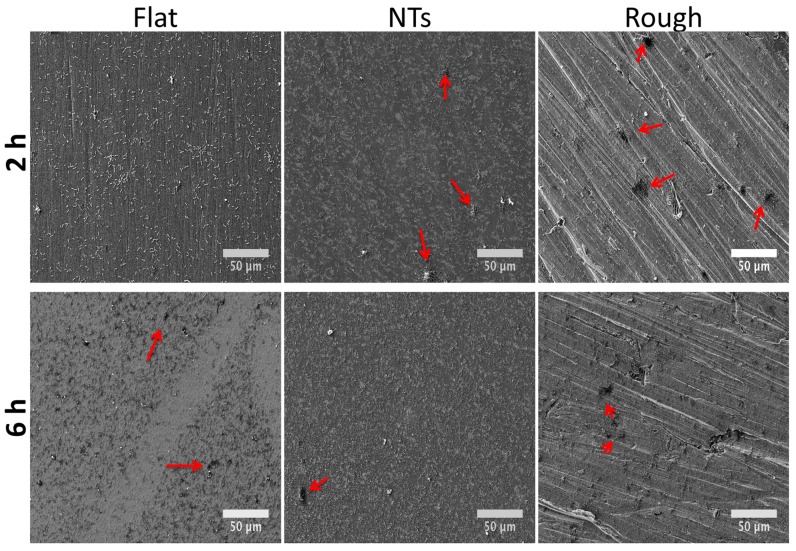
It is imperative to understand and systematically compare the initial interactions between bacteria genre and surface properties. Thus, we fabricated a flat, anodized with 80 nm TiO₂ nanotubes (NTs), and a rough Ti6Al4V surface. The materials were characterized using field-emission scanning electron microscopy (FE-SEM), energy dispersive X-ray spectroscopy (EDX) and atomic force microscopy (AFM). We cultured in vitro () and () to evaluate the bacterial-surface behavior by FE-SEM and viability calculation. In addition, the initial effects of human osteoblasts were tested on the materials. Gram-negative bacteria showed promoted adherence and viability over the flat and rough surface, while NTs displayed opposite activity with altered morphology. Gram-positive bacteria illustrated similar cellular architecture over the surfaces but with promoted surface adhesion bonds on the flat alloy. Rough surfaces supported viability, whilst NTs exhibited lower vitality. NTs advocated promoted better osteoblast organization with enhanced vitality. Gram-positive bacteria suggested preferred adhesion capability over flat and carbon-rich surfaces. Gram-negative bacteria were strongly disturbed by NTs but largely stimulated by flat and rough materials. Our work proposed that the chemical profile of the material surface and the bacterial cell wall characteristics might play an important role in the bacteria-surface interactions.
理解并系统比较细菌种类与表面特性之间的初始相互作用势在必行。因此,我们制备了一个平整的、阳极氧化有80纳米二氧化钛纳米管(NTs)的以及一个粗糙的Ti6Al4V表面。使用场发射扫描电子显微镜(FE-SEM)、能量色散X射线光谱仪(EDX)和原子力显微镜(AFM)对这些材料进行了表征。我们在体外培养了()和(),通过FE-SEM和活力计算来评估细菌与表面的行为。此外,还测试了人成骨细胞对这些材料的初始作用。革兰氏阴性菌在平整和粗糙表面上表现出增强的黏附力和活力,而NTs则表现出相反的活性且形态发生改变。革兰氏阳性菌在这些表面上呈现出相似的细胞结构,但在平整合金表面上表面黏附键增强。粗糙表面支持()活力,而NTs活力较低。NTs促进了更好的成骨细胞组织且活力增强。革兰氏阳性菌在平整和富碳表面上表现出更好的黏附能力。革兰氏阴性菌受到NTs的强烈干扰,但受到平整和粗糙材料的极大刺激。我们的工作表明,材料表面的化学特征和细菌细胞壁特性可能在细菌与表面的相互作用中起重要作用。