Taparia Tanvi, Ignell Rickard, Hill Sharon Rose
Unit of Chemical Ecology, Department of Plant Protection Biology, Swedish University of Agricultural Sciences, Alnarp, Sweden.
Present Address: Department of Environmental Sciences, Wageningen University and Research, Wageningen, The Netherlands.
BMC Genomics. 2017 May 19;18(1):393. doi: 10.1186/s12864-017-3779-2.
The southern house mosquito, Culex quinquefasciatus, is one of the most prevalent vectors of lymphatic filariasis and flavivirus-induced encephalitis. Its vectorial capacity is directly affected by its reproductive feeding behaviors, such as host seeking, blood feeding, resting, and egg laying. In mosquitoes, these gonotrophic behaviors are odor-mediated and regulated following blood feeding. Immediately after a blood meal, female mosquitoes show reduced olfactory responsiveness and flight activity, as they enter a resting state. Insights into antennal chemosensory gene regulation at this time period can provide a foundation to identify targets involved in the state switch between host seeking and resting.
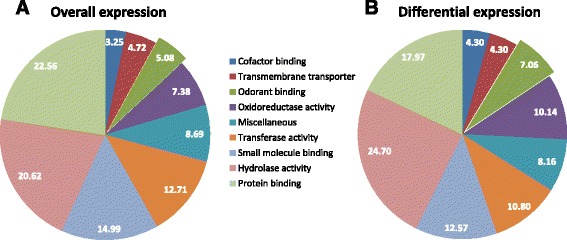
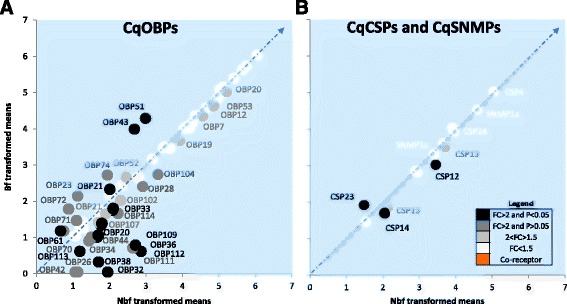
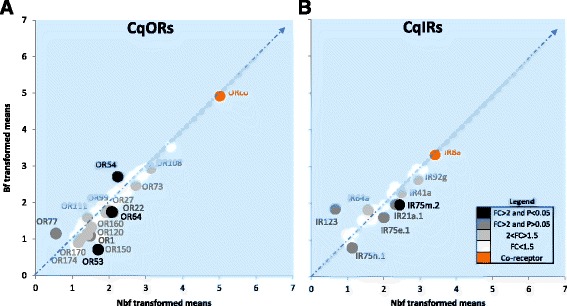
This study used quantitative gene expression analyses to explore blood meal induced regulation of chemosensory gene families in the antennae of 6 days post-emergence C. quinquefasciatus females. Improved annotations for multiple chemosensory gene families, and a quantitative differential gene expression analysis between host seeking and 24 h post- blood fed females of the same age, allowed for the detection of transcripts that potentially play a role in the switch from host seeking to resting, in C. quinquefasciatus. The expression profiles of chemosensory genes varied significantly between the two treatments.
Annotations for chemosensory gene repertoires in C. quinquefasciatus have been manually curated and corrected for 3' exon choice and transcript length, through sequence and transcriptome analyses. The gene expression analyses identified various molecular components of the peripheral olfactory system in C. quinquefasciatus, including odorant receptors, ionotropic receptors, odorant binding proteins and chemosensory proteins, that are regulated in response to blood feeding, and could be critical for the behavioral switch from host seeking to resting. Functional characterization of these proteins in the future can identify targets essential for the females' gonotrophic behaviors, and can be used to design novel vector control strategies.
致倦库蚊是淋巴丝虫病和黄病毒引起的脑炎最常见的传播媒介之一。其传播能力直接受其生殖取食行为的影响,如寻找宿主、吸血、休息和产卵。在蚊子中,这些生殖营养行为由气味介导,并在吸血后受到调节。刚吸食完血液后,雌蚊进入休息状态,嗅觉反应性和飞行活动降低。了解这一时期触角化学感应基因的调控可为识别参与寻找宿主和休息状态转换的靶点提供基础。
本研究采用定量基因表达分析方法,探究了羽化6天的致倦库蚊雌蚊触角中血液诱导的化学感应基因家族调控情况。对多个化学感应基因家族进行了改进注释,并对同龄寻找宿主的雌蚊和吸血后24小时的雌蚊进行了定量差异基因表达分析,从而检测出可能在致倦库蚊从寻找宿主到休息状态转换中发挥作用的转录本。两种处理之间化学感应基因的表达谱存在显著差异。
通过序列和转录组分析,对致倦库蚊化学感应基因库进行了人工整理,并对3'外显子选择和转录本长度进行了校正。基因表达分析确定了致倦库蚊外周嗅觉系统的各种分子成分,包括气味受体、离子型受体、气味结合蛋白和化学感应蛋白,这些成分在吸血后受到调控,可能对从寻找宿主到休息的行为转换至关重要。未来对这些蛋白质的功能表征可以确定雌蚊生殖营养行为所必需的靶点,并可用于设计新的病媒控制策略。