Reid William R, Zhang Lee, Liu Nannan
1. Department of Entomology and Plant Pathology, Auburn University, Auburn, AL 36849, USA ; 2. Current address: UDSA-ARS Center for Medical Veterinary and Agricultural Entomology, Mosquito and Fly Research Unit, Gainesville, FL 32608, USA.
3. Genomics Laboratory, Auburn University, Auburn, AL 36849, USA.
Int J Biol Sci. 2015 Sep 20;11(11):1306-13. doi: 10.7150/ijbs.12829. eCollection 2015.
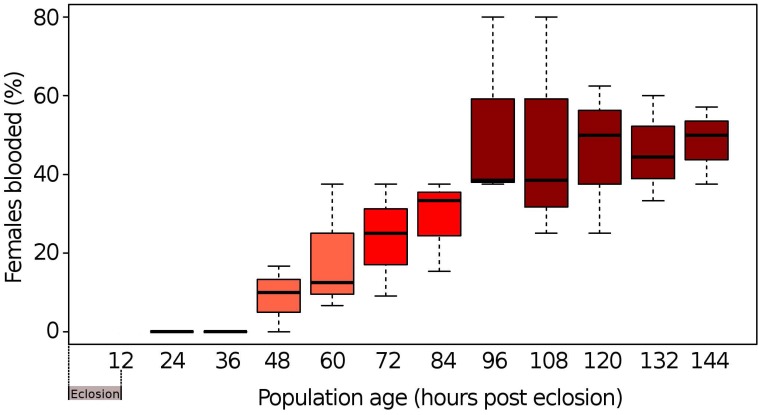
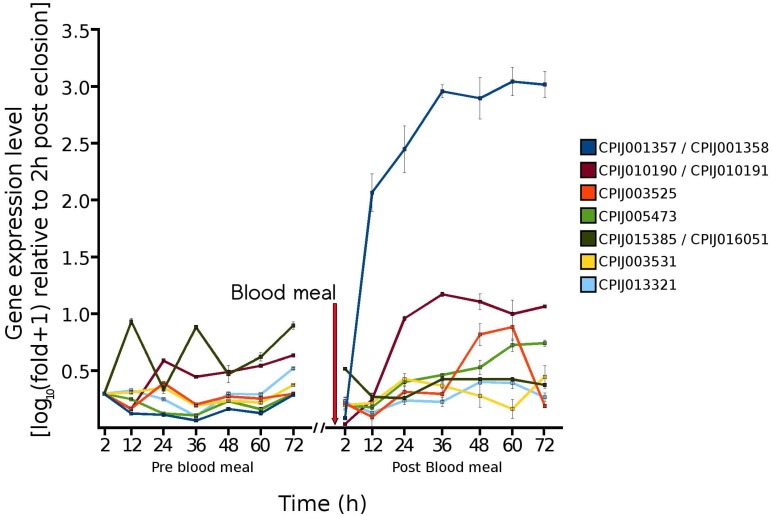
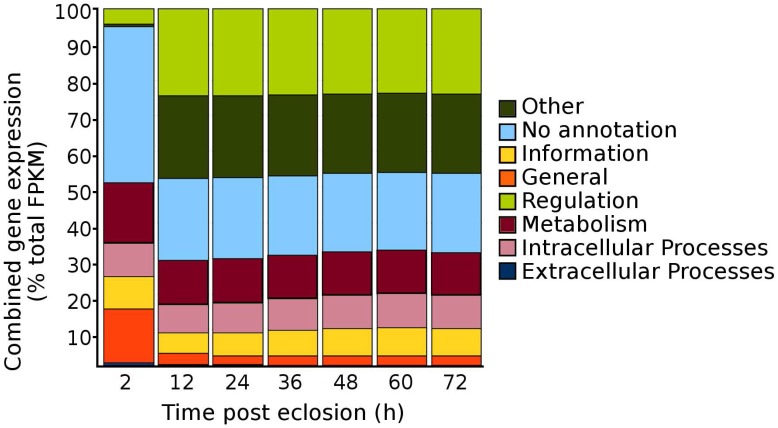
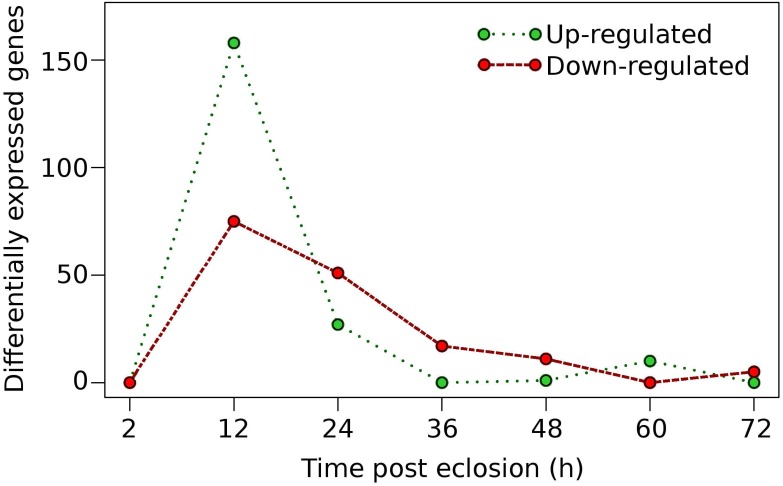
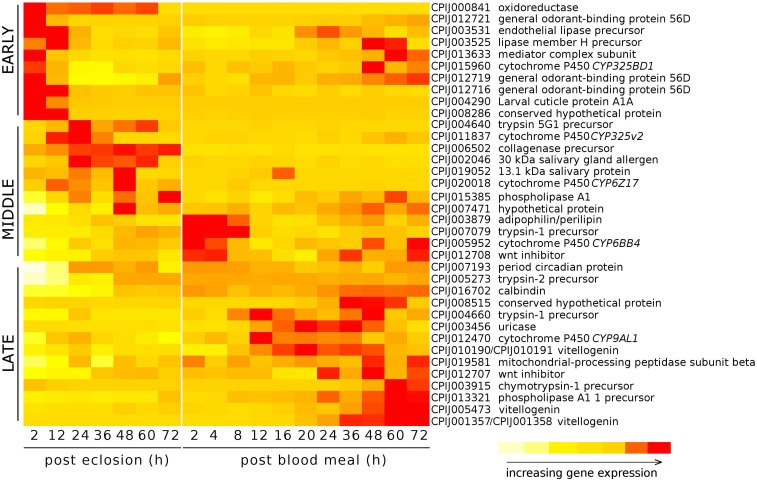
Prior to acquisition of the first host blood meal, the anautogenous mosquito Culex quinquefasciatus requires a period of time in order to prepare for the blood feeding and, later, vitellogenesis. In the current study, we conducted whole transcriptome analyses of adult female Culex mosquitoes to identify genes that may be necessary for both taking of the blood meal, and processing of the blood meal in adult female mosquitoes Cx. quinquefasciatus. We examined temporal expression of genes for the periods of post eclosion and prior to the female freely taking a blood meal. We further evaluated the temporal expression of certain genes for the periods after the taking of a blood meal to identify genes that may be necessary for both the taking of the blood meal, and the processing of the blood meal. We found that adult females required a minimum of 48 h post-eclosion before they freely took their first blood meal. We hypothesized that gene expression signatures were altered in the mosquitoes before blood feeding in preparation for the acquisition of the blood meal through changes in multiple gene expression. To identify the genes involved in the acquisition of blood feeding, we quantified the gene expression levels of adult female Cx. quinquefasciatus using RNA Seq throughout a pre-blooding period from 2 to 72 h post eclosion at 12 h intervals. A total of 325 genes were determined to be differentially-expressed throughout the pre-blooding period, with the majority of differentially-expressed genes occurring between the 2 h and 12 h post-eclosion time points. Among the up-regulated genes were salivary proteins, cytochrome P450s, odorant-binding proteins, and proteases, while the majority of the down-regulated genes were hypothetical or cuticular genes. In addition, Trypsin was found to be up-regulated immediately following blood feeding, while trypsin and chymotrypsin were up-regulated at 48 h and 60 h post blood-feeding, respectively, suggesting that these proteases are likely involved in the digestion of the blood meal. Overall, this study reviewed multiple genes that might be involved in the adult female competency for blood meal acquisition in mosquitoes.
在首次摄取宿主血餐之前,非自育性蚊子致倦库蚊需要一段时间来为取食血液以及随后的卵黄生成做准备。在本研究中,我们对成年雌性致倦库蚊进行了全转录组分析,以确定可能对成年雌性致倦库蚊摄取血餐和处理血餐都必需的基因。我们研究了羽化后至雌性自由摄取血餐之前这段时间内基因的表达情况。我们还进一步评估了摄取血餐之后某些基因的表达情况,以确定可能对摄取血餐和处理血餐都必需的基因。我们发现成年雌性在羽化后至少需要48小时才会自由摄取第一顿血餐。我们推测,在取食血液之前,蚊子体内的基因表达特征会通过多种基因表达的变化而改变,为摄取血餐做准备。为了确定参与取食血液的基因,我们在羽化后2至72小时的预吸血期内,每隔12小时使用RNA测序对成年雌性致倦库蚊的基因表达水平进行定量。在整个预吸血期内,共确定了325个差异表达基因,其中大多数差异表达基因出现在羽化后2小时至12小时的时间点之间。上调的基因包括唾液蛋白、细胞色素P450、气味结合蛋白和蛋白酶,而下调的基因大多数是假定基因或表皮基因。此外,发现胰蛋白酶在取食血液后立即上调,而胰蛋白酶和胰凝乳蛋白酶分别在取食血液后48小时和60小时上调,这表明这些蛋白酶可能参与血餐的消化。总体而言,本研究回顾了多个可能参与成年雌性蚊子摄取血餐能力的基因。