Ranković Slavica, Popović Tamara, Martačić Jasmina Debeljak, Petrović Snježana, Tomić Mirko, Ignjatović Đurđica, Tovilović-Kovačević Gordana, Glibetić Maria
Centre of Research Excellence in Nutrition and Metabolism, Institute for Medical Research, University of Belgrade, Tadeuša Košćuška 1, Belgrade, 11129, Serbia.
Institute for Biological Research "Siniša Stanković", University of Belgrade, Bulevar despota Stefana 142, Belgrade, 11060, Serbia.
Lipids Health Dis. 2017 May 19;16(1):94. doi: 10.1186/s12944-017-0483-9.
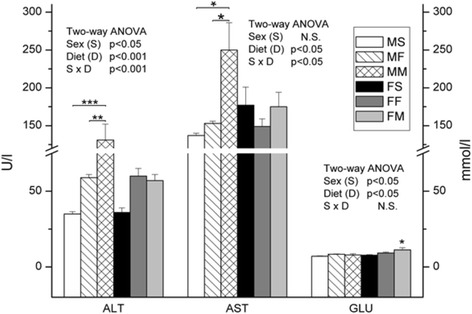
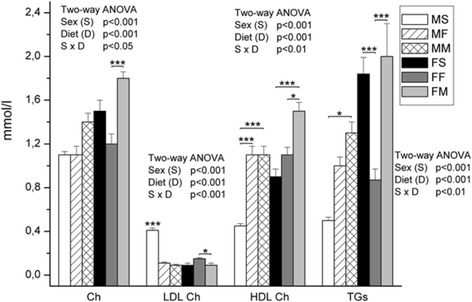
Dietary intake influence changes in fatty acids (FA) profiles in liver which plays a central role in fatty acid metabolism, triacylglycerol synthesis and energy homeostasis. We investigated the effects of 4-weeks treatment with milk- and fish-based diet, on plasma biochemical parameters and FA composition of liver phospholipids (PL) in rats of both sexes.
Adult, 4 months old, Wistar rats of both sexes, were fed with different types of diets: standard, milk-based and fish-based, during 4 weeks. Analytical characterization of different foods was done. Biochemical parameters in plasma were determined. Fatty acid composition was analyzed by gas-chromatography. Statistical significance of FA levels was tested with two-way analysis of variance (ANOVA) using the sex of animals and treatment (type of diet) as factors on logarithmic or trigonometric transformed data.
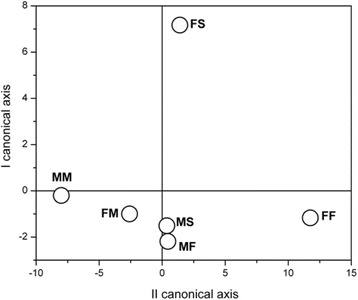
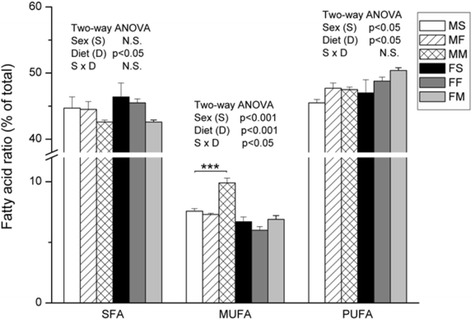
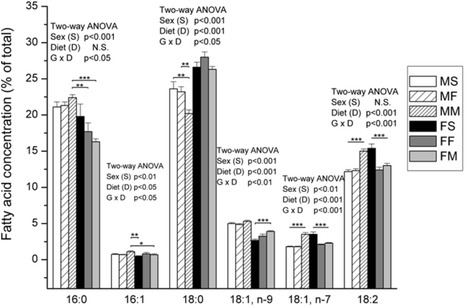
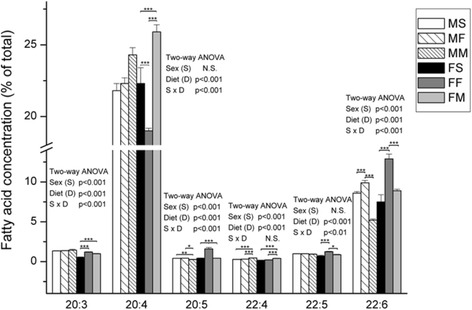
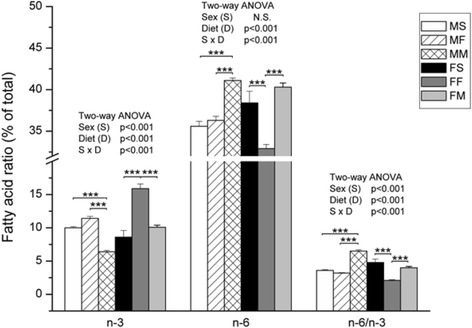
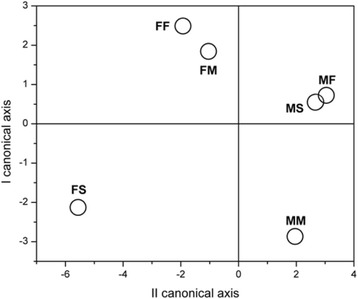
Our results showed that both, milk- and fish-based diet, changed the composition and ratio of rat liver phospholipids FA, in gender-specific manner. Initially present sex differences appear to be dietary modulated. Although, applied diets changed the ratio of total saturated fatty acids (SFA), monounsaturated fatty acids (MUFA) and polyunsaturated fatty acids (PUFA), and effects were gender specific. Milk-based diet lowered SFA and elevated MUFA in males and increased PUFA in females vs. standard diet. The same diet decreased n-3, increased n-6 and n-6/n-3 ratio in males. Fish-based diet increased n-3, decreased n-6 and n-6/n-3 ratio vs. standard and milk-based diet in females. However, the ratio of individual FA in liver PL was also dietary-influenced, but with gender specific manner. While in females fish-based diet decreased AA (arachidonic acid) increased level of EPA (eicosapentaenoic acid), DPA (docosapentaenoic acid) and DHA (docosahexaenoic acid), the same diet elevated only DHA levels in males.
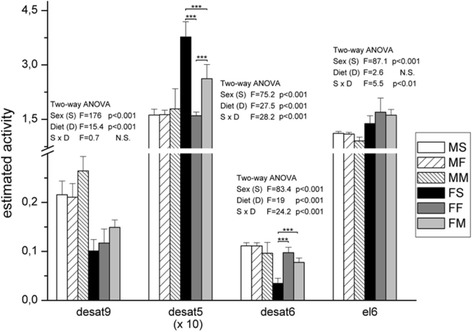
Gender related variations in FA composition of rat liver PL were observed, and results have shown that those initial differences could be significantly modulated by the type of diet. Furthermore, the modulatory effects of milk- and fish-based diets on liver phospholipids FA profiles appeared to be sex-specific.
饮食摄入会影响肝脏中脂肪酸(FA)谱的变化,而肝脏在脂肪酸代谢、三酰甘油合成和能量稳态中起着核心作用。我们研究了以牛奶和鱼类为基础的饮食进行4周治疗对雌雄大鼠血浆生化参数和肝脏磷脂(PL)脂肪酸组成的影响。
4个月大的成年Wistar雌雄大鼠在4周内喂食不同类型的饮食:标准饮食、以牛奶为基础的饮食和以鱼类为基础的饮食。对不同食物进行分析表征。测定血浆中的生化参数。通过气相色谱分析脂肪酸组成。使用动物性别和治疗(饮食类型)作为因素,对对数或三角变换数据进行双向方差分析(ANOVA),以检验脂肪酸水平的统计学显著性。
我们的结果表明,以牛奶和鱼类为基础的饮食均以性别特异性方式改变了大鼠肝脏磷脂脂肪酸的组成和比例。最初存在的性别差异似乎受到饮食调节。尽管所应用的饮食改变了总饱和脂肪酸(SFA)、单不饱和脂肪酸(MUFA)和多不饱和脂肪酸(PUFA)的比例,且影响具有性别特异性。与标准饮食相比,以牛奶为基础的饮食降低了雄性大鼠的SFA并提高了MUFA,在雌性大鼠中增加了PUFA。相同的饮食降低了雄性大鼠的n-3,增加了n-6和n-6/n-3比例。与标准饮食和以牛奶为基础的饮食相比,以鱼类为基础的饮食在雌性大鼠中增加了n-3,降低了n-6和n-6/n-3比例。然而,肝脏磷脂中单个脂肪酸的比例也受到饮食影响,但具有性别特异性。在雌性大鼠中,以鱼类为基础的饮食降低了花生四烯酸(AA),提高了二十碳五烯酸(EPA)、二十二碳五烯酸(DPA)和二十二碳六烯酸(DHA)的水平,而相同的饮食在雄性大鼠中仅提高了DHA水平。
观察到大鼠肝脏磷脂脂肪酸组成存在与性别相关的差异,结果表明这些初始差异可通过饮食类型得到显著调节。此外,以牛奶和鱼类为基础的饮食对肝脏磷脂脂肪酸谱的调节作用似乎具有性别特异性。