May-Wilson Sebastian, Sud Amit, Law Philip J, Palin Kimmo, Tuupanen Sari, Gylfe Alexandra, Hänninen Ulrika A, Cajuso Tatiana, Tanskanen Tomas, Kondelin Johanna, Kaasinen Eevi, Sarin Antti-Pekka, Eriksson Johan G, Rissanen Harri, Knekt Paul, Pukkala Eero, Jousilahti Pekka, Salomaa Veikko, Ripatti Samuli, Palotie Aarno, Renkonen-Sinisalo Laura, Lepistö Anna, Böhm Jan, Mecklin Jukka-Pekka, Al-Tassan Nada A, Palles Claire, Farrington Susan M, Timofeeva Maria N, Meyer Brian F, Wakil Salma M, Campbell Harry, Smith Christopher G, Idziaszczyk Shelley, Maughan Timothy S, Fisher David, Kerr Rachel, Kerr David, Passarelli Michael N, Figueiredo Jane C, Buchanan Daniel D, Win Aung K, Hopper John L, Jenkins Mark A, Lindor Noralane M, Newcomb Polly A, Gallinger Steven, Conti David, Schumacher Fred, Casey Graham, Aaltonen Lauri A, Cheadle Jeremy P, Tomlinson Ian P, Dunlop Malcolm G, Houlston Richard S
Division of Genetics and Epidemiology, The Institute of Cancer Research, London, SW7 3RP, UK.
Genome-Scale Biology Research Program, Research Programs Unit, University of Helsinki, Helsinki, 00014, Finland; Department of Medical and Clinical Genetics, Medicum, University of Helsinki, Helsinki, 00014, Finland.
Eur J Cancer. 2017 Oct;84:228-238. doi: 10.1016/j.ejca.2017.07.034. Epub 2017 Aug 19.
While dietary fat has been established as a risk factor for colorectal cancer (CRC), associations between fatty acids (FAs) and CRC have been inconsistent. Using Mendelian randomisation (MR), we sought to evaluate associations between polyunsaturated (PUFA), monounsaturated (MUFA) and saturated FAs (SFAs) and CRC risk.
We analysed genotype data on 9254 CRC cases and 18,386 controls of European ancestry. Externally weighted polygenic risk scores were generated and used to evaluate associations with CRC per one standard deviation increase in genetically defined plasma FA levels.
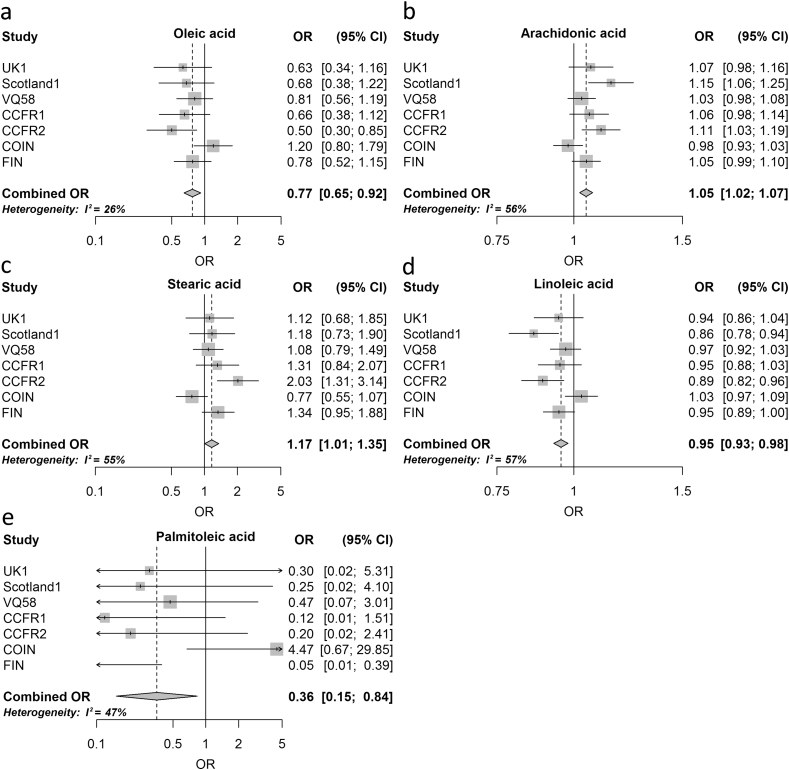
Risk reduction was observed for oleic and palmitoleic MUFAs (OR = 0.77, 95% CI: 0.65-0.92, P = 3.9 × 10; OR = 0.36, 95% CI: 0.15-0.84, P = 0.018). PUFAs linoleic and arachidonic acid had negative and positive associations with CRC respectively (OR = 0.95, 95% CI: 0.93-0.98, P = 3.7 × 10; OR = 1.05, 95% CI: 1.02-1.07, P = 1.7 × 10). The SFA stearic acid was associated with increased CRC risk (OR = 1.17, 95% CI: 1.01-1.35, P = 0.041).
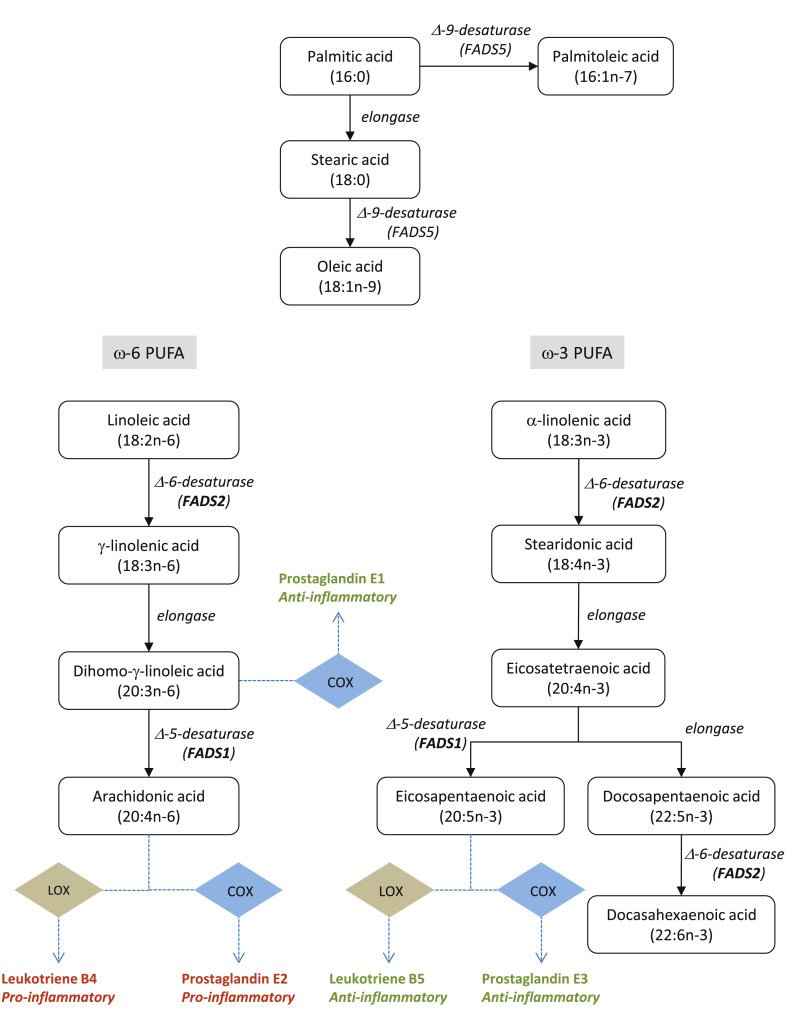
Results from our analysis are broadly consistent with a pro-inflammatory FA profile having a detrimental effect in terms of CRC risk.
虽然膳食脂肪已被确认为结直肠癌(CRC)的一个风险因素,但脂肪酸(FAs)与CRC之间的关联并不一致。我们使用孟德尔随机化(MR)方法来评估多不饱和脂肪酸(PUFA)、单不饱和脂肪酸(MUFA)和饱和脂肪酸(SFA)与CRC风险之间的关联。
我们分析了9254例CRC病例和18386例欧洲血统对照的基因型数据。生成了外部加权多基因风险评分,并用于评估基因定义的血浆FA水平每增加一个标准差与CRC的关联。
观察到油酸和棕榈油酸等MUFA有降低风险的作用(OR = 0.77,95%CI:0.65 - 0.92,P = 3.9×10;OR = 0.36,95%CI:0.15 - 0.84,P = 0.018)。PUFA中的亚油酸和花生四烯酸分别与CRC呈负相关和正相关(OR = 0.95,95%CI:0.93 - 0.98,P = 3.7×10;OR = 1.05,95%CI:1.02 - 1.07,P = 1.7×10)。SFA硬脂酸与CRC风险增加有关(OR = 1.17,95%CI:1.01 - 1.35,P = 0.041)。
我们的分析结果大致与促炎FA谱对CRC风险有不利影响一致。