Williams Jessica R, Gonzalez-Guarda Rosa M, Ilias Vanessa
J Assoc Nurses AIDS Care. 2017 Sep-Oct;28(5):819-831. doi: 10.1016/j.jana.2017.04.010. Epub 2017 May 4.
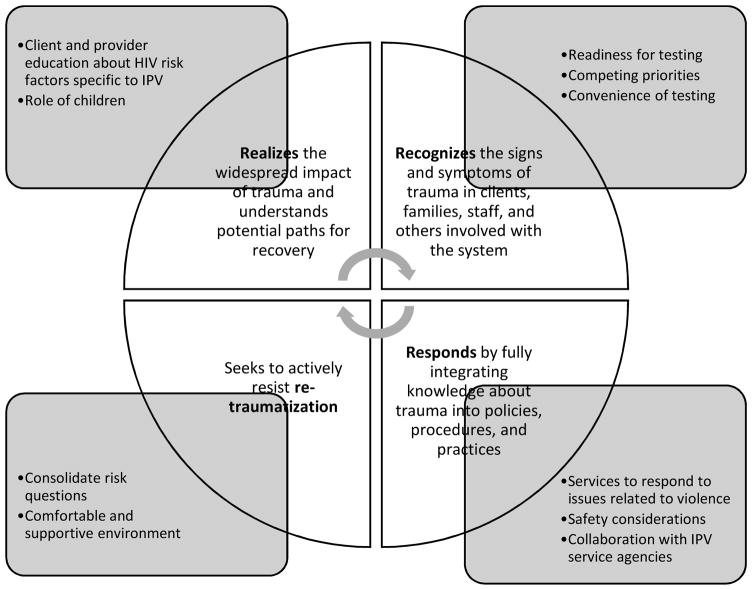
We explored the process of implementing an HIV testing program at an intimate partner violence (IPV) service agency from the client and provider perspectives. A qualitative descriptive approach was used wherein semi-structured interviews were conducted with 19 key informants (i.e., women with a history of IPV, HIV service providers, IPV service providers). Interviews focused on facilitators and barriers to HIV testing implementation, the decision-making process during HIV testing, and support needs. All interviews were recorded and transcribed. The text of the interviews was analyzed using directed content analysis. Unique factors were found to influence HIV testing in victims of IPV including potential for re-traumatization, readiness for testing, competing priorities, and the influence of children. The results provided important information that can be used to improve the implementation of HIV testing, tailoring processes so they are more trauma-informed; and better support individuals with a history of IPV.
我们从客户和提供者的角度探讨了在亲密伴侣暴力(IPV)服务机构实施艾滋病毒检测计划的过程。采用了定性描述方法,对19名关键信息提供者(即有IPV病史的女性、艾滋病毒服务提供者、IPV服务提供者)进行了半结构化访谈。访谈重点关注艾滋病毒检测实施的促进因素和障碍、艾滋病毒检测期间的决策过程以及支持需求。所有访谈均进行了录音和转录。使用定向内容分析法对访谈文本进行了分析。发现了影响IPV受害者艾滋病毒检测的独特因素,包括再次创伤的可能性、检测准备情况、相互竞争的优先事项以及儿童的影响。研究结果提供了重要信息,可用于改进艾滋病毒检测的实施,调整流程使其更具创伤意识,并更好地支持有IPV病史的个人。