Hong Jin-Ni, Li Wei-Wei, Wang Lin-Lin, Guo Hao, Jiang Yong, Gao Yun-Jia, Tu Peng-Fei, Wang Xue-Mei
Integrated Laboratory of Traditional Chinese Medicine and Western Medicine, Peking University First Hospital, Beijing, People's Republic of China.
Institute of Basic Medical Sciences, Xiyuan Hospital, China Academy of Chinese Medical Sciences, Beijing, People's Republic of China.
Chin Med. 2017 May 19;12:13. doi: 10.1186/s13020-017-0134-0. eCollection 2017.
Jiangtang decoction (JTD) is a China patented drug which contains Willd, Bunge, Bunge, Bunge, and Franch. For decades, it has also been used clinically to treat diabetic nephropathy (DN) effectively; however, the associated mechanisms remain unknown. Thus, the present study aimed to examine the protective efficacy of JTD in DN and elucidate the underlying molecular mechanisms.
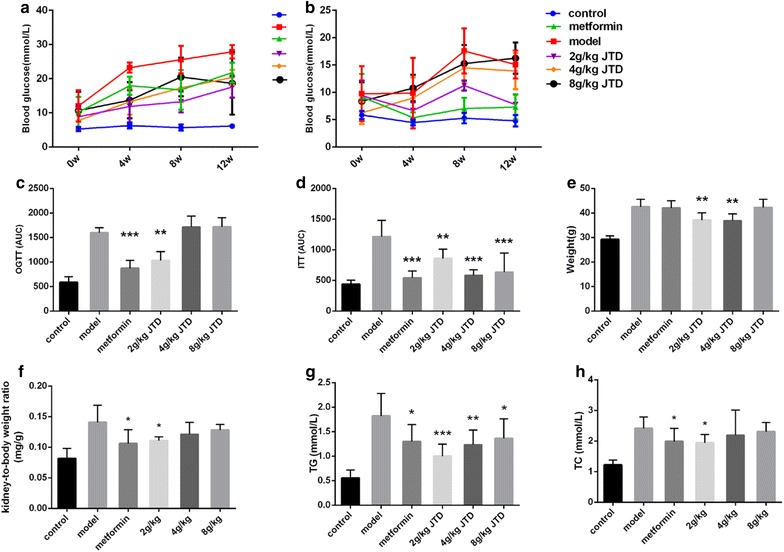
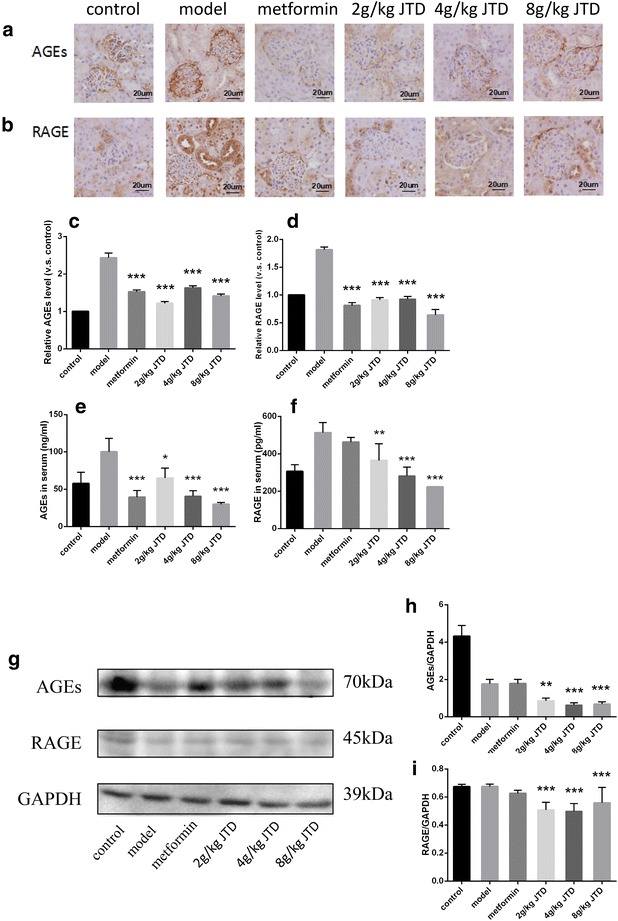
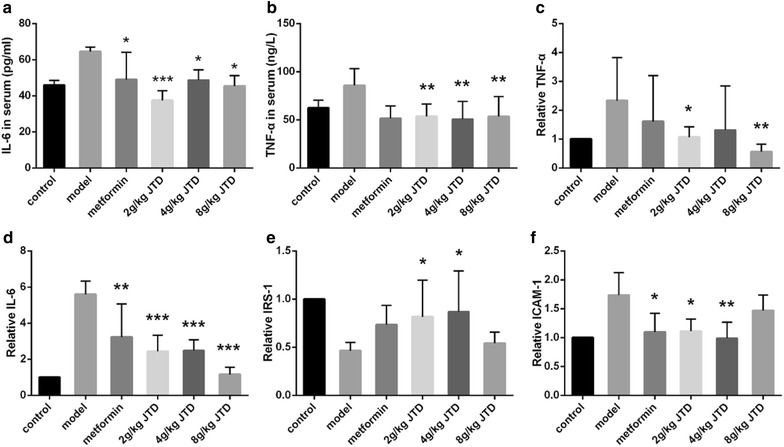
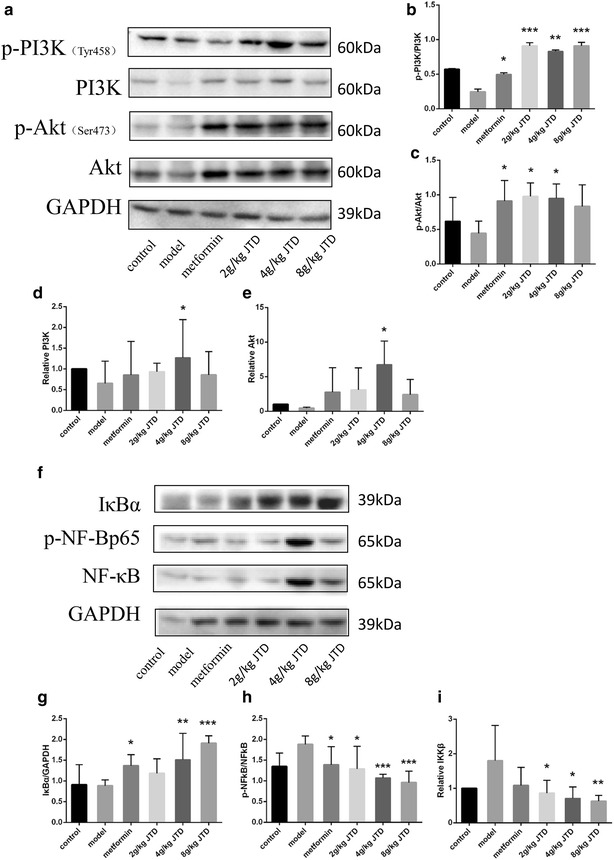
A diabetic model using KK-Ay mice received a daily administration of JTD for 12 weeks. Body weight, blood glucose, triglycerides (TGs), total cholesterol (TC), urea nitrogen (UN), creatinine (Cr), and microalbumin/urine creatinine (MA/UCREA) was measured every 4 weeks. Furthermore, on the day of the sacrifice, blood, urine, and kidneys were collected to assess renal function according to general parameters. Pathological staining was performed to evaluate the protective renal effect of JTD. In addition, the levels of inflammatory cytokines (tumor necrosis factor-α [TNF-α], interleukin [IL]-6 and intercellular adhesion molecule [ICAM]-1), insulin receptor substrate [IRS]-1, advanced glycation end products [AGEs], and receptor of glycation end products [RAGE] were assessed. Finally, the phosphoinositide 3-kinase (PI3K)/protein kinase B (Akt) signaling pathway and involvement of nuclear factor-κB (NF-κB) was further analyzed.
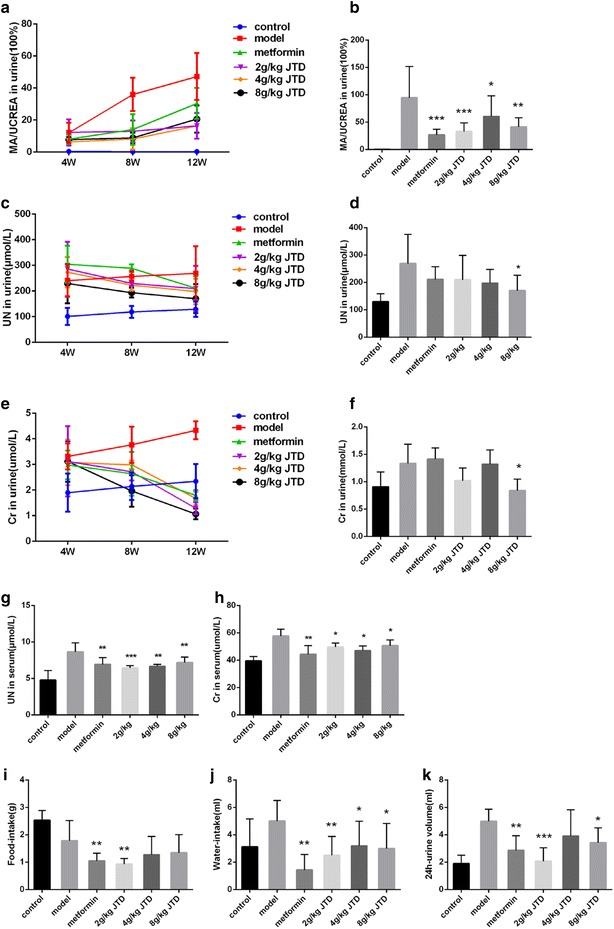
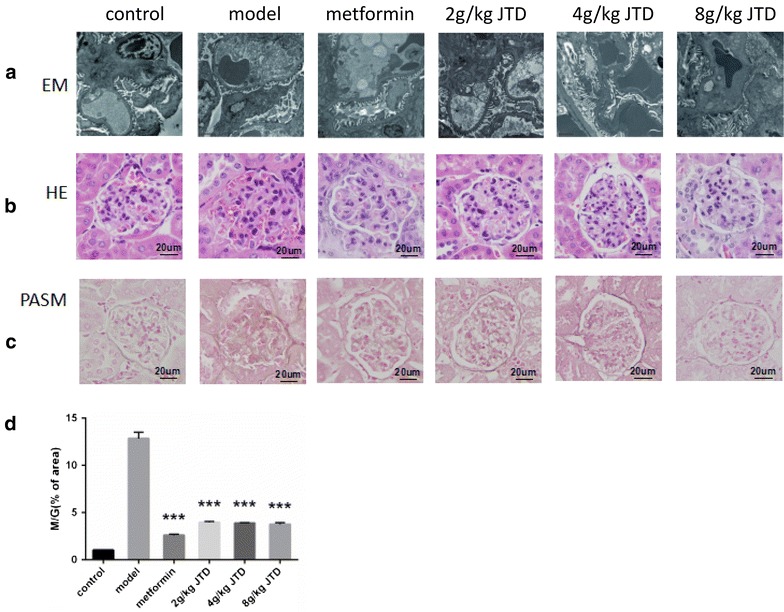
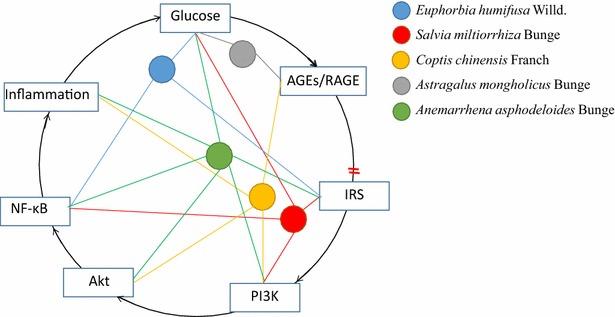
After 12 weeks of metformin and JTD administration, the mice exhibited a significant amelioration in glucose and lipid metabolism dysfunction, reduced morphological changes in the renal tissue, decreased urinary albumin excretion, and normalized creatinine clearance. JTD treatment also reduced the accumulation of AGEs and RAGE, up-regulated IRS-1, and increased the phosphorylation of both PI3K (p85) and Akt, indicating that the activation of the PI3K/Akt signaling pathway was involved. Additionally, JTD administration reduced the elevated levels of renal inflammatory mediators and decreased the phosphorylation of NF-κB p65.
These results demonstrate that JTD might reduce inflammation in DN through the PI3K/Akt and NF-κB signaling pathways.
降糖汤(JTD)是一种中国专利药物,其成分包含[具体植物名称未给出,原文Willd, Bunge, Bunge, Bunge, and Franch]。几十年来,它也一直被临床用于有效治疗糖尿病肾病(DN);然而,相关机制仍不清楚。因此,本研究旨在探讨JTD对DN的保护作用及其潜在的分子机制。
使用KK-Ay小鼠建立糖尿病模型,每天给予JTD,持续12周。每4周测量体重、血糖、甘油三酯(TGs)、总胆固醇(TC)、尿素氮(UN)、肌酐(Cr)和微量白蛋白/尿肌酐(MA/UCREA)。此外,在处死当天,收集血液、尿液和肾脏,根据一般参数评估肾功能。进行病理染色以评估JTD对肾脏的保护作用。另外,评估炎症细胞因子(肿瘤坏死因子-α [TNF-α]、白细胞介素 [IL]-6和细胞间黏附分子 [ICAM]-1)、胰岛素受体底物 [IRS]-1、晚期糖基化终产物 [AGEs] 和糖基化终产物受体 [RAGE] 的水平。最后,进一步分析磷脂酰肌醇3-激酶(PI3K)/蛋白激酶B(Akt)信号通路以及核因子-κB(NF-κB)的参与情况。
给予二甲双胍和JTD 12周后,小鼠在糖脂代谢功能障碍方面有显著改善,肾组织形态学变化减少,尿白蛋白排泄减少,肌酐清除率恢复正常。JTD治疗还减少了AGEs和RAGE的积累,上调了IRS-1,并增加了PI3K(p85)和Akt的磷酸化,表明PI3K/Akt信号通路的激活参与其中。此外,给予JTD降低了肾脏炎症介质的升高水平,并减少了NF-κB p65的磷酸化。
这些结果表明,JTD可能通过PI3K/Akt和NF-κB信号通路减轻DN中的炎症反应。