Succurro Antonella, Moejes Fiona Wanjiku, Ebenhöh Oliver
Botanical Institute, University of Cologne, Cologne, Germany
Cluster of Excellence on Plant Sciences (CEPLAS), Düsseldorf, Germany.
J Bacteriol. 2017 Jul 11;199(15). doi: 10.1128/JB.00865-16. Print 2017 Aug 1.
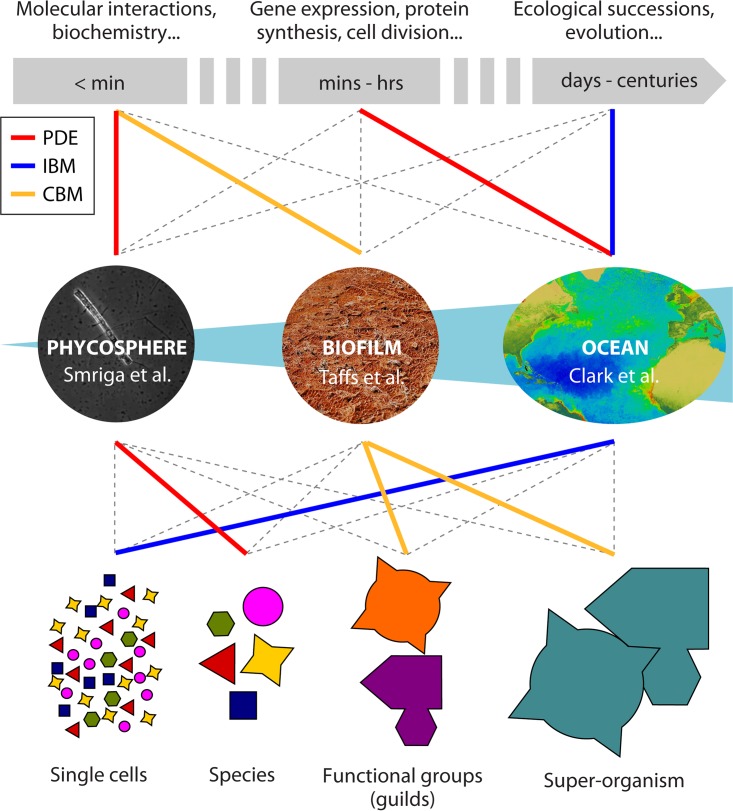
The last few years have seen the advancement of high-throughput experimental techniques that have produced an extraordinary amount of data. Bioinformatics and statistical analyses have become instrumental to interpreting the information coming from, e.g., sequencing data and often motivate further targeted experiments. The broad discipline of "computational biology" extends far beyond the well-established field of bioinformatics, but it is our impression that more theoretical methods such as the use of mathematical models are not yet as well integrated into the research studying microbial interactions. The empirical complexity of microbial communities presents challenges that are difficult to address with / approaches alone, and with microbiology developing from a qualitative to a quantitative science, we see stronger opportunities arising for interdisciplinary projects integrating theoretical approaches with experiments. Indeed, the addition of experiments, i.e., computational simulations, has a discovery potential that is, unfortunately, still largely underutilized and unrecognized by the scientific community. This minireview provides an overview of mathematical models of natural ecosystems and emphasizes that one critical point in the development of a theoretical description of a microbial community is the choice of problem scale. Since this choice is mostly dictated by the biological question to be addressed, in order to employ theoretical models fully and successfully it is vital to implement an interdisciplinary view at the conceptual stages of the experimental design.
在过去几年中,高通量实验技术取得了进展,产生了大量的数据。生物信息学和统计分析对于解读来自例如测序数据的信息变得至关重要,并且常常推动进一步的靶向实验。“计算生物学”这一广泛的学科远远超出了已成熟的生物信息学领域,但我们的印象是,诸如使用数学模型等更多的理论方法尚未很好地融入到研究微生物相互作用的研究中。微生物群落的经验复杂性带来了仅用[此处原文缺失具体方法内容]方法难以解决的挑战,并且随着微生物学从定性科学发展为定量科学,我们看到将理论方法与实验相结合的跨学科项目出现了更强的机遇。确实,增加实验,即计算模拟,具有发现潜力,不幸的是,这种潜力在很大程度上仍未被科学界充分利用和认识到。本综述概述了自然生态系统的数学模型,并强调在微生物群落理论描述的发展中一个关键点是问题规模的选择。由于这种选择大多由要解决的生物学问题决定,为了充分且成功地应用理论模型,在实验设计的概念阶段实施跨学科观点至关重要。