Succurro Antonella, Segrè Daniel, Ebenhöh Oliver
Botanical Institute, University of Cologne, Cologne, Germany.
Cluster of Excellence on Plant Sciences (CEPLAS), Düsseldorf, Germany.
mSystems. 2019 Jan 15;4(1). doi: 10.1128/mSystems.00230-18. eCollection 2019 Jan-Feb.
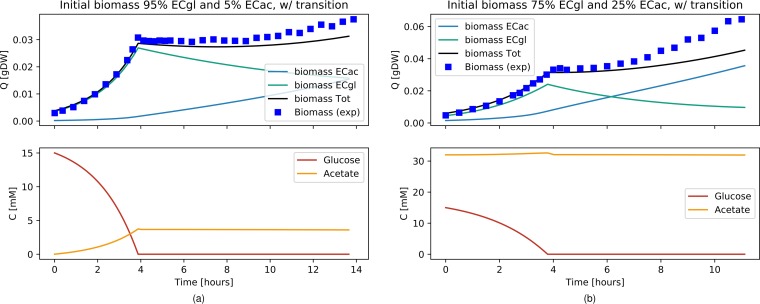
Microbes have adapted to greatly variable environments in order to survive both short-term perturbations and permanent changes. A classical and yet still actively studied example of adaptation to dynamic environments is the diauxic shift of Escherichia coli, in which cells grow on glucose until its exhaustion and then transition to using previously secreted acetate. Here we tested different hypotheses concerning the nature of this transition by using dynamic metabolic modeling. To reach this goal, we developed an open source modeling framework integrating dynamic models (ordinary differential equation systems) with structural models (metabolic networks) which can take into account the behavior of multiple subpopulations and smooth flux transitions between time points. We used this framework to model the diauxic shift, first with a single E. coli model whose metabolic state represents the overall population average and then with a community of two subpopulations, each growing exclusively on one carbon source (glucose or acetate). After introduction of an environment-dependent transition function that determined the balance between subpopulations, our model generated predictions that are in strong agreement with published data. Our results thus support recent experimental evidence that diauxie, rather than a coordinated metabolic shift, would be the emergent pattern of individual cells differentiating for optimal growth on different substrates. This work offers a new perspective on the use of dynamic metabolic modeling to investigate population heterogeneity dynamics. The proposed approach can easily be applied to other biological systems composed of metabolically distinct, interconverting subpopulations and could be extended to include single-cell-level stochasticity. Escherichia coli diauxie is a fundamental example of metabolic adaptation, a phenomenon that is not yet completely understood. Further insight into this process can be achieved by integrating experimental and computational modeling methods. We present a dynamic metabolic modeling approach that captures diauxie as an emergent property of subpopulation dynamics in E. coli monocultures. Without fine-tuning the parameters of the E. coli core metabolic model, we achieved good agreement with published data. Our results suggest that single-organism metabolic models can only approximate the average metabolic state of a population, therefore offering a new perspective on the use of such modeling approaches. The open source modeling framework that we provide can be applied to model general subpopulation systems in more-complex environments and can be extended to include single-cell-level stochasticity.
微生物已经适应了千变万化的环境,以便在短期扰动和永久性变化中都能生存下来。一个经典且仍在积极研究的适应动态环境的例子是大肠杆菌的二次生长转变,即细胞在葡萄糖上生长直至耗尽,然后转而利用先前分泌的乙酸盐。在这里,我们通过使用动态代谢建模来检验关于这种转变本质的不同假设。为了实现这一目标,我们开发了一个开源建模框架,将动态模型(常微分方程系统)与结构模型(代谢网络)整合在一起,该框架可以考虑多个亚群的行为以及时间点之间平滑的通量转变。我们使用这个框架对二次生长转变进行建模,首先使用一个单一的大肠杆菌模型,其代谢状态代表总体群体平均值,然后使用一个由两个亚群组成的群落,每个亚群仅在一种碳源(葡萄糖或乙酸盐)上生长。在引入一个依赖环境的转变函数来确定亚群之间的平衡后,我们的模型产生的预测与已发表的数据高度一致。因此,我们的结果支持了最近的实验证据,即二次生长转变,而非协调的代谢转变,将是单个细胞为在不同底物上实现最佳生长而分化的涌现模式。这项工作为使用动态代谢建模来研究群体异质性动态提供了一个新视角。所提出的方法可以很容易地应用于由代谢不同、相互转化的亚群组成的其他生物系统,并且可以扩展到包括单细胞水平的随机性。大肠杆菌的二次生长转变是代谢适应的一个基本例子,这一现象尚未完全被理解。通过整合实验和计算建模方法,可以进一步深入了解这个过程。我们提出了一种动态代谢建模方法,将二次生长转变捕获为大肠杆菌单培养中亚群动态的一种涌现特性。在不对大肠杆菌核心代谢模型的参数进行微调的情况下,我们取得了与已发表数据的良好一致性。我们的结果表明,单生物体代谢模型只能近似群体的平均代谢状态,因此为使用此类建模方法提供了一个新视角。我们提供的开源建模框架可以应用于对更复杂环境中的一般亚群系统进行建模,并且可以扩展到包括单细胞水平的随机性。