Saa Pedro, Urrutia Arles, Silva-Andrade Claudia, Martín Alberto J, Garrido Daniel
Department of Chemical and Bioprocess Engineering, School of Engineering, Pontificia Universidad Católica de Chile, Santiago, Chile.
Institute for Mathematical and Computational Engineering, Pontificia Universidad Católica de Chile, Vicuña Mackenna, 4860 Santiago, Chile.
Comput Struct Biotechnol J. 2021 Dec 8;20:79-89. doi: 10.1016/j.csbj.2021.12.006. eCollection 2022.
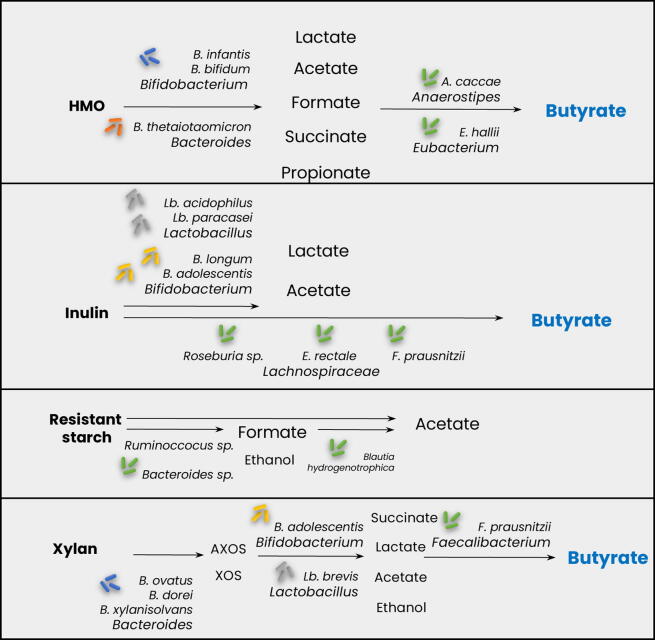
Microbial communities perform emergent activities that are essentially different from those carried by their individual members. The gut microbiome and its metabolites have a significant impact on the host, contributing to homeostasis or disease. Food molecules shape this community, being fermented through cross-feeding interactions of metabolites such as lactate, acetate, and amino acids, or products derived from macromolecule degradation. Mathematical and experimental approaches have been applied to understand and predict the interactions between microorganisms in complex communities such as the gut microbiota. Rational and mechanistic understanding of microbial interactions is essential to exploit their metabolic activities and identify keystone taxa and metabolites. The latter could be used in turn to modulate or replicate the metabolic behavior of the community in different contexts. This review aims to highlight recent experimental and modeling approaches for studying cross-feeding interactions within the gut microbiome. We focus on short-chain fatty acid production and fiber fermentation, which are fundamental processes in human health and disease. Special attention is paid to modeling approaches, particularly kinetic and genome-scale stoichiometric models of metabolism, to integrate experimental data under different diet and health conditions. Finally, we discuss limitations and challenges for the broad application of these modeling approaches and their experimental verification for improving our understanding of the mechanisms of microbial interactions.
微生物群落执行的涌现活动与它们个体成员所执行的活动本质上不同。肠道微生物群及其代谢产物对宿主有重大影响,有助于维持体内平衡或引发疾病。食物分子塑造了这个群落,通过乳酸、乙酸和氨基酸等代谢产物或大分子降解产物的交叉喂养相互作用进行发酵。数学和实验方法已被应用于理解和预测复杂群落(如肠道微生物群)中微生物之间的相互作用。对微生物相互作用进行合理和机制性的理解对于利用它们的代谢活动以及识别关键分类群和代谢产物至关重要。后者进而可用于在不同背景下调节或复制群落的代谢行为。本综述旨在强调研究肠道微生物群内交叉喂养相互作用的最新实验和建模方法。我们关注短链脂肪酸的产生和纤维发酵,它们是人类健康和疾病中的基本过程。特别关注建模方法,尤其是代谢的动力学和基因组规模化学计量模型,以整合不同饮食和健康状况下的实验数据。最后,我们讨论这些建模方法广泛应用的局限性和挑战以及它们为增进我们对微生物相互作用机制的理解而进行的实验验证。