Bell Vaughan, Mills Kathryn L, Modinos Gemma, Wilkinson Sam
Division of Psychiatry, University College London, 6th Floor, Maple House, 149 Tottenham Court Road, London, W1T 7NF, UK.
Institute of Cognitive Neuroscience, University College London, 17 Queen Square, London, WC1N 3AR, UK.
Clin Psychol Sci. 2017 May;5(3):537-550. doi: 10.1177/2167702616677079. Epub 2017 Feb 10.
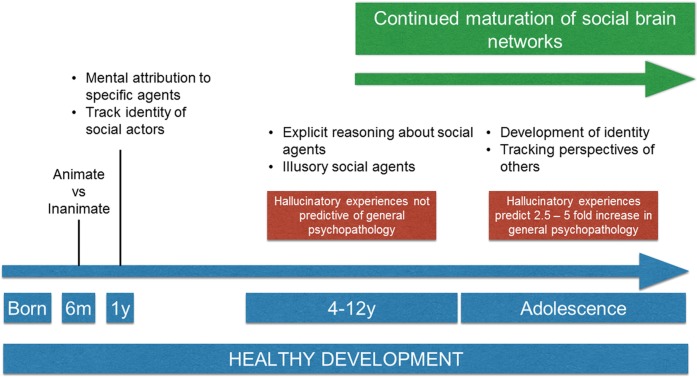
The positive symptoms of psychosis largely involve the experience of illusory social actors and yet our current measures of social cognition, at best, only weakly predict their presence. We review evidence to suggest that the range of current approaches in social cognition is not sufficient to explain the fundamentally social nature of these experiences. We argue that social agent representation is an important organising principle for understanding social cognition and that alterations in social agent representation may be a factor in the formation of delusions and hallucination in psychosis. We evaluate the feasibility of this approach in light of clinical and non-clinical studies, developmental research, cognitive anthropology and comparative psychology. We conclude with recommendations for empirical testing of specific hypotheses and how studies of social cognition could more fully capture the extent of social reasoning and experience in both psychosis and more prosaic mental states.
精神病的阳性症状很大程度上涉及虚幻社会行为者的体验,然而我们目前的社会认知测量方法充其量只能微弱地预测这些症状的出现。我们回顾证据表明,当前社会认知方法的范围不足以解释这些体验的根本社会性。我们认为,社会行为者表征是理解社会认知的一个重要组织原则,社会行为者表征的改变可能是精神病中妄想和幻觉形成的一个因素。我们根据临床和非临床研究、发展研究、认知人类学和比较心理学来评估这种方法的可行性。我们最后提出了对具体假设进行实证检验的建议,以及社会认知研究如何能够更全面地捕捉精神病和更普通心理状态下社会推理和体验的程度。