Owili Patrick Opiyo, Muga Miriam Adoyo, Pan Wen-Chi, Kuo Hsien-Wen
International Ph.D. Program in Environmental Science and Technology, Institute of Environmental and Occupational Health Sciences, School of Medicine, National Yang-Ming University, Taipei, Taiwan.
Institute of Community Health and Development, Great Lakes University of Kisumu, Kisumu, Kenya.
PLoS One. 2017 May 23;12(5):e0177271. doi: 10.1371/journal.pone.0177271. eCollection 2017.
Inhalation of secondhand smoke from tobacco results in serious health outcomes among under-five children, and yet, few studies have assessed its effect on under-five mortality. We investigated the association between frequency of exposure to household tobacco smoke and risk of under-five mortality in sub-Saharan Africa (SSA).
Demographic Health Survey data of under-five children from 23 SSA countries (n = 787,484) were used. Cox proportional hazard models described the association between exposure to tobacco smoke and the risk of under-five mortality in each country, with age as the time-to-event indicator. Meta-analysis was used to investigate the overall effect of tobacco smoke in SSA.
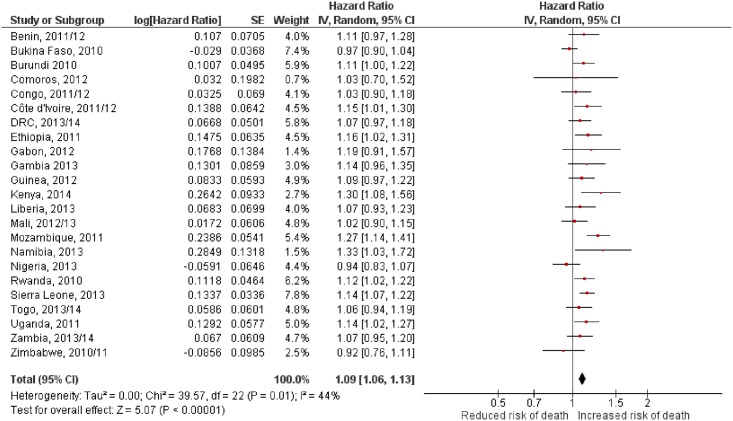
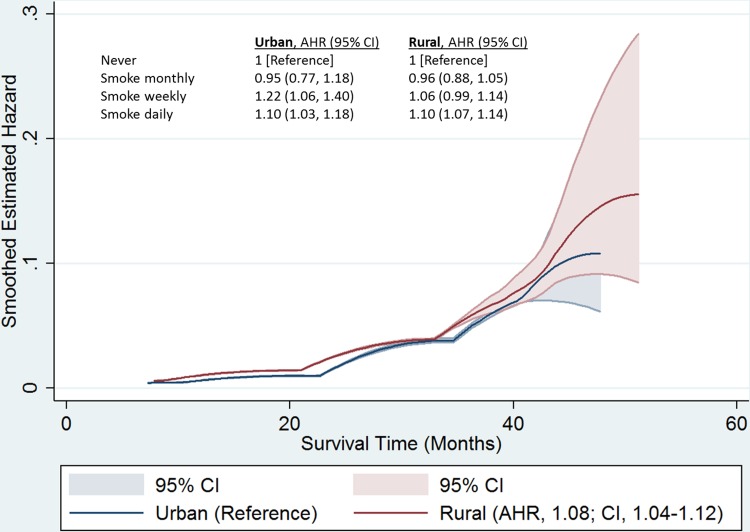
The association between tobacco smoke exposure and the risk of under-five mortality attenuated in eight countries (Burkina Faso, Benin, Congo, Gabon, Guinea, Liberia, Togo, and Zambia) after adjustment, while the hazard ratios (HR) of daily exposure to tobacco smoke in Kenya (HR = 1.40; 95% CI, 1.16-1.70) and Namibia (HR = 1.40; 1.07-1.83) grew. The children in rural areas in SSA were 1.08 (95% CI, 1.04-1.13) times more likely to die than their urban peers. In general, the exposure to household tobacco smoke was associated with an increased risk of under-five mortality in SSA (HR = 1.09; 95% CI, 1.06-1.13).
This study provided evidence of a positive association between exposure to household tobacco smoke and risk of under-five mortality in SSA. Policymakers in low- and middle-income countries, where tobacco control as a child health issue is relatively neglected, should integrate tobacco control measures with other child health promotion policies.
吸入二手烟草烟雾会给五岁以下儿童带来严重的健康后果,然而,很少有研究评估其对五岁以下儿童死亡率的影响。我们调查了撒哈拉以南非洲(SSA)地区接触家庭烟草烟雾的频率与五岁以下儿童死亡风险之间的关联。
使用了来自23个撒哈拉以南非洲国家的五岁以下儿童的人口健康调查数据(n = 787,484)。Cox比例风险模型描述了每个国家接触烟草烟雾与五岁以下儿童死亡风险之间的关联,以年龄作为事件发生时间指标。采用荟萃分析来研究烟草烟雾在撒哈拉以南非洲地区的总体影响。
调整后,八个国家(布基纳法索、贝宁、刚果、加蓬、几内亚、利比里亚、多哥和赞比亚)的烟草烟雾暴露与五岁以下儿童死亡风险之间的关联减弱,而肯尼亚(风险比[HR]=1.40;95%置信区间[CI],1.16 - 1.70)和纳米比亚(HR = 1.40;1.07 - 1.83)每日接触烟草烟雾的HR值增加。撒哈拉以南非洲农村地区的儿童死亡可能性是城市同龄儿童的1.08倍(95%CI,1.04 - 1.13)。总体而言,在撒哈拉以南非洲地区,接触家庭烟草烟雾与五岁以下儿童死亡风险增加相关(HR = 1.09;95%CI,1.06 - 1.13)。
本研究提供了证据,证明在撒哈拉以南非洲地区,接触家庭烟草烟雾与五岁以下儿童死亡风险呈正相关。在烟草控制作为儿童健康问题相对被忽视的低收入和中等收入国家,政策制定者应将烟草控制措施与其他儿童健康促进政策相结合。