Luitz Manuel P, Barth Anders, Crevenna Alvaro H, Bomblies Rainer, Lamb Don C, Zacharias Martin
Department Physik, T38, Technische Universität München, 85748 Garching, Germany.
Department Chemie, Physikalische Chemie, Ludwig-Maximilians-Universität München, 81377 München, Germany.
PLoS One. 2017 May 23;12(5):e0177139. doi: 10.1371/journal.pone.0177139. eCollection 2017.
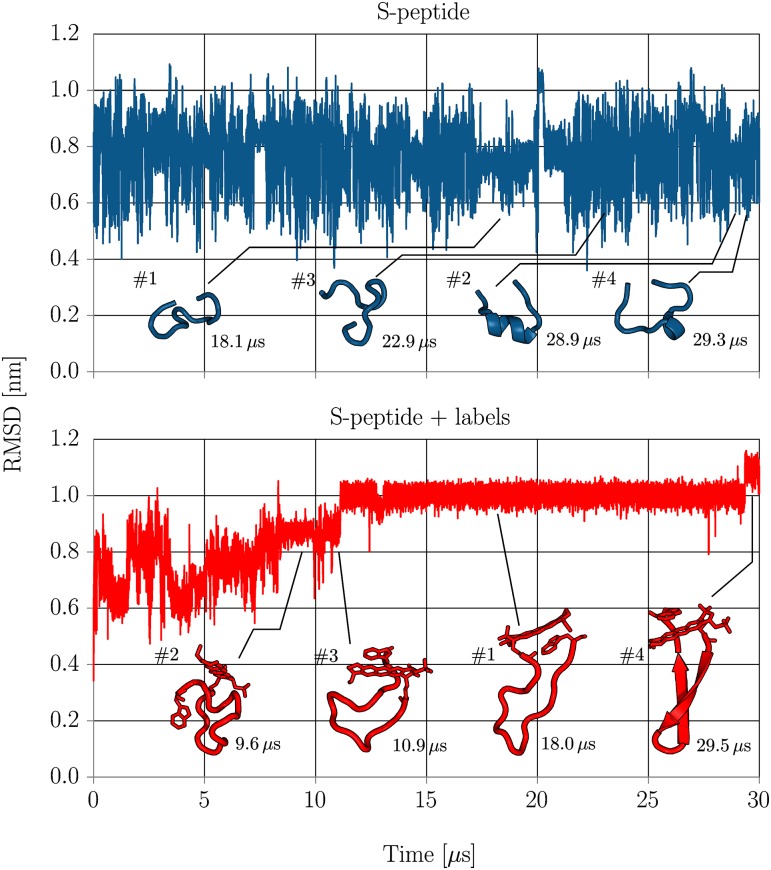
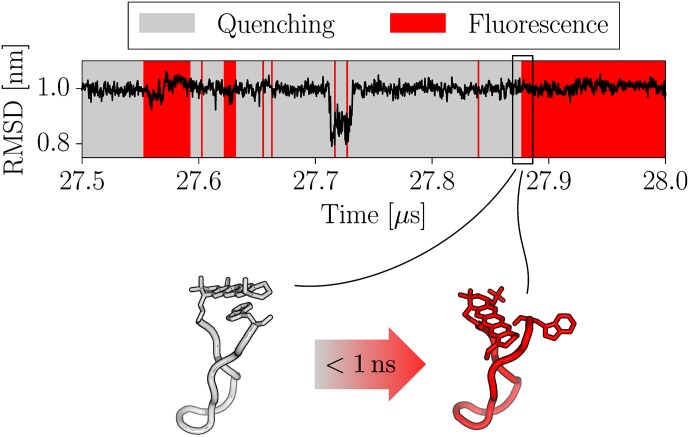
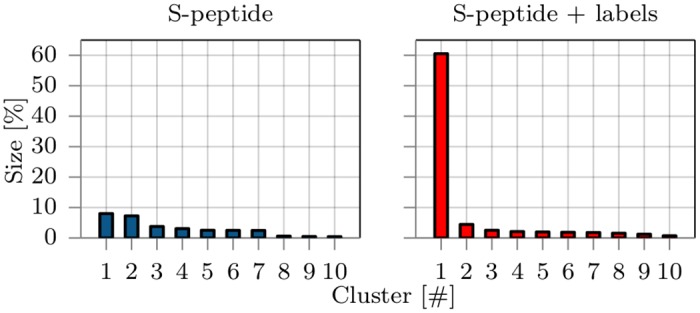
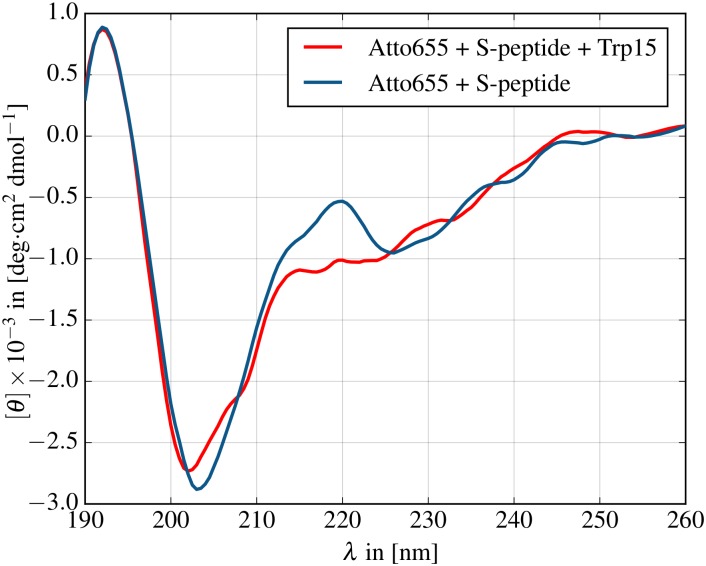
Fluorescence spectroscopy techniques like Förster resonance energy transfer (FRET) and fluorescence correlation spectroscopy (FCS) have become important tools for the in vitro and in vivo investigation of conformational dynamics in biomolecules. These methods rely on the distance-dependent quenching of the fluorescence signal of a donor fluorophore either by a fluorescent acceptor fluorophore (FRET) or a non-fluorescent quencher, as used in FCS with photoinduced electron transfer (PET). The attachment of fluorophores to the molecule of interest can potentially alter the molecular properties and may affect the relevant conformational states and dynamics especially of flexible biomolecules like intrinsically disordered proteins (IDP). Using the intrinsically disordered S-peptide as a model system, we investigate the impact of terminal fluorescence labeling on the molecular properties. We perform extensive molecular dynamics simulations on the labeled and unlabeled peptide and compare the results with in vitro PET-FCS measurements. Experimental and simulated timescales of end-to-end fluctuations were found in excellent agreement. Comparison between simulations with and without labels reveal that the π-stacking interaction between the fluorophore labels traps the conformation of S-peptide in a single dominant state, while the unlabeled peptide undergoes continuous conformational rearrangements. Furthermore, we find that the open to closed transition rate of S-peptide is decreased by at least one order of magnitude by the fluorophore attachment. Our approach combining experimental and in silico methods provides a benchmark for the simulations and reveals the significant effect that fluorescence labeling can have on the conformational dynamics of small biomolecules, at least for inherently flexible short peptides. The presented protocol is not only useful for comparing PET-FCS experiments with simulation results but provides a strategy to minimize the influence on molecular properties when chosing labeling positions for fluorescence experiments.
诸如福斯特共振能量转移(FRET)和荧光相关光谱(FCS)等荧光光谱技术,已成为体外和体内研究生物分子构象动力学的重要工具。这些方法依赖于供体荧光团的荧光信号因荧光受体荧光团(FRET)或非荧光猝灭剂而发生的距离依赖性猝灭,如在光诱导电子转移(PET)的FCS中所使用的那样。将荧光团连接到感兴趣的分子上可能会改变分子性质,并可能影响相关的构象状态和动力学,特别是对于诸如内在无序蛋白(IDP)等柔性生物分子。以内在无序的S肽作为模型系统,我们研究了末端荧光标记对分子性质的影响。我们对标记和未标记的肽进行了广泛的分子动力学模拟,并将结果与体外PET-FCS测量结果进行了比较。发现端到端波动的实验和模拟时间尺度非常吻合。有标签和无标签模拟之间的比较表明,荧光团标签之间的π-堆积相互作用将S肽的构象捕获在单一主导状态,而未标记的肽则经历连续的构象重排。此外,我们发现荧光团连接使S肽从开放到关闭的转变速率至少降低了一个数量级。我们结合实验和计算机模拟方法的方法为模拟提供了一个基准,并揭示了荧光标记对小生物分子构象动力学可能产生的显著影响,至少对于固有柔性的短肽是如此。所提出的方案不仅有助于将PET-FCS实验与模拟结果进行比较,而且提供了一种在为荧光实验选择标记位置时尽量减少对分子性质影响的策略。