Rong Honghui, Cheng Xin, Garcia Jose M, Zhang Ling, Lu Lu, Fang Jian, Le Mingshan, Hu Peng, Dong Xinlu, Yang Junli, Wang Ya, Luo Ting, Liu Jun, Chen Ji-An
Department of Health Education, Third Military Medical University, Chongqing, China.
GRECC, VA Puget Sound Health Care System and University of Washington, Seattle, WA, United States of America.
PLoS One. 2017 May 17;12(5):e0177776. doi: 10.1371/journal.pone.0177776. eCollection 2017.
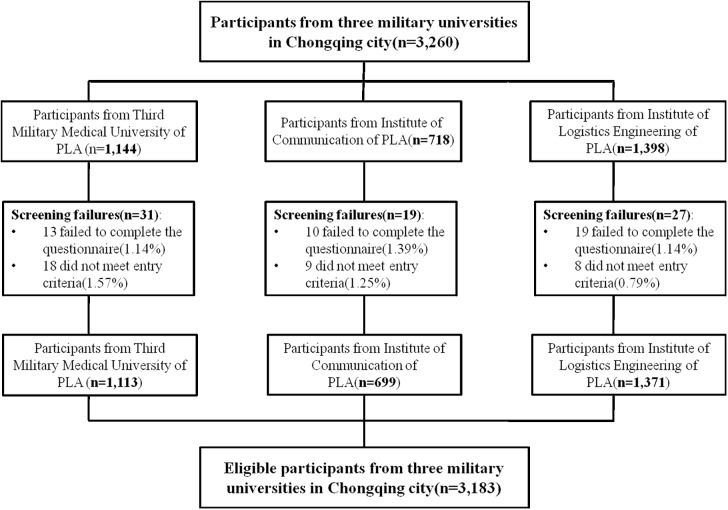
Health literacy (HL) has become an important public health issue and is receiving growing attention. However, the HL levels of military college students in China have never been analyzed. This study aimed to investigate the HL and related associate factors in military college students in Chongqing, China. Data was obtained with the "Chinese Citizen Health Literacy Questionnaire (2012 edition)" from 3183 military college students aged 16-28 years at Chongqing in December 2015. A total score of ≥80 points determined adequate HL, and HL level was defined as the proportion of students who had adequate HL out of the total number of participants. Multiple logistic regression analysis with a stepwise forward likelihood ratio (LR) method was used to determine the effects of sociodemographic characteristics, health-related behaviors, and family-related factors on HL level. The mean score of HL was 68.56, and the HL level of military college students was 21.05%; the overall knowledge rate was 71.33%. The independent factors that were associated with HL level were years in college, educational system, time playing online games, annual household income and father's education level. Senior (odds ratio [OR] = 1.229, 95% confidence interval [CI] 1.018∼1.484), undergraduate (OR = 1.509, 95% CI 1.151∼1.978), time played games more than 5 hours each week (OR = 0.638, 95% CI 0.486∼0.837), annual household incomes more than 50,000 yuan (OR = 1.231, 95% CI 1.027∼1.476) and father's education level (high school: OR = 2.327, 95% CI 1.186∼4.565; university: OR = 2.450, 95% CI 1.244∼4.825), were independently associated with higher HL level. HL levels of military college students in Chongqing need to be improved across the board. Our data suggests that special emphasis should be placed on students in junior and those in the specialist educational system. School departments may also benefit from incorporating health literacy into their curricula and helping students manage the time they spend playing online games.
健康素养(HL)已成为一个重要的公共卫生问题,并受到越来越多的关注。然而,中国军校大学生的健康素养水平从未被分析过。本研究旨在调查中国重庆军校大学生的健康素养及其相关影响因素。2015年12月,采用《中国公民健康素养调查问卷(2012年版)》对重庆3183名年龄在16 - 28岁的军校大学生进行调查。总分≥80分判定为具备足够的健康素养,健康素养水平定义为具备足够健康素养的学生人数占总参与者人数的比例。采用逐步向前似然比(LR)法进行多因素logistic回归分析,以确定社会人口学特征、健康相关行为和家庭相关因素对健康素养水平的影响。健康素养的平均得分为68.56分,军校大学生的健康素养水平为21.05%;总体知晓率为71.33%。与健康素养水平相关的独立因素有大学年级、教育体制、每周玩网络游戏的时间、家庭年收入和父亲的教育水平。高年级学生(比值比[OR]=1.229,95%置信区间[CI]1.018~1.484)、本科生(OR = 1.509,95%CI 1.151~1.978)、每周玩游戏时间超过5小时(OR = 0.638,95%CI 0.486~0.837)、家庭年收入超过5万元(OR = 1.231,95%CI 1.027~1.476)以及父亲的教育水平(高中:OR = 2.327,95%CI 1.186~4.565;大学:OR = 2.450,95%CI 1.244~4.825)与较高的健康素养水平独立相关。重庆军校大学生的健康素养水平亟待全面提高。我们的数据表明,应特别关注低年级学生和专科教育体制的学生。学校各部门也可将健康素养纳入课程,并帮助学生管理玩网络游戏的时间。