Hann Katie E J, Freeman Madeleine, Fraser Lindsay, Waller Jo, Sanderson Saskia C, Rahman Belinda, Side Lucy, Gessler Sue, Lanceley Anne
Department of Women's Cancer, EGA UCL Institute for Women's Health, University College London, London, UK.
Department of Behavioural Science and Health, Institute of Epidemiology and Health Care, University College London, London, UK.
BMC Public Health. 2017 May 25;17(1):503. doi: 10.1186/s12889-017-4375-8.
Genetic testing for risk of hereditary cancer can help patients to make important decisions about prevention or early detection. US and UK studies show that people from ethnic minority groups are less likely to receive genetic testing. It is important to understand various groups' awareness of genetic testing and its acceptability to avoid further disparities in health care. This review aims to identify and detail awareness, knowledge, perceptions, and attitudes towards genetic counselling/testing for cancer risk prediction in ethnic minority groups.
A search was carried out in PsycInfo, CINAHL, Embase and MEDLINE. Search terms referred to ethnicity, genetic testing/counselling, cancer, awareness, knowledge, attitudes, and perceptions. Quantitative and qualitative studies, written in English, and published between 2000 and 2015, were included.
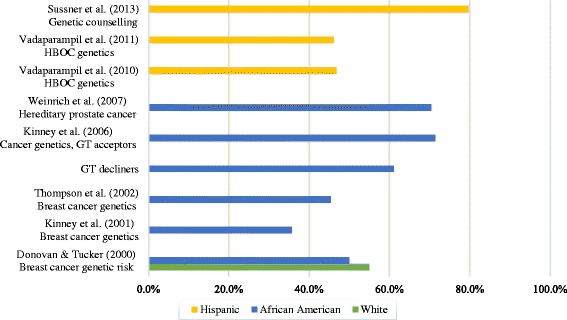
Forty-one studies were selected for review: 39 from the US, and two from Australia. Results revealed low awareness and knowledge of genetic counselling/testing for cancer susceptibility amongst ethnic minority groups including African Americans, Asian Americans, and Hispanics. Attitudes towards genetic testing were generally positive; perceived benefits included positive implications for personal health and being able to inform family. However, negative attitudes were also evident, particularly the anticipated emotional impact of test results, and concerns about confidentiality, stigma, and discrimination. Chinese Australian groups were less studied, but of interest was a finding from qualitative research indicating that different views of who close family members are could impact on reported family history of cancer, which could in turn impact a risk assessment.
Interventions are needed to increase awareness and knowledge of genetic testing for cancer risk and to reduce the perceived stigma and taboo surrounding the topic of cancer in ethnic minority groups. More detailed research is needed in countries other than the US and across a broader spectrum of ethnic minority groups to develop effective culturally sensitive approaches for cancer prevention.
遗传性癌症风险的基因检测有助于患者做出关于预防或早期检测的重要决策。美国和英国的研究表明,少数族裔群体接受基因检测的可能性较小。了解不同群体对基因检测的认知及其可接受性对于避免医疗保健方面的进一步差距很重要。本综述旨在确定并详细阐述少数族裔群体对癌症风险预测的基因咨询/检测的认知、知识、看法和态度。
在PsycInfo、CINAHL、Embase和MEDLINE中进行了检索。检索词涉及种族、基因检测/咨询、癌症、认知、知识、态度和看法。纳入了2000年至2015年间发表的、用英文撰写的定量和定性研究。
选取了41项研究进行综述:39项来自美国,2项来自澳大利亚。结果显示,包括非裔美国人、亚裔美国人和西班牙裔在内的少数族裔群体对癌症易感性的基因咨询/检测的认知和知识水平较低。对基因检测的态度总体上是积极的;感知到的好处包括对个人健康有积极影响以及能够告知家人。然而,消极态度也很明显,特别是对检测结果预期的情绪影响,以及对保密性、耻辱感和歧视的担忧。对澳大利亚华裔群体的研究较少,但定性研究中的一项发现很有意思,即对近亲家庭成员的不同看法可能会影响报告的癌症家族史,进而影响风险评估。
需要采取干预措施来提高对癌症风险基因检测的认知和知识,并减少少数族裔群体中围绕癌症话题的感知耻辱感和禁忌。除美国之外的其他国家以及更广泛的少数族裔群体需要进行更详细的研究,以制定有效的具有文化敏感性的癌症预防方法。